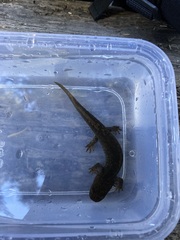
Cope's Giant Salamander

Cope's Giant Salamander

Dicamptodon copei

Silhouette: T. Michael Keesey, from a photograph by Greg Schechter · PhyloPic

LCLeast ConcernNTVUENCR Endemic
Daily sighting probability ~10% · With luck
at Olympic National Park

In 3 days ~30% in a week ~50%

65 Verified sightings at Olympic National Park From 2019 to 2026
65 In 1 park
May Best month
☀️ Diurnal When it's spotted

About the Cope's Giant Salamander

Cope's giant salamander (Dicamptodon copei) is a species of salamander in the family Dicamptodontidae, the Pacific giant salamanders. It is native to Washington and Oregon in the Pacific Northwest region of the United States.

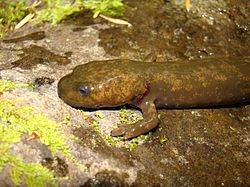
This species can attain lengths up to 19.5 centimeters. It exhibits neoteny rarely undergoing metamorphosis to the adult form, and resembles the larvae of similar salamander species. It usually becomes sexually, but not physically, mature. It is gold and brown in color. The costal grooves are inconspicuous. It has a rounded snout and the laterally compressed, fin-like tail of a typical larva. It retains its gills.

Little is known about the species' habitat requirements, but it has been found in mountain pools and streams. It feeds on smaller animals, such as fish, amphibians and their eggs, including the larvae of its own species.

The female lays a clutch of around 50 and up to 115 eggs in wet habitat near water bodies. She guards them and possibly defends them aggressively. The range of this species extends from the Olympic Peninsula to northern Oregon. Its populations are likely stable to slightly declining... Wikipedia →

Global Distribution

Parks Where Found

# Park Country Daily sighting probability
1 Olympic National Park 🇺🇸 United States
~10%

More parks will be added in future updates.

Before you go

What are the chances of seeing a Cope's Giant Salamander in Olympic National Park?

With luck

About 10% of wildlife watchers report a Cope's Giant Salamander sighting in Olympic National Park on a given day, based on 65 verified sightings from GBIF citizen-science data from 2019 to 2026. It is the 10th most-seen of the 13 amphibians we can rate there. Over three days the chance rises to about 30%, and over a week to about 50%, if each day is a fresh chance.

When is the best time to see a Cope's Giant Salamander in Olympic National Park?

April–September and November

In those months about 10% of wildlife watchers report a Cope's Giant Salamander in Olympic National Park on a given day, against under 5% in October and December–March, the lowest months.

What time of day is best to see a Cope's Giant Salamander?

Between 11 am and 2 pm

Across all the parks we cover, that three-hour window holds the most Cope's Giant Salamander sightings with a recorded time, and about 8 in 10 of them come between 6 am and 6 pm: it is a daytime animal.

Where else can you see a Cope's Giant Salamander?

Only Olympic National Park, in our data

Olympic National Park is the only park on Wallace's Line with enough records to rate Cope's Giant Salamander sightings: about 10% of wildlife watchers there report one on a given day.

Which relatives of the Cope's Giant Salamander live in Olympic National Park?

Same family: Ambystomatidae

The closest relatives of the Cope's Giant Salamander that you can see in Olympic National Park (family Ambystomatidae, Mole Salamanders) are Northwestern Salamander (about 10%) and Long-toed Salamander (about 10%), with each one's daily chance of a sighting.

Where does the Cope's Giant Salamander sighting chance come from?

GBIF citizen-science records

It is estimated from how often the Cope's Giant Salamander is recorded against all the amphibians logged in Olympic National Park (65 verified sightings from 2019 to 2026), calibrated against known sighting rates. Figures are rounded to the nearest 10% because citizen-science data supports honest approximations, not decimals, and months with records from fewer than five people show "—". How it works.

← Back to Olympic National Park