Heermann's Gull

Heermann's Gull

Larus heermanni

Silhouette: Sharon Wegner-Larsen · PhyloPic

LCNTNear ThreatenedVUENCR
Daily sighting probability ~10% · With luck
at Olympic National Park

In 3 days ~30% in a week ~50%

525 Verified sightings at Olympic National Park From 2019 to 2026
3,603 In all 8 parks
September Best month
☀️ Diurnal When it's spotted

About the Heermann's Gull

Heermann's gull (Larus heermanni) is a gull resident in the United States, Mexico and extreme southwestern British Columbia, nearly all nesting on Isla Rasa in the Gulf of California. They are usually found near shores or well out to sea, very rarely inland. The species is named after Adolphus Lewis Heermann, nineteenth-century explorer and naturalist.

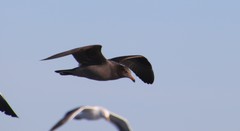
This species looks distinctly different from other gulls. Adults have a medium gray body, blackish-gray wings and tail with white edges, and a red bill with a black tip. The head is dusky gray in non-breeding plumage and white in breeding plumage. Immatures resemble non-breeding adults but are darker and browner, and the bill is pink till the second winter. A few birds, no more than 1 in 200, have white primary coverts, which form a showy spot on the upper wing. This gull is unlikely to be confused with other species as it is the only white-headed, gray-bodied gull found on the west coast of North America.

Calls are described as deep and similar in pattern to other gulls but is noticeably different in quality. Of the current population of about 150,000 pairs, 90% nest on the island of Isla Rasa off... Wikipedia →

Sounds

Call0:14

United States · 2020

© Steve Hampton · XC585136 · CC BY-NC-SA 4.0

Flight call0:11

Mexico · 2020

© Manuel Grosselet · XC522924 · CC BY-NC-SA 4.0

Call0:26

United States · 2017

© Brian Henderson · XC543847 · CC BY-NC-SA 4.0

Global Distribution

Parks Where Found

# Park Country Daily sighting probability
1 Channel Islands National Park 🇺🇸 United States
~30%
2 El Vizcaíno Biosphere Reserve 🇲🇽 Mexico
~20%
3 Bahía de Loreto National Park 🇲🇽 Mexico
~20%
4 Cabo Pulmo National Park 🇲🇽 Mexico
~10%
5 Olympic National Park 🇺🇸 United States
~10%
6 Redwood National Park 🇺🇸 United States
~10%
7 Pacific Rim National Park Reserve 🇨🇦 Canada
<5%
8 Carara National Park 🇨🇷 Costa Rica
<5%

Cities Where Found

# City Country Daily sighting probability
1 San Diego 🇺🇸 United States
~20%
2 Tijuana 🇲🇽 México
~20%
3 Los Angeles 🇺🇸 United States
<5%
4 Miami 🇺🇸 United States
<5%
5 Seattle 🇺🇸 United States
<5%
6 San Francisco 🇺🇸 United States
<5%
7 Baltimore 🇺🇸 United States
<5%
8 Vancouver 🇨🇦 Canada
<5%

Before you go

What are the chances of seeing a Heermann's Gull in Olympic National Park?

With luck

About 10% of wildlife watchers report a Heermann's Gull sighting in Olympic National Park on a given day, based on 525 verified sightings from GBIF citizen-science data from 2019 to 2026. It is the 67th most-seen of the 216 birds we can rate there. Over three days the chance rises to about 30%, and over a week to about 50%, if each day is a fresh chance.

When is the best time to see a Heermann's Gull in Olympic National Park?

August to October

In those months about 20% of wildlife watchers report a Heermann's Gull in Olympic National Park on a given day, against under 5% in December to June, the lowest months.

What time of day is best to see a Heermann's Gull?

Between 11 am and 2 pm

Across all the parks we cover, that three-hour window holds the most Heermann's Gull sightings with a recorded time, and nearly all of them come between 6 am and 6 pm: it is a daytime animal.

Which relatives of the Heermann's Gull live in Olympic National Park?

Same genus: Larus

The closest relatives of the Heermann's Gull that you can see in Olympic National Park (genus Larus, Large White-headed Gulls) are Glaucous-winged Gull (about 40%), California Gull (about 20%) and Western Gull (about 20%), with each one's daily chance of a sighting.

Where does the Heermann's Gull sighting chance come from?

GBIF citizen-science records

It is estimated from how often the Heermann's Gull is recorded against all the birds logged in Olympic National Park (525 verified sightings from 2019 to 2026), calibrated against known sighting rates. Figures are rounded to the nearest 10% because citizen-science data supports honest approximations, not decimals, and months with records from fewer than five people show "—". How it works.

← Back to Olympic National Park