Citril Finch

Citril Finch

Carduelis citrinella

Silhouette: Andy Wilson · PhyloPic

LCLeast ConcernNTVUENCR
Daily sighting probability ~10% · With luck
at Ordesa y Monte Perdido National Park

In 3 days ~30% in a week ~50%

72 Verified sightings at Ordesa y Monte Perdido National Park From 2019 to 2026
1,271 In all 8 parks
August Best month
☀️ Diurnal When it's spotted

About the Citril Finch

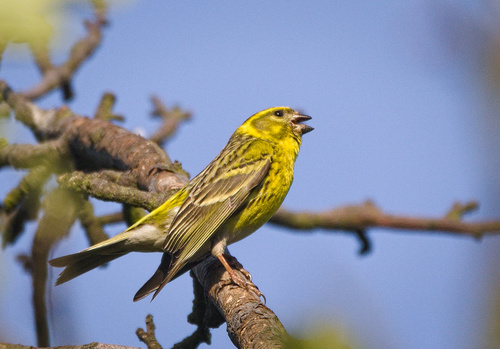
The citril finch (Carduelis citrinella), also known as the Alpine citril finch, is a small songbird, a member of the true finch family, Fringillidae. This bird is a resident breeder in the mountains of southwestern Europe from Spain to the Alps. Its northernmost breeding area is found in the Black Forest of southwestern Germany.

The citril finch was formally described by the German zoologist Peter Simon Pallas in 1764 under the binomial name Fringilla citrinella. Long considered to be closely related to the European serin and the Cape canary, it was traditionally placed with them in the genus Serinus, until a genetic study in 2007 showed that, despite the plumage differences, it was more closely related to the European goldfinch; a second study in 2012 confirmed this, leading to its formal transfer to the genus Carduelis in 2013.

The Corsican finch (Carduelis corsicana) of Corsica and Sardinia was at one time considered as conspecific with the citril finch, but is now treated as a separate species. Carduelis is the Latin word for the European goldfinch, and the specific epithet citrinella is the Italian word for a small yellow bird, from a diminutive... Wikipedia →

Sounds

Flight call0:04

Germany · 2025

© b_hirschmann · XC1051291 · CC BY-NC-ND 4.0

Call0:26

France · 2024

© Azens · XC879791 · CC BY-NC-SA 4.0

Song0:11

France · 2022

© Stanislas Wroza · XC730229 · CC BY-NC-SA 4.0

Global Distribution

Parks Where Found

# Park Country Daily sighting probability
1 Aigüestortes National Park 🇪🇸 Spain
~30%
2 Pyrénées National Park 🇫🇷 France
~20%
3 Vanoise National Park 🇫🇷 France
~10%
4 Ordesa y Monte Perdido National Park 🇪🇸 Spain
~10%
5 Mercantour National Park 🇫🇷 France
~10%
6 Sierra de Guadarrama National Park 🇪🇸 Spain
<5%
7 Sierra Nevada National Park 🇪🇸 Spain
<5%
8 Picos de Europa National Park 🇪🇸 Spain
<5%

Before you go

What are the chances of seeing a Citril Finch in Ordesa y Monte Perdido National Park?

With luck

About 10% of wildlife watchers report a Citril Finch sighting in Ordesa y Monte Perdido National Park on a given day, based on 72 verified sightings from GBIF citizen-science data from 2019 to 2026. It is the 59th most-seen of the 105 birds we can rate there. Over three days the chance rises to about 30%, and over a week to about 50%, if each day is a fresh chance.

When is the best time to see a Citril Finch in Ordesa y Monte Perdido National Park?

August

In that month about 20% of wildlife watchers report a Citril Finch in Ordesa y Monte Perdido National Park on a given day, against under 5% in November, the lowest month.

What time of day is best to see a Citril Finch?

Between 10 am and 1 pm

Across all the parks we cover, that three-hour window holds the most Citril Finch sightings with a recorded time, and about 8 in 10 of them come between 6 am and 6 pm: it is a daytime animal.

Is Ordesa y Monte Perdido National Park the best place to see a Citril Finch?

4th of 8

Of the 8 parks where we can rate Citril Finch sightings, Ordesa y Monte Perdido National Park ranks 4th at about 10%. The best odds are in Aigüestortes National Park (Spain, about 30%), Pyrénées National Park (France, about 20%) and Vanoise National Park (France, about 10%).

Where does the Citril Finch sighting chance come from?

GBIF citizen-science records

It is estimated from how often the Citril Finch is recorded against all the birds logged in Ordesa y Monte Perdido National Park (72 verified sightings from 2019 to 2026), calibrated against known sighting rates. Figures are rounded to the nearest 10% because citizen-science data supports honest approximations, not decimals, and months with records from fewer than five people show "—". How it works.

← Back to Ordesa y Monte Perdido National Park