Funereal Duskywing

Funereal Duskywing

Erynnis funeralis

Daily sighting probability ~10% · With luck
at Padre Island National Seashore

In 3 days ~30% in a week ~50%

12 Verified sightings at Padre Island National Seashore From 2019 to 2026
233 In all 6 parks
August Best month
☀️ Diurnal When it's spotted

About the Funereal Duskywing

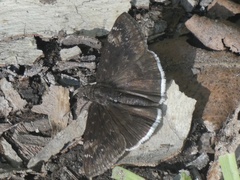
Erynnis funeralis, commonly known as the funereal duskywing, is a species of butterfly of the family Hesperiidae. It is found from southern United States (California, Arizona, New Mexico and Texas), south to Argentina and Chile. Strays can be found north up to northern Illinois, north-eastern Nebraska, central Colorado, southern Nevada and central California.

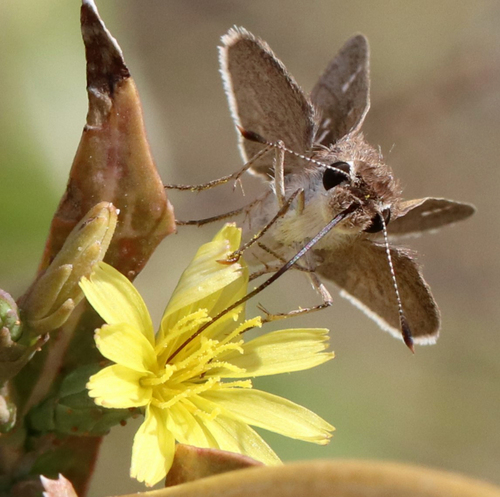
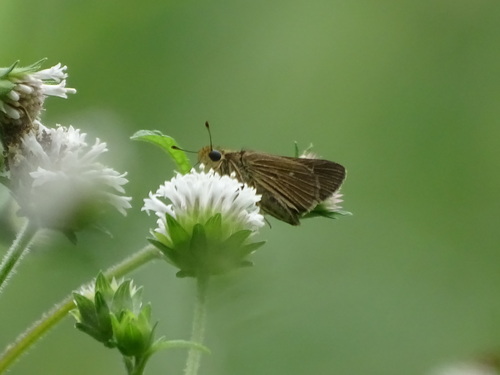
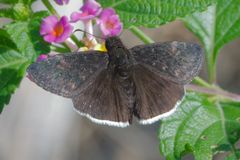
The wingspan is 34–45 mm. They are very similar to the mournful duskywing, but can be distinguished by narrower fore wing with a light brown patch along outer edge. Their wings are black and brown with a white fringe on the hind wings. Adults are seen from February to October.

The larvae have a black head and a green body with yellow hairs and yellow markings. Its host plant is often Medicago sativa. Other plants the larvae feed on include Robinia neomexicana, Medicago hispida, Acmispon glaber, Olneya tesota, Vicia, and Acmispon. Adults feed on flower nectar. Wikipedia →

Global Distribution

Parks Where Found

# Park Country Daily sighting probability
1 Joshua Tree National Park 🇺🇸 United States
~20%
2 Saguaro National Park 🇺🇸 United States
~20%
3 Bahía de Loreto National Park 🇲🇽 Mexico
~10%
4 Padre Island National Seashore 🇺🇸 United States
~10%
5 Big Bend National Park 🇺🇸 United States
~10%
6 Cumbres de Monterrey National Park 🇲🇽 Mexico
<5%

Cities Where Found

# City Country Daily sighting probability
1 Santiago 🇨🇱 Chile
~10%
2 Rosario 🇦🇷 Argentina
~10%
3 Austin 🇺🇸 United States
~10%
4 San Antonio 🇺🇸 United States
~10%
5 Porto Alegre 🇧🇷 Brazil
~10%
6 San Diego 🇺🇸 United States
~10%
7 Phoenix 🇺🇸 United States
~10%
8 Los Angeles 🇺🇸 United States
~10%
9 Buenos Aires 🇦🇷 Argentina
~10%
10 Mesa 🇺🇸 United States
~10%

Before you go

What are the chances of seeing a Funereal Duskywing in Padre Island National Seashore?

With luck

About 10% of wildlife watchers report a Funereal Duskywing sighting in Padre Island National Seashore on a given day, based on 12 verified sightings from GBIF citizen-science data from 2019 to 2026. It is the 33rd most-seen of the 74 insects we can rate there. Over three days the chance rises to about 30%, and over a week to about 50%, if each day is a fresh chance.

When is the best time to see a Funereal Duskywing in Padre Island National Seashore?

August

In that month about 20% of wildlife watchers report a Funereal Duskywing in Padre Island National Seashore on a given day, against under 5% in November to March, the lowest months.

What time of day is best to see a Funereal Duskywing?

Between 11 am and 2 pm

Across all the parks we cover, that three-hour window holds the most Funereal Duskywing sightings with a recorded time, and nearly all of them come between 6 am and 6 pm: it is a daytime animal.

Is Padre Island National Seashore the best place to see a Funereal Duskywing?

4th of 6

Of the 6 parks where we can rate Funereal Duskywing sightings, Padre Island National Seashore ranks 4th at about 10%. The best odds are in Joshua Tree National Park (United States, about 20%), Saguaro National Park (United States, about 20%) and Bahía de Loreto National Park (Mexico, about 10%).

Which relatives of the Funereal Duskywing live in Padre Island National Seashore?

Same family: Hesperiidae

The closest relatives of the Funereal Duskywing that you can see in Padre Island National Seashore (family Hesperiidae, Skippers) are Eufala Skipper (about 20%) and Obscure Skipper (about 10%), with each one's daily chance of a sighting.

Where does the Funereal Duskywing sighting chance come from?

GBIF citizen-science records

It is estimated from how often the Funereal Duskywing is recorded against all the insects logged in Padre Island National Seashore (12 verified sightings from 2019 to 2026), calibrated against known sighting rates. Figures are rounded to the nearest 10% because citizen-science data supports honest approximations, not decimals, and months with records from fewer than five people show "—". How it works.

← Back to Padre Island National Seashore