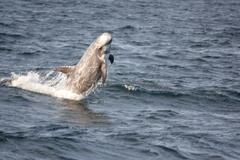
Risso's Dolphin

Risso's Dolphin

Grampus griseus

Silhouette: Chris huh · PhyloPic

LCLeast ConcernNTVUENCR
Daily sighting probability ~50% · Likely
at Pico Island Natural Park (Azores)

In 3 days ~80% in a week >90%

79 Verified sightings at Pico Island Natural Park (Azores) From 2019 to 2026
112 In all 2 parks
May Best month
☀️ Diurnal When it's spotted

About the Risso's Dolphin

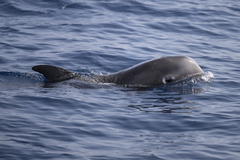
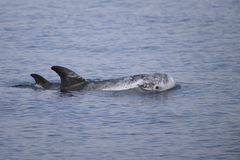
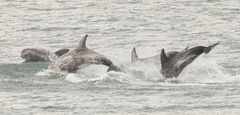
Risso's dolphin (Grampus griseus) is the only species of the genus Grampus in the family Delphinidae (dolphins). Some of the most closely related species to these dolphins include: pilot whales (Globicephala spp.), pygmy killer whales (Feresa attenuata), melon-headed whales (Peponocephala electra), and false killer whales (Pseudorca crassidens). These dolphins grow to be about 10 ft in length and can be identified by heavy scarring that appears white. They are located worldwide in cold to temperate waters, but most typically found along continental shelves due to their eating habits. Risso's dolphins have a diet that contains primarily cephalopods. They are able to search for prey at various depths due to their ability to reach depths of almost 600 m (2,000 ft). Individuals typically travel in pods ranging from 10 to 50 dolphins, with which they form tight social bonds.

Like most marine species, Risso's dolphins suffer from anthropogenic disruptions to the environment. Pollution, both from noise and plastics, is a common cause of higher mortality rates. Many can be, or have been, affected by entanglement in fishing nets and whaling. Risso's dolphins are currently protected in the United States, but they are still hunted in other parts of the world.

Wikipedia →

Global Distribution

Parks Where Found

# Park Country Daily sighting probability
1 Pico Island Natural Park (Azores) 🇵🇹 Portugal
~50%
2 Channel Islands National Park 🇺🇸 United States
~10%

Before you go

What are the chances of seeing a Risso's Dolphin in Pico Island Natural Park (Azores)?

Likely

About 50% of wildlife watchers report a Risso's Dolphin sighting in Pico Island Natural Park (Azores) on a given day, based on 79 verified sightings from GBIF citizen-science data from 2019 to 2026. It is the 4th most-seen of the 13 mammals we can rate there. Over three days the chance rises to about 80%, and over a week to over 90%, if each day is a fresh chance.

When is the best time to see a Risso's Dolphin in Pico Island Natural Park (Azores)?

May

In that month about 70% of wildlife watchers report a Risso's Dolphin in Pico Island Natural Park (Azores) on a given day, against about 10% in February and November–December, the lowest months.

What time of day is best to see a Risso's Dolphin?

Between 10 am and 1 pm

Across all the parks we cover, that three-hour window holds the most Risso's Dolphin sightings with a recorded time, and about 9 in 10 of them come between 6 am and 6 pm: it is a daytime animal.

Is Pico Island Natural Park (Azores) the best place to see a Risso's Dolphin?

Yes

Of the 2 parks where we can rate Risso's Dolphin sightings, Pico Island Natural Park (Azores) has the highest daily chance: about 50%. Next come Channel Islands National Park (United States, about 10%).

Which relatives of the Risso's Dolphin live in Pico Island Natural Park (Azores)?

Same family: Delphinidae

The closest relatives of the Risso's Dolphin that you can see in Pico Island Natural Park (Azores) (family Delphinidae, Oceanic Dolphins) are Common Dolphin (about 70%), Bottlenose Dolphin (about 60%) and Atlantic Spotted Dolphin (about 40%), with each one's daily chance of a sighting.

Where does the Risso's Dolphin sighting chance come from?

GBIF citizen-science records

It is estimated from how often the Risso's Dolphin is recorded against all the mammals logged in Pico Island Natural Park (Azores) (79 verified sightings from 2019 to 2026), calibrated against known sighting rates. Figures are rounded to the nearest 10% because citizen-science data supports honest approximations, not decimals, and months with records from fewer than five people show "—". How it works.

← Back to Pico Island Natural Park (Azores)