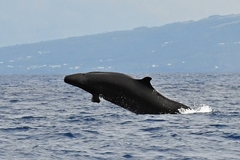
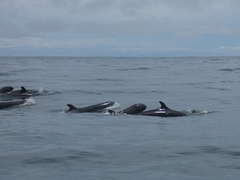
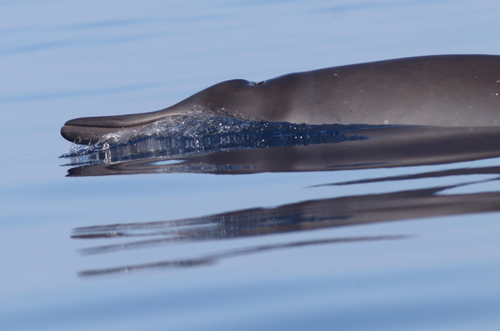
False Killer Whale

False Killer Whale

Pseudorca crassidens

Silhouette: Chris huh · PhyloPic

LCNTNear ThreatenedVUENCR
Daily sighting probability ~30% · Possible
at Pico Island Natural Park (Azores)

In 3 days ~60% in a week ~90%

9 Verified sightings at Pico Island Natural Park (Azores) From 2019 to 2026
30 In all 3 parks
July Best month
☀️ Diurnal When it's spotted

About the False Killer Whale

The false killer whale (Pseudorca crassidens) is a species of oceanic dolphin that is the only extant representative of the genus Pseudorca. It is found in oceans worldwide but mainly in tropical regions. It was first described in 1846 as a species of porpoise based on a skull, which was revised when the first carcasses were observed in 1861. The name "false killer whale" comes from having a skull similar to the orca or killer whale (Orcinus orca).

The false killer whale reaches a maximum length of 6 m (20 ft), though size can vary around the world. It is highly sociable, known to form pods of up to 50 members, and can also form pods with other dolphin species, such as the common bottlenose dolphin (Tursiops truncatus). It can form close bonds with other species, as well as have sexual interactions with them. But the false killer whale has also been known to eat other dolphins, though it typically eats squid and fish. It is a deep-diver; maximum known depth is 927.5 m (3,043 ft); maximum speed is around 30 km/h (19 mph).

Several aquariums around the world keep one or more false killer whales, though its aggression toward other dolphins makes it less desirable. It is threatened by fishing operations, as it can entangle in fishing gear. It is drive hunted in some Japanese villages. The false killer whale has a tendency to mass-strand given its highly social nature; the largest stranding consisted of over 800 beached at Mar del Plata, Argentina, in 1946. Most of what is known of this species comes from examining stranded individuals.

Wikipedia →

Sounds

Recording0:17

Portugal · 2022

© tunicatedreamz · iNaturalist · CC BY 4.0

Global Distribution

Parks Where Found

# Park Country Daily sighting probability
1 Pico Island Natural Park (Azores) 🇵🇹 Portugal
~30%
2 Raja Ampat 🇮🇩 Indonesia
~10%
3 Corcovado National Park 🇨🇷 Costa Rica
~10%

Zoos & Centres Where Found

# Zoo / Centre Country
1 Zoobic Safari 🇵🇭 Philippines In captivity
2 Yokohama Hakkeijima Sea Paradise 🇯🇵 Japan In captivity
3 Aqua World 🇯🇵 Japan In captivity
4 Taiji Whale Museum 🇯🇵 Japan In captivity

Before you go

What are the chances of seeing a False Killer Whale in Pico Island Natural Park (Azores)?

Possible

About 30% of wildlife watchers report a False Killer Whale sighting in Pico Island Natural Park (Azores) on a given day, based on 9 verified sightings from GBIF citizen-science data from 2019 to 2026. It is the 9th most-seen of the 13 mammals we can rate there. Over three days the chance rises to about 60%, and over a week to about 90%, if each day is a fresh chance.

When is the best time to see a False Killer Whale in Pico Island Natural Park (Azores)?

July

In that month about 40% of wildlife watchers report a False Killer Whale in Pico Island Natural Park (Azores) on a given day, against under 5% in April–May and October, the lowest months. That is one of Pico Island Natural Park (Azores)'s driest months, with about 70 mm of rain against 250 mm in December. January has too few records to rate.

What time of day is best to see a False Killer Whale?

Between 2 and 5 pm

Across all the parks we cover, that three-hour window holds the most False Killer Whale sightings with a recorded time, and about 9 in 10 of them come between 6 am and 6 pm: it is a daytime animal.

Is Pico Island Natural Park (Azores) the best place to see a False Killer Whale?

Yes

Of the 3 parks where we can rate False Killer Whale sightings, Pico Island Natural Park (Azores) has the highest daily chance: about 30%. Next come Raja Ampat (Indonesia, about 10%) and Corcovado National Park (Costa Rica, about 10%).

Which relatives of the False Killer Whale live in Pico Island Natural Park (Azores)?

Same family: Delphinidae

The closest relatives of the False Killer Whale that you can see in Pico Island Natural Park (Azores) (family Delphinidae, Oceanic Dolphins) are Common Dolphin (about 70%), Bottlenose Dolphin (about 60%) and Risso's Dolphin (about 50%), with each one's daily chance of a sighting.

Where does the False Killer Whale sighting chance come from?

GBIF citizen-science records

It is estimated from how often the False Killer Whale is recorded against all the mammals logged in Pico Island Natural Park (Azores) (9 verified sightings from 2019 to 2026), calibrated against known sighting rates. Figures are rounded to the nearest 10% because citizen-science data supports honest approximations, not decimals, and months with records from fewer than five people show "—". How it works.

← Back to Pico Island Natural Park (Azores)