Sowerby's Beaked Whale

Sowerby's Beaked Whale

Mesoplodon bidens

LCLeast ConcernNTVUENCR
Daily sighting probability ~30% · Possible
at Pico Island Natural Park (Azores)

In 3 days ~60% in a week ~90%

11 Verified sightings at Pico Island Natural Park (Azores) From 2019 to 2026
11 In 1 park
July Best month
☀️ Diurnal When it's spotted

About the Sowerby's Beaked Whale

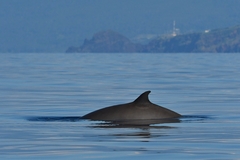
Sowerby's beaked whale (Mesoplodon bidens), also known as the North Atlantic or North Sea beaked whale, is a species of toothed whale. It was the first mesoplodont whale to be described. James Sowerby, an English naturalist and artist, first described the species in 1804 from a skull obtained from a male that had stranded in the Moray Firth, Scotland, in 1800. He named it bidens, which derives from the two teeth present in the jaw, now known to be a very common feature among the genus.

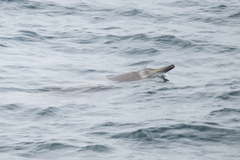
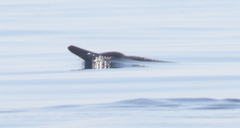
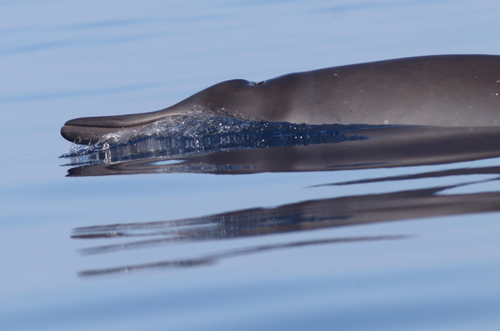
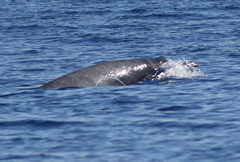
Sowerby's beaked whale has a typical body shape for the genus, and is mainly distinguished by the male's dual teeth positioned far back in the mouth. The whale's beak is moderately long, and the melon is slightly convex. The body pattern is dark grey above with light countershading on the bottom; it frequently has cookiecutter shark bites, and (in males) scars from teeth from fighting. The whale reaches 5 metres (16 ft) in females and 5.5 m (18 ft) in males, with a weight of 1,000–1,300 kg (2,200–2,900 lb).

Sowerby's beaked whale ranges from Nantucket to Labrador in the western North Atlantic and from Madeira to the Norwegian Sea in the eastern...
Wikipedia →

Global Distribution

Parks Where Found

# Park Country Daily sighting probability
1 Pico Island Natural Park (Azores) 🇵🇹 Portugal
~30%

More parks will be added in future updates.

Before you go

What are the chances of seeing a Sowerby's Beaked Whale in Pico Island Natural Park (Azores)?

Possible

About 30% of wildlife watchers report a Sowerby's Beaked Whale sighting in Pico Island Natural Park (Azores) on a given day, based on 11 verified sightings from GBIF citizen-science data from 2019 to 2026. It is the 9th most-seen of the 13 mammals we can rate there. Over three days the chance rises to about 60%, and over a week to about 90%, if each day is a fresh chance.

When is the best time to see a Sowerby's Beaked Whale in Pico Island Natural Park (Azores)?

July

In that month about 50% of wildlife watchers report a Sowerby's Beaked Whale in Pico Island Natural Park (Azores) on a given day, against under 5% in April–June and October, the lowest months. That is one of Pico Island Natural Park (Azores)'s driest months, with about 70 mm of rain against 250 mm in December. January has too few records to rate.

What time of day is best to see a Sowerby's Beaked Whale?

Between 3 and 6 pm

Across all the parks we cover, that three-hour window holds the most Sowerby's Beaked Whale sightings with a recorded time, and about 9 in 10 of them come between 6 am and 6 pm: it is a daytime animal.

Where else can you see a Sowerby's Beaked Whale?

Only Pico Island Natural Park (Azores), in our data

Pico Island Natural Park (Azores) is the only park on Wallace's Line with enough records to rate Sowerby's Beaked Whale sightings: about 30% of wildlife watchers there report one on a given day.

Which relatives of the Sowerby's Beaked Whale live in Pico Island Natural Park (Azores)?

Same order: Cetacea

The closest relatives of the Sowerby's Beaked Whale that you can see in Pico Island Natural Park (Azores) (order Cetacea) are Common Dolphin (about 70%), Bottlenose Dolphin (about 60%) and Sperm Whale (about 50%), with each one's daily chance of a sighting.

Where does the Sowerby's Beaked Whale sighting chance come from?

GBIF citizen-science records

It is estimated from how often the Sowerby's Beaked Whale is recorded against all the mammals logged in Pico Island Natural Park (Azores) (11 verified sightings from 2019 to 2026), calibrated against known sighting rates. Figures are rounded to the nearest 10% because citizen-science data supports honest approximations, not decimals, and months with records from fewer than five people show "—". How it works.

← Back to Pico Island Natural Park (Azores)