Iberian Frog

Iberian Frog

Rana iberica

Silhouette: Sharp Photography, sharpphotography.co.uk · PhyloPic

LCNTVUVulnerableENCR
Daily sighting probability ~10% · With luck
at Picos de Europa National Park

In 3 days ~30% in a week ~50%

7 Verified sightings at Picos de Europa National Park From 2019 to 2026
117 In all 2 parks
August Best month
🌅 Crepuscular When it's spotted

About the Iberian Frog

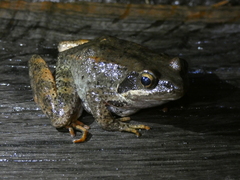
The Iberian frog (Rana iberica), also known as Iberian stream frog, is a species of frog in the family Ranidae found in Portugal and Spain. Its natural habitats are rivers, mountain streams and swamps. It is threatened by habitat loss, introduced species, climate change, water contamination, and increased ultraviolet radiation.

The Iberian frog can grow to about 7 cm (2.8 in) in length but a more normal size is 5 cm (2.0 in). Females tend to be larger than males. The tympanum can be seen just behind the eye and is about half its size in diameter. From the side of the head to the groin is a distinct ridge, the dorsolateral fold, which distinguishes this species from the common frog. The skin is smooth with fine granulations. The colour is very variable, being mainly olive, reddish or greyish-brown, sometimes with darker markings. A dark streak runs between the nostril and the eye, and a thin, white line marks the upper lip. The hind legs are sometimes barred with dark brown. The hind feet are more completely webbed than the common frog. The underside is pale, sometimes with darker spots, but the centre of the throat is not spotted.

The Iberian frog has a distinctive... Wikipedia →

Global Distribution

Parks Where Found

# Park Country Daily sighting probability
1 Sierra de Guadarrama National Park 🇪🇸 Spain
~20%
2 Picos de Europa National Park 🇪🇸 Spain
~10%

Cities Where Found

# City Country Daily sighting probability
1 Porto 🇵🇹 Portugal
~10%

Before you go

What are the chances of seeing an Iberian Frog in Picos de Europa National Park?

With luck

About 10% of wildlife watchers report an Iberian Frog sighting in Picos de Europa National Park on a given day, based on 7 verified sightings from GBIF citizen-science data from 2019 to 2026. It is the 8th most-seen of the 8 amphibians we can rate there. Over three days the chance rises to about 30%, and over a week to about 50%, if each day is a fresh chance.

When is the best time to see an Iberian Frog in Picos de Europa National Park?

June and August

In those months about 20% of wildlife watchers report an Iberian Frog in Picos de Europa National Park on a given day, against under 5% in September to May, the lowest months.

What time of day is best to see an Iberian Frog?

Between 5 and 8 pm

Across all the parks we cover, that three-hour window holds the most Iberian Frog sightings with a recorded time, and about half of them come between 6 am and 6 pm: it is most active around dawn and dusk.

Is Picos de Europa National Park the best place to see an Iberian Frog?

2nd of 2

Of the 2 parks where we can rate Iberian Frog sightings, Picos de Europa National Park ranks 2nd at about 10%. The best odds are in Sierra de Guadarrama National Park (Spain, about 20%).

Where does the Iberian Frog sighting chance come from?

GBIF citizen-science records

It is estimated from how often the Iberian Frog is recorded against all the amphibians logged in Picos de Europa National Park (7 verified sightings from 2019 to 2026), calibrated against known sighting rates. Figures are rounded to the nearest 10% because citizen-science data supports honest approximations, not decimals, and months with records from fewer than five people show "—". How it works.

← Back to Picos de Europa National Park