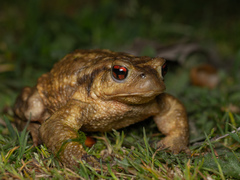
Giant Toad

Giant Toad

Bufo spinosus

Silhouette: Steven Traver · PhyloPic

LCLeast ConcernNTVUENCR
Daily sighting probability ~50% · Likely
at Picos de Europa National Park

In 3 days ~90% in a week >90%

59 Verified sightings at Picos de Europa National Park From 2019 to 2026
975 In all 9 parks
April Best month
☀️🌙 Day & Night When it's spotted

About the Giant Toad

The spiny toad, spiny common toad, or giant toad (Bufo spinosus) is a species of toad native to the Iberian Peninsula, southern France, extreme northwestern Italy, and North Africa (Morocco, Algeria, and Tunisia), with an isolated population in Jersey in the Channel Islands. For much of the 20th century, it was considered either a synonym or a subspecies of common toad Bufo bufo, but it is now classified as a separate species.

Adult males measure 58.6–112 mm (2.3–4.4 in) and adult females 65–180 mm (2.6–7.1 in) in snout–vent length. These toads feed on a number of invertebrates from earthworms to insects and woodlice. Wikipedia →

Sounds

Advertisement call0:37

France · 2026

© Olivier SWIFT, Ronan LATTUGA · XC1083402 · CC BY-NC-SA 4.0

Territorial call0:05

France · 2026

© Olivier SWIFT · XC1080195 · CC BY-NC-SA 4.0

Recording0:34

France · 2026

© claude mauline · iNaturalist · CC BY-NC 4.0

Global Distribution

Parks Where Found

# Park Country Daily sighting probability
1 Picos de Europa National Park 🇪🇸 Spain
~50%
2 Cévennes National Park 🇫🇷 France
~50%
3 Pyrénées National Park 🇫🇷 France
~50%
4 Aigüestortes National Park 🇪🇸 Spain
~40%
5 Ordesa y Monte Perdido National Park 🇪🇸 Spain
~40%
6 Monfragüe National Park 🇪🇸 Spain
~40%
7 Mercantour National Park 🇫🇷 France
~30%
8 Sierra Nevada National Park 🇪🇸 Spain
~20%
9 Sierra de Guadarrama National Park 🇪🇸 Spain
~10%

Cities Where Found

# City Country Daily sighting probability
1 Porto 🇵🇹 Portugal
~20%
2 Barcelona 🇪🇸 Spain
<5%
3 Lisbon 🇵🇹 Portugal
<5%

Zoos & Centres Where Found

# Zoo / Centre Country
1 Lisbon Oceanarium 🇵🇹 Portugal In captivity
2 Zoo La Barben 🇫🇷 France In captivity
3 Aquarium of Gijón 🇪🇸 Spain In captivity
4 Fluviário de Mora 🇵🇹 Portugal In captivity

Before you go

What are the chances of seeing a Giant Toad in Picos de Europa National Park?

Likely

About 50% of wildlife watchers report a Giant Toad sighting in Picos de Europa National Park on a given day, based on 59 verified sightings from GBIF citizen-science data from 2019 to 2026. It is the most-seen of the 8 amphibians we can rate there. Over three days the chance rises to about 90%, and over a week to over 90%, if each day is a fresh chance.

When is the best time to see a Giant Toad in Picos de Europa National Park?

April

In that month about 70% of wildlife watchers report a Giant Toad in Picos de Europa National Park on a given day, against about 10% in February and November–December, the lowest months.

What time of day is best to see a Giant Toad?

Between 9 pm and midnight

Across all the parks we cover, that three-hour window holds the most Giant Toad sightings with a recorded time, and about 7 in 10 of them come between 6 pm and 6 am: it is seen both by day and at night.

Is Picos de Europa National Park the best place to see a Giant Toad?

Yes

Of the 9 parks where we can rate Giant Toad sightings, Picos de Europa National Park has the highest daily chance: about 50%. Next come Cévennes National Park (France, about 50%) and Pyrénées National Park (France, about 50%). All parks ranked.

Which relatives of the Giant Toad live in Picos de Europa National Park?

Same order: Anura

The closest relatives of the Giant Toad that you can see in Picos de Europa National Park (order Anura, Frogs and Toads) are Common Midwife Toad (about 50%), Galician Common Frog (about 30%) and Iberian Frog (about 10%), with each one's daily chance of a sighting.

Where does the Giant Toad sighting chance come from?

GBIF citizen-science records

It is estimated from how often the Giant Toad is recorded against all the amphibians logged in Picos de Europa National Park (59 verified sightings from 2019 to 2026), calibrated against known sighting rates. Figures are rounded to the nearest 10% because citizen-science data supports honest approximations, not decimals, and months with records from fewer than five people show "—". How it works.

← Back to Picos de Europa National Park