Palmate Newt

Palmate Newt

Lissotriton helveticus

Silhouette: Original foto by Gilles San Martin, modified by Luca Leicht · PhyloPic

LCLeast ConcernNTVUENCR
Daily sighting probability ~50% · Likely
at Picos de Europa National Park

In 3 days ~80% in a week >90%

51 Verified sightings at Picos de Europa National Park From 2019 to 2026
400 In all 6 parks
May Best month
☀️ Diurnal When it's spotted

About the Palmate Newt

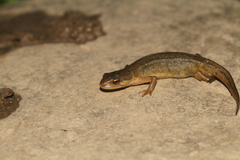
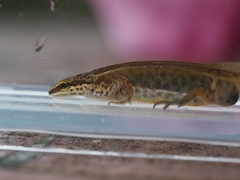
The palmate newt (Lissotriton helveticus) is a species of newt found in Western Europe, from Great Britain to the northern Iberian Peninsula. It is 5–9.5 cm (2.0–3.7 in) long and olive or brown with some dark spots. The underside is yellow to orange, and the throat, unlike in the similar smooth newt, always unspotted. A dark stripe runs along the head and through the eyes. Breeding males develop a distinct filament on the end of their tail, strongly webbed hind feet, and a low, smooth crest on their back.

Habitats include forests, marshes, pastures or gardens. While on land, the newts are mainly nocturnal. After emerging from hibernation in spring, they move to stagnant, fish-free bodies of water for breeding. Following a courtship display, the male deposits a spermatophore that is picked up by the female. Larvae develop over after 1.5–3.5 months before metamorphosing into land-dwelling juveniles (efts). Sexual maturity is reached after two to three years, and the newts can live up to 12 years in the wild. The species is generally common and has been assessed as Least Concern by the IUCN.

The palmate newt was first scientifically described in 1789 by Russian naturalist... Wikipedia →

Sounds

Recording0:22

France · 2026

© Erell Olivo · iNaturalist · CC BY-NC 4.0

Global Distribution

Parks Where Found

# Park Country Daily sighting probability
1 Picos de Europa National Park 🇪🇸 Spain
~50%
2 Pyrénées National Park 🇫🇷 France
~30%
3 Snowdonia National Park 🇬🇧 United Kingdom
~30%
4 Cévennes National Park 🇫🇷 France
~20%
5 Cairngorms National Park 🇬🇧 United Kingdom
~20%
6 Aigüestortes National Park 🇪🇸 Spain
~20%

Cities Where Found

# City Country Daily sighting probability
1 Manchester 🇬🇧 United Kingdom
~10%
2 Paris 🇫🇷 France
~10%
3 Liverpool 🇬🇧 United Kingdom
~10%
4 London 🇬🇧 United Kingdom
~10%

Zoos & Centres Where Found

# Zoo / Centre Country
1 Wildwood Discovery Park 🇬🇧 United Kingdom In captivity

Before you go

What are the chances of seeing a Palmate Newt in Picos de Europa National Park?

Likely

About 50% of wildlife watchers report a Palmate Newt sighting in Picos de Europa National Park on a given day, based on 51 verified sightings from GBIF citizen-science data from 2019 to 2026. It is the 5th most-seen of the 8 amphibians we can rate there. Over three days the chance rises to about 80%, and over a week to over 90%, if each day is a fresh chance.

When is the best time to see a Palmate Newt in Picos de Europa National Park?

May

In that month about 60% of wildlife watchers report a Palmate Newt in Picos de Europa National Park on a given day, against under 5% in September, the lowest month.

What time of day is best to see a Palmate Newt?

Between 11 am and 2 pm

Across all the parks we cover, that three-hour window holds the most Palmate Newt sightings with a recorded time, and about 7 in 10 of them come between 6 am and 6 pm: it is a daytime animal.

Is Picos de Europa National Park the best place to see a Palmate Newt?

Yes

Of the 6 parks where we can rate Palmate Newt sightings, Picos de Europa National Park has the highest daily chance: about 50%. Next come Pyrénées National Park (France, about 30%) and Snowdonia National Park (United Kingdom, about 30%). All parks ranked.

Which relatives of the Palmate Newt live in Picos de Europa National Park?

Same family: Salamandridae

The closest relatives of the Palmate Newt that you can see in Picos de Europa National Park (family Salamandridae, True Salamanders and Newts) are Fire Salamander (about 50%), Alpine Newt (about 50%) and Gold-striped salamander (about 20%), with each one's daily chance of a sighting.

Where does the Palmate Newt sighting chance come from?

GBIF citizen-science records

It is estimated from how often the Palmate Newt is recorded against all the amphibians logged in Picos de Europa National Park (51 verified sightings from 2019 to 2026), calibrated against known sighting rates. Figures are rounded to the nearest 10% because citizen-science data supports honest approximations, not decimals, and months with records from fewer than five people show "—". How it works.

← Back to Picos de Europa National Park