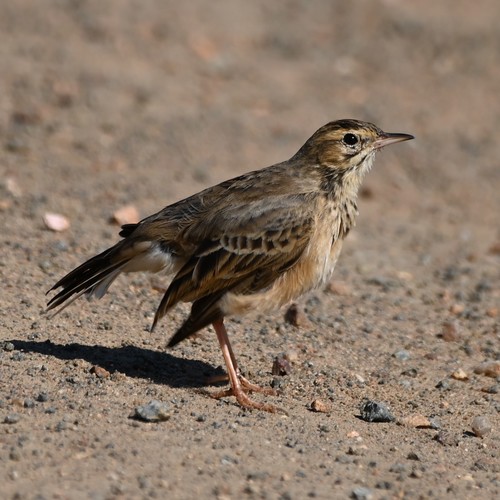
Buffy Pipit

Buffy Pipit

Anthus vaalensis

Silhouette: Susan Murphy (original photograph), T. Michael Keesey (vectorization) · PhyloPic

LCLeast ConcernNTVUENCR
Daily sighting probability <5% · Rare
at Pilanesberg National Park

In 3 days ~10% in a week ~30%

20 Verified sightings at Pilanesberg National Park From 2019 to 2026
212 In all 9 parks
April Best month
☀️ Diurnal When it's spotted

About the Buffy Pipit

The buffy pipit (Anthus vaalensis) is a species of bird in the Motacillidae family. It is found in plains and open countryside in southern and eastern Africa. The IUCN has assessed its conservation status as being of least concern.

This species was described by English naturalist George Ernest Shelley in 1900. Some authors include subspecies saphiroi and goodsoni of the plain-backed pipit (Anthus leucophrys) in this species. Its length is 16–18 cm (6.3–7.1 in), and its weight is 23–36.6 g (0.81–1.29 oz). It is often confused with the plain-backed pipit because both species have plain upperparts. The upperparts of the buffy pipit are paler and buffier than the plain-backed pipit.... Wikipedia →

Sounds

Song0:55

South Africa · 2020

© Nature Sounds by Simply Birding · XC575660 · CC BY-NC-ND 4.0

Call0:15

Zambia · 2019

© Peter Boesman · XC508705 · CC BY-NC-ND 4.0

Call0:14

South Africa · 2020

© Tony Archer · XC581613 · CC BY-NC-SA 4.0

Global Distribution

Parks Where Found

# Park Country Daily sighting probability
1 Pilanesberg National Park 🇿🇦 South Africa
<5%
2 Moremi Game Reserve 🇧🇼 Botswana
<5%
3 Kafue National Park 🇿🇲 Zambia
<5%
4 Kgalagadi Transfrontier Park 🇿🇦 South Africa
<5%
5 Mana Pools National Park 🇿🇼 Zimbabwe
<5%
6 Hwange National Park 🇿🇼 Zimbabwe
<5%
7 Etosha National Park 🇳🇦 Namibia
<5%
8 Chobe National Park 🇧🇼 Botswana
<5%
9 Kruger National Park 🇿🇦 South Africa
<5%

Before you go

What are the chances of seeing a Buffy Pipit in Pilanesberg National Park?

Rare

Under 5% of wildlife watchers report a Buffy Pipit sighting in Pilanesberg National Park on a given day, based on 20 verified sightings from GBIF citizen-science data from 2019 to 2026. It is the 167th most-seen of the 233 birds we can rate there. Over three days the chance rises to about 10%, and over a week to about 30%, if each day is a fresh chance.

When is the best time to see a Buffy Pipit in Pilanesberg National Park?

April

In that month about 20% of wildlife watchers report a Buffy Pipit in Pilanesberg National Park on a given day, against under 5% in May–July, September–October and December–March, the lowest months.

What time of day is best to see a Buffy Pipit?

Between 8 and 11 am

Across all the parks we cover, that three-hour window holds the most Buffy Pipit sightings with a recorded time, and about 9 in 10 of them come between 6 am and 6 pm: it is a daytime animal.

Is Pilanesberg National Park the best place to see a Buffy Pipit?

Yes

Of the 9 parks where we can rate Buffy Pipit sightings, Pilanesberg National Park has the highest daily chance: under 5%. Next come Moremi Game Reserve (Botswana, under 5%) and Kafue National Park (Zambia, under 5%).

Where does the Buffy Pipit sighting chance come from?

GBIF citizen-science records

It is estimated from how often the Buffy Pipit is recorded against all the birds logged in Pilanesberg National Park (20 verified sightings from 2019 to 2026), calibrated against known sighting rates. Figures are rounded to the nearest 10% because citizen-science data supports honest approximations, not decimals, and months with records from fewer than five people show "—". How it works.

← Back to Pilanesberg National Park