Monotonous Lark

Monotonous Lark

Mirafra passerina

Silhouette: Gossipguy and T. Michael Keesey · PhyloPic

LCLeast ConcernNTVUENCR
Daily sighting probability <5% · Rare
at Pilanesberg National Park

In 3 days ~10% in a week ~20%

19 Verified sightings at Pilanesberg National Park From 2019 to 2026
267 In all 4 parks
December Best month
☀️ Diurnal When it's spotted

About the Monotonous Lark

The monotonous lark (Mirafra passerina) is a species of lark in the family Alaudidae found in southern Africa. The alternate names "white-tailed lark" and "white-tailed bush-lark" should not be confused with the species of the same name, Mirafra albicauda. Other alternate names include monotonous bush lark and Southern white-tailed bush-lark.

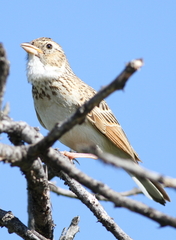
A medium-small, compact lark with a small bill, a plain face, and an indistinct eyebrow. It has streaky upperparts with a distinct rufous wing panel and a lightly-streaked buffy chest that separates the white throat from the pale belly.

The range of the monotonous lark is quite broad, extending over six countries: Angola, Botswana, Namibia, South Africa, Zambia, and Zimbabwe. Its global extent of occurrence is estimated at 1,400,000 km2. Its natural habitats are dry savanna and subtropical or tropical dry lowland grassland.

Compilers: Stuart Butchart, Jonathan Ekstrom (2008). "Monotonous Lark - BirdLife Species Factsheet". Evaluators: Jeremy Bird, Stuart Butchart. BirdLife International. Retrieved May 11, 2009. "Territory establishment... Wikipedia →

Sounds

Song1:18

South Africa · 1994

© Rick Nuttall · XC662425 · CC BY-NC-SA 4.0

Song0:10

South Africa · 2018

© Paul Bourdin · XC650860 · CC BY-NC-SA 4.0

Song0:19

South Africa · 2020

© Nature Sounds by Simply Birding · XC530057 · CC BY-NC-ND 4.0

Global Distribution

Parks Where Found

# Park Country Daily sighting probability
1 Hwange National Park 🇿🇼 Zimbabwe
<5%
2 Pilanesberg National Park 🇿🇦 South Africa
<5%
3 Kruger National Park 🇿🇦 South Africa
<5%
4 Etosha National Park 🇳🇦 Namibia
<5%

Before you go

What are the chances of seeing a Monotonous Lark in Pilanesberg National Park?

Rare

Under 5% of wildlife watchers report a Monotonous Lark sighting in Pilanesberg National Park on a given day, based on 19 verified sightings from GBIF citizen-science data from 2019 to 2026. It is the 191st most-seen of the 233 birds we can rate there. Over three days the chance rises to about 10%, and over a week to about 20%, if each day is a fresh chance.

When is the best time to see a Monotonous Lark in Pilanesberg National Park?

December to February

In those months about 10% of wildlife watchers report a Monotonous Lark in Pilanesberg National Park on a given day, against under 5% in March to November, the lowest months. Those are among Pilanesberg National Park's wettest months, with about 110 mm of rain a month against almost none in August.

What time of day is best to see a Monotonous Lark?

Between 7 and 10 am

Across all the parks we cover, that three-hour window holds the most Monotonous Lark sightings with a recorded time, and about 9 in 10 of them come between 6 am and 6 pm: it is a daytime animal.

Is Pilanesberg National Park the best place to see a Monotonous Lark?

Among the best

Of the 4 parks where we can rate Monotonous Lark sightings, Pilanesberg National Park ranks 2nd at under 5%, level with the leaders once rounded. The best odds are in Hwange National Park (Zimbabwe, under 5%).

Where does the Monotonous Lark sighting chance come from?

GBIF citizen-science records

It is estimated from how often the Monotonous Lark is recorded against all the birds logged in Pilanesberg National Park (19 verified sightings from 2019 to 2026), calibrated against known sighting rates. Figures are rounded to the nearest 10% because citizen-science data supports honest approximations, not decimals, and months with records from fewer than five people show "—". How it works.

← Back to Pilanesberg National Park