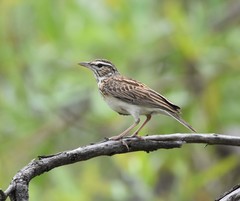
Sabota Lark

Sabota Lark

Calendulauda sabota

Silhouette: Gossipguy and T. Michael Keesey · PhyloPic

LCLeast ConcernNTVUENCR
Daily sighting probability ~20% · Possible
at Pilanesberg National Park

In 3 days ~60% in a week ~90%

172 Verified sightings at Pilanesberg National Park From 2019 to 2026
4,201 In all 12 parks
November Best month
☀️ Diurnal When it's spotted

About the Sabota Lark

The sabota lark (Calendulauda sabota) is a species of lark in the family Alaudidae. It is found in southern Africa in its natural habitats of dry savannah, moist savannah, and subtropical or tropical dry shrubland. It is generally sedentary but local movements occur in drier regions. The species name is derived from sebotha or sebothé, the Tswana generic name for a lark.

Formerly, the Sabota lark was classified as belonging to the genus Mirafra until moved to Calendulauda in 2009. Not all authorities have followed this re-classification. Two distinctive taxa of this species are respectively known as the large-billed Sabota lark and small-billed Sabota lark. The large-billed subspecies are found in the dry to arid west and south of its range, while the small-billed subspecies are native to mesic woodlands of the north and east.

Found on the Cabinda coast of north-western Angola Wikipedia →

Sounds

Imitation0:36

South Africa · 2025

© Dawie de Swardt · XC1058880 · CC BY-NC-SA 4.0

Call0:28

Zimbabwe · 2024

© Dries Van de Loock · XC962986 · CC BY-NC-ND 4.0

Song0:42

South Africa · 2024

© Niall Perrins · XC893262 · CC BY-NC-SA 4.0

Global Distribution

Parks Where Found

# Park Country Daily sighting probability
1 Etosha National Park 🇳🇦 Namibia
~40%
2 Pilanesberg National Park 🇿🇦 South Africa
~20%
3 Kruger National Park 🇿🇦 South Africa
~20%
4 Kgalagadi Transfrontier Park 🇿🇦 South Africa
~20%
5 uMkhuze Game Reserve 🇿🇦 South Africa
~20%
6 Gonarezhou National Park 🇿🇼 Zimbabwe
~20%
7 Hluhluwe-Imfolozi Park 🇿🇦 South Africa
~10%
8 Namib-Naukluft National Park 🇳🇦 Namibia
<5%
9 Moremi Game Reserve 🇧🇼 Botswana
<5%
10 Addo Elephant National Park 🇿🇦 South Africa
<5%
11 Chobe National Park 🇧🇼 Botswana
<5%
12 iSimangaliso Wetland Park 🇿🇦 South Africa
<5%

Before you go

What are the chances of seeing a Sabota Lark in Pilanesberg National Park?

Possible

About 20% of wildlife watchers report a Sabota Lark sighting in Pilanesberg National Park on a given day, based on 172 verified sightings from GBIF citizen-science data from 2019 to 2026. It is the 62nd most-seen of the 233 birds we can rate there. Over three days the chance rises to about 60%, and over a week to about 90%, if each day is a fresh chance.

When is the best time to see a Sabota Lark in Pilanesberg National Park?

April and November

In those months about 40% of wildlife watchers report a Sabota Lark in Pilanesberg National Park on a given day, against about 10% in February–March and September, the lowest months.

What time of day is best to see a Sabota Lark?

Between 7 and 10 am

Across all the parks we cover, that three-hour window holds the most Sabota Lark sightings with a recorded time, and about 9 in 10 of them come between 6 am and 6 pm: it is a daytime animal.

Is Pilanesberg National Park the best place to see a Sabota Lark?

2nd of 12

Of the 12 parks where we can rate Sabota Lark sightings, Pilanesberg National Park ranks 2nd at about 20%. The best odds are in Etosha National Park (Namibia, about 40%). All parks ranked.

Where does the Sabota Lark sighting chance come from?

GBIF citizen-science records

It is estimated from how often the Sabota Lark is recorded against all the birds logged in Pilanesberg National Park (172 verified sightings from 2019 to 2026), calibrated against known sighting rates. Figures are rounded to the nearest 10% because citizen-science data supports honest approximations, not decimals, and months with records from fewer than five people show "—". How it works.

← Back to Pilanesberg National Park