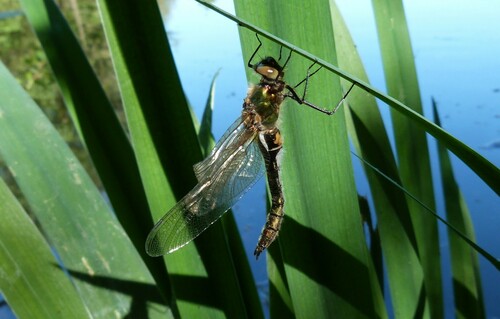
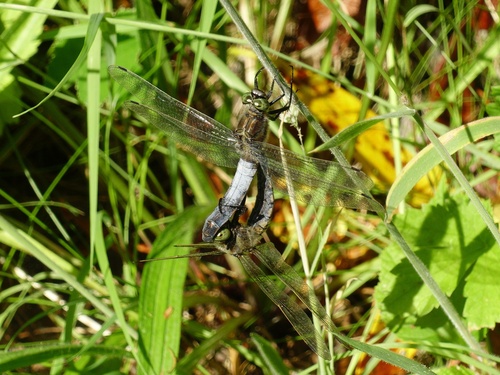
Banded Demoiselle

Banded Demoiselle

Calopteryx splendens

Daily sighting probability ~40% · Likely
at Plitvice Lakes National Park

In 3 days ~80% in a week >90%

27 Verified sightings at Plitvice Lakes National Park From 2019 to 2026
197 In all 7 parks
June Best month
☀️ Diurnal When it's spotted

About the Banded Demoiselle

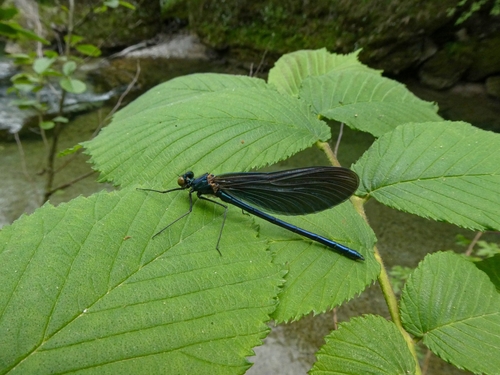
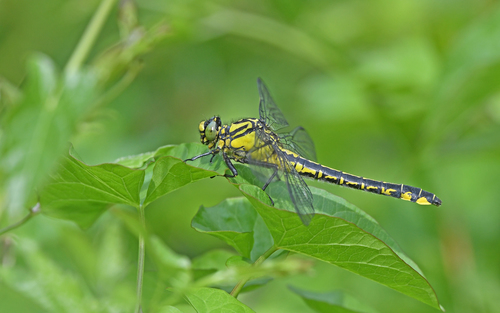
The banded demoiselle (Calopteryx splendens) is a species of damselfly belonging to the family Calopterygidae. It is often found along slow-flowing streams and rivers. It is a Eurasian species occurring from the Atlantic coast eastwards to Lake Baikal and northwestern China.

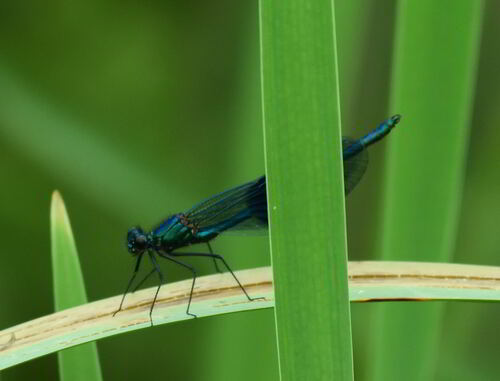
This is a common species throughout much of its range. This is a large damselfly with a total length of up to 48 millimetres (1.9 in) and a hindwing length of up to 36 millimetres (1.4 in). Male and female are variable in color and pattern. The male has translucent wings which each have a broad, dark iridescent blue-black spot (or band) across the outer part. On immature individuals the spot is dark brown. The body can be a metallic blue or bluish green or a combination of both colours, depending on the time of year and location.

The dark wing patch of the male starts at the nodus (the slight dip midway down the upper edge of the wing) but can reach up to the wing-tip in southern races. In the very similar beautiful demoiselle (Calopteryx virgo), the dark patch starts before the nodus.

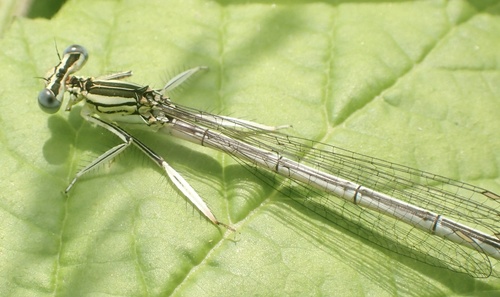
The female has translucent, pale green iridescent wings with a white patch near the tip (a pseudopterostigma)... Wikipedia →
Global Distribution

Parks Where Found

# Park Country Daily sighting probability
1 Plitvice Lakes National Park 🇭🇷 Croatia
~40%
2 Biebrza National Park 🇵🇱 Poland
~40%
3 Gauja National Park 🇱🇻 Latvia
~30%
4 Bavarian Forest National Park 🇩🇪 Germany
~20%
5 Białowieża National Park 🇵🇱 Poland
~20%
6 Fertő-Hanság National Park 🇭🇺 Hungary
~20%
7 Cévennes National Park 🇫🇷 France
<5%

Cities Where Found

# City Country Daily sighting probability
1 Turin 🇮🇹 Italy
~30%
2 Leeds 🇬🇧 United Kingdom
~20%
3 Brussels 🇧🇪 Belgium
~20%
4 Milan 🇮🇹 Italy
~20%
5 Rostov-on-Don 🇷🇺 Russia
~20%
6 Manchester 🇬🇧 United Kingdom
~20%
7 London 🇬🇧 United Kingdom
~20%
8 Munich 🇩🇪 Germany
~20%
9 Budapest 🇭🇺 Hungary
~10%
10 Lyon 🇫🇷 France
~10%

Before you go

What are the chances of seeing a Banded Demoiselle in Plitvice Lakes National Park?

Likely

About 40% of wildlife watchers report a Banded Demoiselle sighting in Plitvice Lakes National Park on a given day, based on 27 verified sightings from GBIF citizen-science data from 2019 to 2026. It is the 7th most-seen of the 51 insects we can rate there. Over three days the chance rises to about 80%, and over a week to over 90%, if each day is a fresh chance.

When is the best time to see a Banded Demoiselle in Plitvice Lakes National Park?

June

In that month about 60% of wildlife watchers report a Banded Demoiselle in Plitvice Lakes National Park on a given day, against under 5% in April and September–October, the lowest months. December has too few records to rate.

What time of day is best to see a Banded Demoiselle?

Between 1 and 4 pm

Across all the parks we cover, that three-hour window holds the most Banded Demoiselle sightings with a recorded time, and about 9 in 10 of them come between 6 am and 6 pm: it is a daytime animal.

Is Plitvice Lakes National Park the best place to see a Banded Demoiselle?

Yes

Of the 7 parks where we can rate Banded Demoiselle sightings, Plitvice Lakes National Park has the highest daily chance: about 40%. Next come Biebrza National Park (Poland, about 40%) and Gauja National Park (Latvia, about 30%).

Where does the Banded Demoiselle sighting chance come from?

GBIF citizen-science records

It is estimated from how often the Banded Demoiselle is recorded against all the insects logged in Plitvice Lakes National Park (27 verified sightings from 2019 to 2026), calibrated against known sighting rates. Figures are rounded to the nearest 10% because citizen-science data supports honest approximations, not decimals, and months with records from fewer than five people show "—". How it works.

← Back to Plitvice Lakes National Park