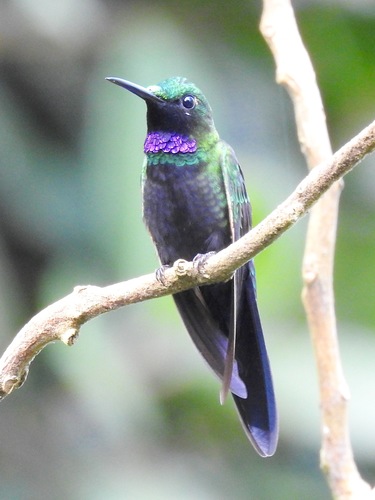
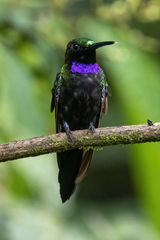
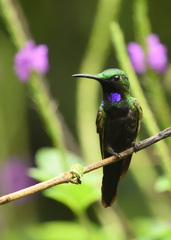
Black-throated Brilliant

Black-throated Brilliant

Heliodoxa schreibersii

Silhouette: PhyloPic

LCLeast ConcernNTVUENCR
Daily sighting probability <5% · Rare
at Podocarpus National Park

In 3 days <5% in a week ~10%

22 Verified sightings at Podocarpus National Park From 2019 to 2026
29 In all 2 parks
June Best month
☀️ Diurnal When it's spotted

About the Black-throated Brilliant

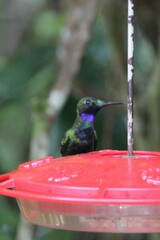
The black-throated brilliant (Heliodoxa schreibersii) is a species of hummingbird in tribe Heliantheini of subfamily Lesbiinae. It lives in Brazil, Colombia, Ecuador and Peru. The taxonomy of the black-throated brilliant has not been settled. BirdLife International's Handbook of the Birds of the World (HBW) treats those taxa as full species, the "black-throated" and "black-breasted" brilliants respectively. In addition, for a time in the early 20th century, the two subspecies were treated as species, the only members of genus Ionolaima, which was subsequently merged into the present Heliodoxa. As of May 2022 the SACC has a proposal pending to resurrect Ionolaima but it has gained little support.

The nominate subspecies H. s. schreibersii of black-throated brilliant is 11.5 to 13 cm (4.5 to 5.1 in) long. Males weigh about 9.9 g (0.35 oz) and females 7.1 to 8.5 g (0.25 to 0.30 oz). Both have an almost... Wikipedia →

Sounds

Song0:14

Ecuador · 2002

© Jonas Nilsson · XC276074 · CC BY-NC-SA 4.0

Call0:21

Ecuador · 2002

© Niels Krabbe · XC238371 · CC BY-NC-SA 3.0

Calling - territorial?0:10

Ecuador · 2009

© Manuel Sanchez N. · XC55822 · CC BY-NC-ND 2.5

Global Distribution

Parks Where Found

# Park Country Daily sighting probability
1 Podocarpus National Park 🇪🇨 Ecuador
<5%
2 Yasuní National Park 🇪🇨 Ecuador
<5%

Before you go

What are the chances of seeing a Black-throated Brilliant in Podocarpus National Park?

Rare

Under 5% of wildlife watchers report a Black-throated Brilliant sighting in Podocarpus National Park on a given day, based on 22 verified sightings from GBIF citizen-science data from 2019 to 2026. It is the 307th most-seen of the 446 birds we can rate there. Over three days the chance rises to under 5%, and over a week to about 10%, if each day is a fresh chance.

When is the best time to see a Black-throated Brilliant in Podocarpus National Park?

May and June

In those months about 10% of wildlife watchers report a Black-throated Brilliant in Podocarpus National Park on a given day, against under 5% in July to April, the lowest months.

What time of day is best to see a Black-throated Brilliant?

Between 2 and 5 pm

Across all the parks we cover, that three-hour window holds the most Black-throated Brilliant sightings with a recorded time, and about 9 in 10 of them come between 6 am and 6 pm: it is a daytime animal.

Is Podocarpus National Park the best place to see a Black-throated Brilliant?

Yes

Of the 2 parks where we can rate Black-throated Brilliant sightings, Podocarpus National Park has the highest daily chance: under 5%. Next come Yasuní National Park (Ecuador, under 5%).

Which relatives of the Black-throated Brilliant live in Podocarpus National Park?

Same genus: Heliodoxa

The closest relatives of the Black-throated Brilliant that you can see in Podocarpus National Park (genus Heliodoxa, Brilliants) are Violet-fronted Brilliant (about 30%) and Fawn-breasted Brilliant (about 20%), with each one's daily chance of a sighting.

Where does the Black-throated Brilliant sighting chance come from?

GBIF citizen-science records

It is estimated from how often the Black-throated Brilliant is recorded against all the birds logged in Podocarpus National Park (22 verified sightings from 2019 to 2026), calibrated against known sighting rates. Figures are rounded to the nearest 10% because citizen-science data supports honest approximations, not decimals, and months with records from fewer than five people show "—". How it works.

← Back to Podocarpus National Park