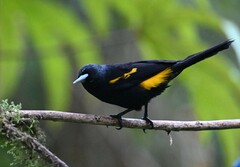
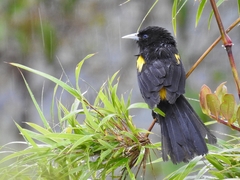
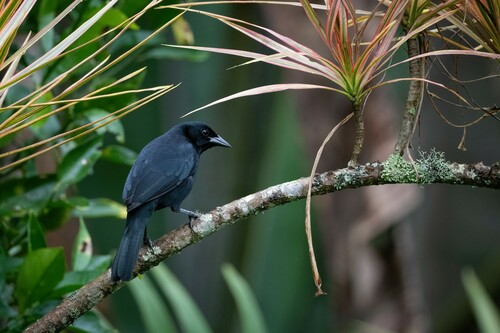
Mountain Cacique

Mountain Cacique

Cacicus chrysonotus

Silhouette: Sheatherius · PhyloPic

LCLeast ConcernNTVUENCR
Daily sighting probability <5% · Rare
at Podocarpus National Park

In 3 days ~10% in a week ~20%

49 Verified sightings at Podocarpus National Park From 2019 to 2026
452 In all 4 parks
November Best month
☀️ Diurnal When it's spotted

About the Mountain Cacique

The mountain cacique (Cacicus chrysonotus) is a species of bird in the family Icteridae, the oropendolas, New World orioles, and New World blackbirds. It is found in Bolivia, Colombia, Ecuador, Peru, and Venezuela. The mountain cacique has a complicated taxonomic history. It was formally described in 1838 with the binomial Cacicus Chrysonotus [sic]. In the first half of the twentieth century many authors placed it in genus Archiplanus which was later merged into Cacicus.

As of late 2025 taxonomic systems assign the mountain cacique these three subspecies: However, in the second half of the twentieth century and well into the twenty-first many authors treated chrysonotus as a species, the "southern mountain cacique" and the other two as the "northern mountain cacique". The IOC and BirdLife International's Handbook of the Birds of the World kept them separate until 2023. The Clements taxonomy recognizes some distinction within the species, calling C. c. chrysonotus the "mountain cacique (Bolivian)" and grouping the other two subspecies... Wikipedia →

Sounds

Song1:15

Peru · 2018

© Rolf A. de By · XC468833 · CC BY-NC-SA 4.0

Call0:58

Bolivia · 2016

© Dan Lane · XC350989 · CC BY-NC-SA 4.0

Alarm call0:58

Bolivia · 1993

© Sjoerd Mayer · XC1988 · CC BY-NC-SA 3.0

Global Distribution

Parks Where Found

# Park Country Daily sighting probability
1 Chingaza National Natural Park 🇨🇴 Colombia
~10%
2 Los Nevados National Natural Park 🇨🇴 Colombia
<5%
3 Podocarpus National Park 🇪🇨 Ecuador
<5%
4 Farallones de Cali National Natural Park 🇨🇴 Colombia
<5%

Before you go

What are the chances of seeing a Mountain Cacique in Podocarpus National Park?

Rare

Under 5% of wildlife watchers report a Mountain Cacique sighting in Podocarpus National Park on a given day, based on 49 verified sightings from GBIF citizen-science data from 2019 to 2026. It is the 220th most-seen of the 446 birds we can rate there. Over three days the chance rises to about 10%, and over a week to about 20%, if each day is a fresh chance.

When is the best time to see a Mountain Cacique in Podocarpus National Park?

January–February, June and November

In those months about 10% of wildlife watchers report a Mountain Cacique in Podocarpus National Park on a given day, against under 5% in March–May, July–October and December, the lowest months.

What time of day is best to see a Mountain Cacique?

Between 10 am and 1 pm

Across all the parks we cover, that three-hour window holds the most Mountain Cacique sightings with a recorded time, and about 9 in 10 of them come between 6 am and 6 pm: it is a daytime animal.

Is Podocarpus National Park the best place to see a Mountain Cacique?

3rd of 4

Of the 4 parks where we can rate Mountain Cacique sightings, Podocarpus National Park ranks 3rd at under 5%. The best odds are in Chingaza National Natural Park (Colombia, about 10%) and Los Nevados National Natural Park (Colombia, under 5%).

Where does the Mountain Cacique sighting chance come from?

GBIF citizen-science records

It is estimated from how often the Mountain Cacique is recorded against all the birds logged in Podocarpus National Park (49 verified sightings from 2019 to 2026), calibrated against known sighting rates. Figures are rounded to the nearest 10% because citizen-science data supports honest approximations, not decimals, and months with records from fewer than five people show "—". How it works.

← Back to Podocarpus National Park