
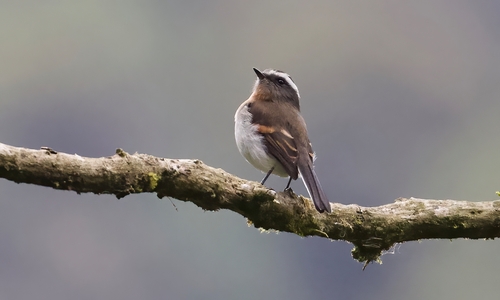
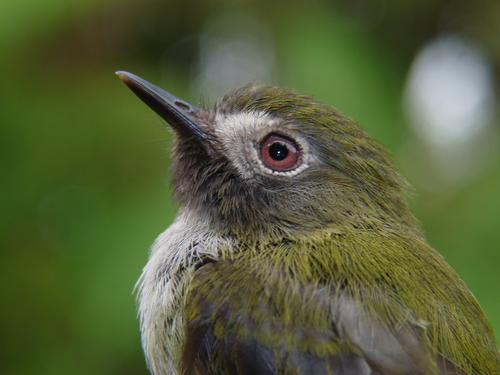
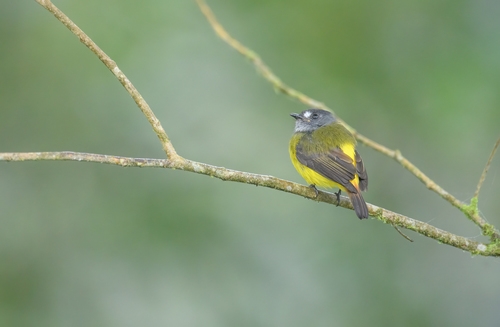
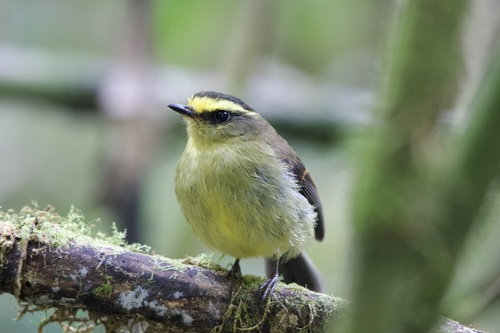
Olive-chested Flycatcher

Olive-chested Flycatcher

Myiophobus cryptoxanthus

Silhouette: Emily Willoughby · PhyloPic

LCLeast ConcernNTVUENCR
Daily sighting probability <5% · Rare
at Podocarpus National Park

In 3 days <5% in a week ~10%

24 Verified sightings at Podocarpus National Park From 2019 to 2026
24 In 1 park
April Best month
☀️ Diurnal When it's spotted

About the Olive-chested Flycatcher

The olive-chested flycatcher (Myiophobus cryptoxanthus) is a species of bird in the family Tyrannidae, the tyrant flycatchers. It is found in Ecuador and Peru. The olive-chested flycatcher was originally described by English ornithologist Philip Sclater in 1861 as Myiobius cryptoxanthus, from specimens collected by Louis Fraser in Gualaquiza and Zamora in Ecuador. Its specific epithet cryptoxanthus comes from the Greek kryptos and xanthos, meaning hidden and yellow respectively, and apparently refers to its crown patch.

The olive-chested flycatcher was considered a subspecies of the bran-colored flycatcher (M. fasciatus) by Cory & Hellmayr in 1927 under the name Sclater's banded flycatcher. The olive-chested and bran-colored flycatchers form a superspecies, and some authors have suggested that the two should be assigned their own genus.

The olive-chested flycatcher is monotypic. The olive-chested flycatcher is about 12 cm (4.7 in) long and weighs about 8.5 to 11 g (0.30 to 0.39 oz). The sexes have almost identical plumage. Adult males have a dull olive-brown crown with a partially hidden yellow patch in the middle. Females have a smaller... Wikipedia →

Sounds

Call0:32

Ecuador · 2025

© Manuel Sánchez-Nivicela · XC1100877 · CC BY-NC-ND 4.0

Song0:23

Ecuador · 2025

© Scott Olmstead · XC1064621 · CC BY-NC-SA 4.0

Dawn song0:16

Ecuador · 2002

© John V. Moore · XC258852 · CC BY-NC-SA 4.0

Global Distribution

Parks Where Found

# Park Country Daily sighting probability
1 Podocarpus National Park 🇪🇨 Ecuador
<5%

More parks will be added in future updates.

Before you go

What are the chances of seeing an Olive-chested Flycatcher in Podocarpus National Park?

Rare

Under 5% of wildlife watchers report an Olive-chested Flycatcher sighting in Podocarpus National Park on a given day, based on 24 verified sightings from GBIF citizen-science data from 2019 to 2026. It is the 313th most-seen of the 446 birds we can rate there. Over three days the chance rises to under 5%, and over a week to about 10%, if each day is a fresh chance.

When is the best time to see an Olive-chested Flycatcher in Podocarpus National Park?

Any time of year

In every month with enough records, under 5% of wildlife watchers report an Olive-chested Flycatcher in Podocarpus National Park on a given day, so our monthly data shows no clear season.

What time of day is best to see an Olive-chested Flycatcher?

Between 7 and 10 am

Across all the parks we cover, that three-hour window holds the most Olive-chested Flycatcher sightings with a recorded time, and nearly all of them come between 6 am and 6 pm: it is a daytime animal.

Where else can you see an Olive-chested Flycatcher?

Only Podocarpus National Park, in our data

Podocarpus National Park is the only park on Wallace's Line with enough records to rate Olive-chested Flycatcher sightings: under 5% of wildlife watchers there report one on a given day.

Which relatives of the Olive-chested Flycatcher live in Podocarpus National Park?

Same genus: Myiophobus

The closest relatives of the Olive-chested Flycatcher that you can see in Podocarpus National Park (genus Myiophobus, Myiophobus Flycatchers) are Orange-banded Flycatcher (about 20%) and Orange-crested Flycatcher (about 10%), with each one's daily chance of a sighting.

Where does the Olive-chested Flycatcher sighting chance come from?

GBIF citizen-science records

It is estimated from how often the Olive-chested Flycatcher is recorded against all the birds logged in Podocarpus National Park (24 verified sightings from 2019 to 2026), calibrated against known sighting rates. Figures are rounded to the nearest 10% because citizen-science data supports honest approximations, not decimals, and months with records from fewer than five people show "—". How it works.

← Back to Podocarpus National Park