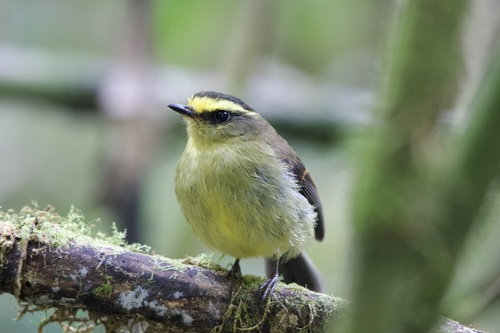
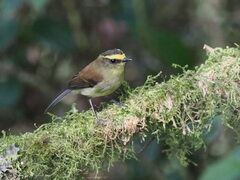
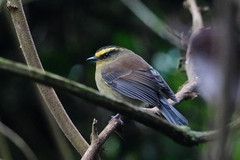

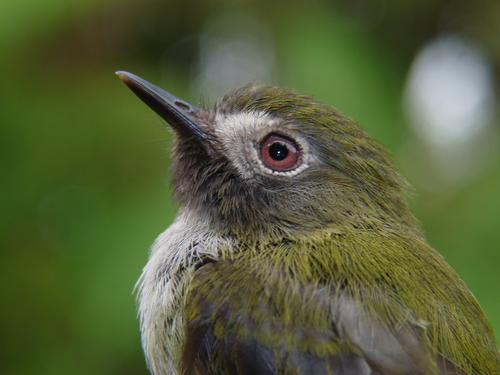
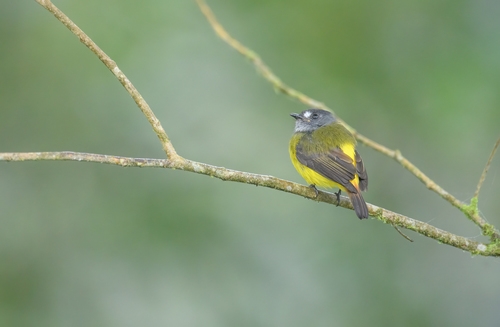
Yellow Bellied Chat Tyrant

Yellow Bellied Chat Tyrant

Ochthoeca diadema

Silhouette: Emily Willoughby · PhyloPic

Daily sighting probability ~10% · With luck
at Podocarpus National Park

In 3 days ~30% in a week ~60%

182 Verified sightings at Podocarpus National Park From 2019 to 2026
379 In all 4 parks
February Best month
☀️ Diurnal When it's spotted

About the Yellow Bellied Chat Tyrant

The yellow-bellied chat-tyrant (Silvicultrix diadema) is a species of passerine bird in the family Tyrannidae, the tyrant flycatchers. It is found in Colombia, Ecuador, Peru, and Venezuela. The yellow-bellied chat-tyrant has a complicated taxonomic history. It was formally described in 1843 as Myiobius diadema. In 1966 Meyer de Schauensee placed the yellow-bellied chat-tyrant in genus Ochthoeca. Wesley Lanyon moved it to Silvicultrix when he erected that genus in 1986. In 2009 the IOC adopted the change in genus to Silvicultrix. BirdLife International's Handbook of the Birds of the World (HBW) adopted the reassignment to Silvicultrix in 2016, the Clements taxonomy in 2022, and the South American Classification Committee of the American Ornithological Society (SACC) in 2023.

The yellow-bellied chat-tyrant has these five subspecies: It appears large-headed and has long rictal bristles. The sexes have the same... Wikipedia →

Sounds

Recording

© Sue Riffe · XCXC1036930 · CC BY-NC-SA 4.0

Recording

© Peter Boesman · XCXC693849 · CC BY-NC-ND 4.0

Recording

© Juan Carlos Crespo · XCXC597909 · CC BY-NC-SA 4.0

Global Distribution

Parks Where Found

# Park Country Daily sighting probability
1 Podocarpus National Park 🇪🇨 Ecuador
~10%
2 Los Nevados National Natural Park 🇨🇴 Colombia
<5%
3 Chingaza National Natural Park 🇨🇴 Colombia
<5%
4 Farallones de Cali National Natural Park 🇨🇴 Colombia
<5%

Before you go

What are the chances of seeing a Yellow Bellied Chat Tyrant in Podocarpus National Park?

With luck

About 10% of wildlife watchers report a Yellow Bellied Chat Tyrant sighting in Podocarpus National Park on a given day, based on 182 verified sightings from GBIF citizen-science data from 2019 to 2026. It is the 103rd most-seen of the 446 birds we can rate there. Over three days the chance rises to about 30%, and over a week to about 60%, if each day is a fresh chance.

When is the best time to see a Yellow Bellied Chat Tyrant in Podocarpus National Park?

January–February and July–August

In those months about 20% of wildlife watchers report a Yellow Bellied Chat Tyrant in Podocarpus National Park on a given day, against under 5% in December, the lowest month.

What time of day is best to see a Yellow Bellied Chat Tyrant?

Between 8 and 11 am

Across all the parks we cover, that three-hour window holds the most Yellow Bellied Chat Tyrant sightings with a recorded time, and about 9 in 10 of them come between 6 am and 6 pm: it is a daytime animal.

Is Podocarpus National Park the best place to see a Yellow Bellied Chat Tyrant?

Yes

Of the 4 parks where we can rate Yellow Bellied Chat Tyrant sightings, Podocarpus National Park has the highest daily chance: about 10%. Next come Los Nevados National Natural Park (Colombia, under 5%) and Chingaza National Natural Park (Colombia, under 5%).

Which relatives of the Yellow Bellied Chat Tyrant live in Podocarpus National Park?

Same genus: Ochthoeca

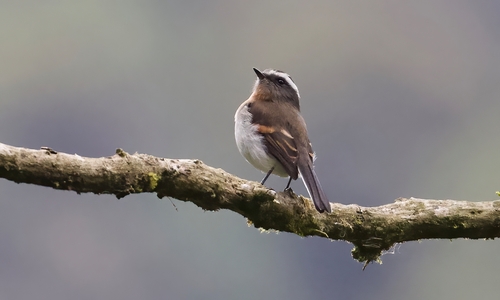
The closest relatives of the Yellow Bellied Chat Tyrant that you can see in Podocarpus National Park (genus Ochthoeca, Typical Chat-Tyrants) are Rufous-breasted Chat-Tyrant (about 20%) and Slaty-backed Chat-Tyrant (about 10%), with each one's daily chance of a sighting.

Where does the Yellow Bellied Chat Tyrant sighting chance come from?

GBIF citizen-science records

It is estimated from how often the Yellow Bellied Chat Tyrant is recorded against all the birds logged in Podocarpus National Park (182 verified sightings from 2019 to 2026), calibrated against known sighting rates. Figures are rounded to the nearest 10% because citizen-science data supports honest approximations, not decimals, and months with records from fewer than five people show "—". How it works.

← Back to Podocarpus National Park