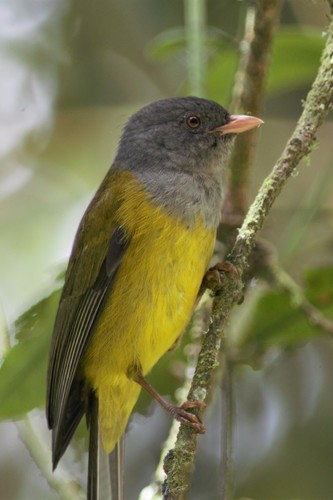
Orange-throated Tanager

Orange-throated Tanager

Wetmorethraupis sterrhopteron

Silhouette: Sheatherius · PhyloPic

LCNTVUVulnerableENCR
Daily sighting probability ~10% · With luck
at Podocarpus National Park

In 3 days ~30% in a week ~60%

12 Verified sightings at Podocarpus National Park From 2019 to 2026
12 In 1 park
April Best month
☀️ Diurnal When it's spotted

About the Orange-throated Tanager

The orange-throated tanager (Wetmorethraupis sterrhopteron) is a species of bird in the tanager family Thraupidae that is found very locally in humid forests around the Ecuador-Peru border. As a species it is considered threatened. The orange-throated tanager is the only member of the genus Wetmorethraupis, named after the ornithologist Alexander Wetmore. It is closely related to members of the genus Bangsia.

The orange-throated tanager was formally described by George Lowery and John O'Neill in 1964. The authors placed the species in a new genus Wetmorethraupis to give the binomial name Wetmorethraupis sterrhopteron. The genus name honours the American ornithologist Alexander Wetmore by combining his name with the genus name Thraupis, the type genus of the tanager family Thraupidae. The specific epithet combines the Ancient Greek sterrhos meaning "stiff" or "hard" with pteron meaning feather.

A molecular phylogenetic study published in 2014 found that Wetmorethraupis was the sister taxon to Bangsia. The orange-throated tanager is monotypic: no subspecies are recognised. Schulenberg, T., Stotz, D., Lane, D., O'Neill, J., & Parker III, T. (2007). Birds... Wikipedia →

Sounds

Song0:20

Ecuador · 2020

© Peter de Rouw · XC565534 · CC BY-NC-SA 4.0

Call1:19

Ecuador · 2018

© Hans Matheve · XC512753 · CC BY-NC-ND 4.0

Dawn song0:15

Peru · 1999

© Paul Coopmans · XC264834 · CC BY-NC-SA 4.0

Global Distribution

Parks Where Found

# Park Country Daily sighting probability
1 Podocarpus National Park 🇪🇨 Ecuador
~10%

More parks will be added in future updates.

Before you go

What are the chances of seeing an Orange-throated Tanager in Podocarpus National Park?

With luck

About 10% of wildlife watchers report an Orange-throated Tanager sighting in Podocarpus National Park on a given day, based on 12 verified sightings from GBIF citizen-science data from 2019 to 2026. It is the 108th most-seen of the 446 birds we can rate there. Over three days the chance rises to about 30%, and over a week to about 60%, if each day is a fresh chance.

When is the best time to see an Orange-throated Tanager in Podocarpus National Park?

April and June

In those months about 20% of wildlife watchers report an Orange-throated Tanager in Podocarpus National Park on a given day, against under 5% in May, July and December, the lowest months.

What time of day is best to see an Orange-throated Tanager?

Between 6 and 9 am

Across all the parks we cover, that three-hour window holds the most Orange-throated Tanager sightings with a recorded time, and nearly all of them come between 6 am and 6 pm: it is a daytime animal.

Where else can you see an Orange-throated Tanager?

Only Podocarpus National Park, in our data

Podocarpus National Park is the only park on Wallace's Line with enough records to rate Orange-throated Tanager sightings: about 10% of wildlife watchers there report one on a given day.

Which relatives of the Orange-throated Tanager live in Podocarpus National Park?

Same family: Thraupidae

The closest relatives of the Orange-throated Tanager that you can see in Podocarpus National Park (family Thraupidae, Tanagers and Allies) are Lacrimose Mountain-Tanager (about 40%), Masked Flowerpiercer (about 40%) and Blue-necked Tanager (about 30%), with each one's daily chance of a sighting.

Where does the Orange-throated Tanager sighting chance come from?

GBIF citizen-science records

It is estimated from how often the Orange-throated Tanager is recorded against all the birds logged in Podocarpus National Park (12 verified sightings from 2019 to 2026), calibrated against known sighting rates. Figures are rounded to the nearest 10% because citizen-science data supports honest approximations, not decimals, and months with records from fewer than five people show "—". How it works.

← Back to Podocarpus National Park