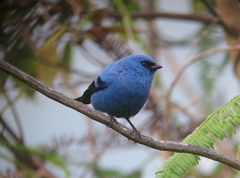
Blue-and-black Tanager

Blue-and-black Tanager

Tangara vassorii

Silhouette: Sheatherius · PhyloPic

LCLeast ConcernNTVUENCR
Daily sighting probability ~30% · Possible
at Podocarpus National Park

In 3 days ~60% in a week ~90%

444 Verified sightings at Podocarpus National Park From 2019 to 2026
1,430 In all 4 parks
April Best month
☀️ Diurnal When it's spotted

About the Blue-and-black Tanager

The blue-and-black tanager (Tangara vassorii) is a species of bird in the tanager family Thraupidae. It is found in the Andes of Bolivia, Colombia, Ecuador, Peru and Venezuela, where it inhabits montane evergreen forest, dwarf forest, and secondary forest at elevations of 1,500–3,500 m (4,900–11,500 ft). It inhabits the highest altitude of any Tangara species, and is the only species from the genus that is found near the tree line. Adults are 13 cm (5.1 in) long and weigh 18 g (0.63 oz) on average, and are mostly blue with black masks, wings, and tails. The species shows slight sexual dimorphism, with females being slightly duller than males.

The blue-and-black tanager feeds on fruit and arthropods, with the most favored fruit being Miconia. It forages in mixed-species flocks in pairs or groups of 3–6 individuals, especially with Iridosornis or Anisognathus. It breeds from February to August, making cup nests out of moss and rootlets. Begging young have been reported in January, while fledglings have been reported in May. The blue-and-black tanager is listed as being of least concern by the International Union for Conservation of Nature (IUCN) on the IUCN Red List due to its large range, relative commonness, and lack of significant population declines, but is threatened by habitat destruction. Wikipedia →

Sounds

Call1:04

Ecuador · 2024

© Manuel Sánchez-Nivicela · XC1142923 · CC BY-NC-ND 4.0

Flight call0:09

Ecuador · 1987

© Paul Coopmans · XC264827 · CC BY-NC-SA 4.0

Song1:08

Peru · 2008

© Peter Boesman · XC230525 · CC BY-NC-ND 4.0

Global Distribution

Parks Where Found

# Park Country Daily sighting probability
1 Podocarpus National Park 🇪🇨 Ecuador
~30%
2 Los Nevados National Natural Park 🇨🇴 Colombia
~10%
3 Chingaza National Natural Park 🇨🇴 Colombia
~10%
4 Farallones de Cali National Natural Park 🇨🇴 Colombia
<5%

Cities Where Found

# City Country Daily sighting probability
1 Quito 🇪🇨 Ecuador
<5%

Before you go

What are the chances of seeing a Blue-and-black Tanager in Podocarpus National Park?

Possible

About 30% of wildlife watchers report a Blue-and-black Tanager sighting in Podocarpus National Park on a given day, based on 444 verified sightings from GBIF citizen-science data from 2019 to 2026. It is the 26th most-seen of the 446 birds we can rate there. Over three days the chance rises to about 60%, and over a week to about 90%, if each day is a fresh chance.

When is the best time to see a Blue-and-black Tanager in Podocarpus National Park?

April and November

In those months about 40% of wildlife watchers report a Blue-and-black Tanager in Podocarpus National Park on a given day, against about 20% in February, June–July and September, the lowest months.

What time of day is best to see a Blue-and-black Tanager?

Between 8 and 11 am

Across all the parks we cover, that three-hour window holds the most Blue-and-black Tanager sightings with a recorded time, and about 9 in 10 of them come between 6 am and 6 pm: it is a daytime animal.

Is Podocarpus National Park the best place to see a Blue-and-black Tanager?

Yes

Of the 4 parks where we can rate Blue-and-black Tanager sightings, Podocarpus National Park has the highest daily chance: about 30%. Next come Los Nevados National Natural Park (Colombia, about 10%) and Chingaza National Natural Park (Colombia, about 10%).

Which relatives of the Blue-and-black Tanager live in Podocarpus National Park?

Same genus: Tangara

The closest relatives of the Blue-and-black Tanager that you can see in Podocarpus National Park (genus Tangara, Tangara Tanagers) are Green-and-gold Tanager (about 30%), Paradise Tanager (about 30%) and Bay-headed Tanager (about 20%), with each one's daily chance of a sighting.

Where does the Blue-and-black Tanager sighting chance come from?

GBIF citizen-science records

It is estimated from how often the Blue-and-black Tanager is recorded against all the birds logged in Podocarpus National Park (444 verified sightings from 2019 to 2026), calibrated against known sighting rates. Figures are rounded to the nearest 10% because citizen-science data supports honest approximations, not decimals, and months with records from fewer than five people show "—". How it works.

← Back to Podocarpus National Park