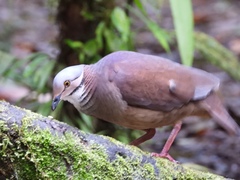
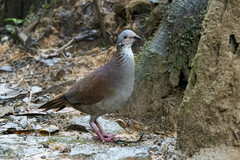
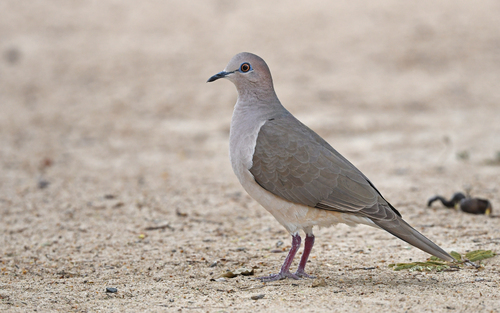
White-throated Quail-Dove

White-throated Quail-Dove

Zentrygon frenata

Silhouette: Natalia Ladino · PhyloPic

LCLeast ConcernNTVUENCR
Daily sighting probability ~20% · Possible
at Podocarpus National Park

In 3 days ~50% in a week ~80%

276 Verified sightings at Podocarpus National Park From 2019 to 2026
497 In all 4 parks
February Best month
☀️ Diurnal When it's spotted

About the White-throated Quail-Dove

The white-throated quail-dove (Zentrygon frenata) is a species of bird in the family Columbidae. It is found in Argentina, Bolivia, Colombia, Ecuador, and Peru. The white-throated quail-dove's taxonomic history is complicated. It was originally described in genus Geotrygon, later erroneously given the binomial Oreopeleia bourcieri, and still later attained its present binomial. The four subspecies below are currently recognized. Z. f. boucieri was at one time treated as separate species by some authors. Additional subspecies have been proposed but are now generally accepted as color morphs or individual variations of one of the four accepted subspecies.

The white-throated quail-dove has these four subspecies: The adult nominate subspecies Z. f. frenata male's forehead and the lower part of the face are buff and the crown blue-gray. The mantle is deep purple... Wikipedia →

Sounds

Song0:58

Colombia · 2026

© Julio Delgado · XC1094085 · CC BY-NC-SA 4.0

Call0:51

Peru · 2005

© Todd Mark · XC7875 · CC BY-NC-SA 3.0

Song0:50

Ecuador · 2023

© rudy gelis · XC833478 · CC BY-NC-SA 4.0

Global Distribution

Parks Where Found

# Park Country Daily sighting probability
1 Podocarpus National Park 🇪🇨 Ecuador
~20%
2 Farallones de Cali National Natural Park 🇨🇴 Colombia
<5%
3 Amboró National Park 🇧🇴 Bolivia
<5%
4 Los Nevados National Natural Park 🇨🇴 Colombia
<5%

Zoos & Centres Where Found

# Zoo / Centre Country
1 Dallas World Aquarium 🇺🇸 United States In captivity

Before you go

What are the chances of seeing a White-throated Quail-Dove in Podocarpus National Park?

Possible

About 20% of wildlife watchers report a White-throated Quail-Dove sighting in Podocarpus National Park on a given day, based on 276 verified sightings from GBIF citizen-science data from 2019 to 2026. It is the 64th most-seen of the 446 birds we can rate there. Over three days the chance rises to about 50%, and over a week to about 80%, if each day is a fresh chance.

When is the best time to see a White-throated Quail-Dove in Podocarpus National Park?

February and March

In those months about 30% of wildlife watchers report a White-throated Quail-Dove in Podocarpus National Park on a given day, against about 10% in June–August and October–December, the lowest months.

What time of day is best to see a White-throated Quail-Dove?

Between 7 and 10 am

Across all the parks we cover, that three-hour window holds the most White-throated Quail-Dove sightings with a recorded time, and about 9 in 10 of them come between 6 am and 6 pm: it is a daytime animal.

Is Podocarpus National Park the best place to see a White-throated Quail-Dove?

Yes

Of the 4 parks where we can rate White-throated Quail-Dove sightings, Podocarpus National Park has the highest daily chance: about 20%. Next come Farallones de Cali National Natural Park (Colombia, under 5%) and Amboró National Park (Bolivia, under 5%).

Which relatives of the White-throated Quail-Dove live in Podocarpus National Park?

Same family: Columbidae

The closest relatives of the White-throated Quail-Dove that you can see in Podocarpus National Park (family Columbidae, Pigeons and Doves) are Band-tailed Pigeon (about 40%), Grey-fronted Dove (about 20%) and Plumbeous Pigeon (about 10%), with each one's daily chance of a sighting.

Where does the White-throated Quail-Dove sighting chance come from?

GBIF citizen-science records

It is estimated from how often the White-throated Quail-Dove is recorded against all the birds logged in Podocarpus National Park (276 verified sightings from 2019 to 2026), calibrated against known sighting rates. Figures are rounded to the nearest 10% because citizen-science data supports honest approximations, not decimals, and months with records from fewer than five people show "—". How it works.

← Back to Podocarpus National Park