Black Satyr

Black Satyr

Satyrus actaea

Daily sighting probability ~10% · With luck
at Pyrénées National Park

In 3 days ~20% in a week ~30%

26 Verified sightings at Pyrénées National Park From 2019 to 2026
185 In all 5 parks
August Best month
☀️ Diurnal When it's spotted

About the Black Satyr

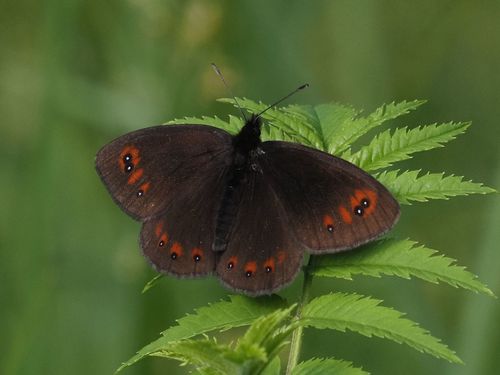
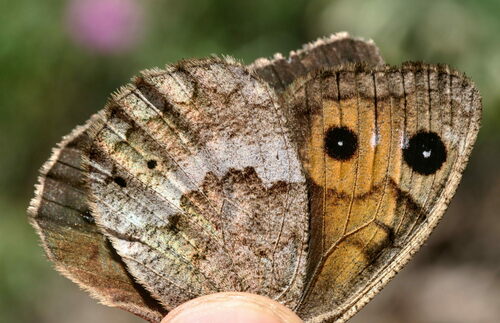
Satyrus actaea, the black satyr, is a butterfly of the family Nymphalidae. It is found in South-Western Europe, Asia Minor, Syria, Iran and Baluchistan (SW Pakistan). The length of the forewings is 24 to 28 mm. Upperside of male black-brown, with a dark sheen in live specimens: the 2 ocelli of the forewing mostly represented only by the small bluish white pupils. In old specimens, with the ground-colour faded, the pupil is bordered with deep black. Between the ocelli of the forewing sometimes 2 minute white dots. The number of the ocelli may be enlarged or diminished as in all Satyrus, e. g. merula Schultz, ornata Schultz. In the female the distal band is indicated by a paler, sometimes yellowish brown tint, and the ocelli are

considerably larger than in the male. Underside different in the various forms, with a distinctly defined distal ban, a dark dentate line in the cell and across the hindwing, and a somewhat irregular submarginal line. The butterfly is on wing in July and August in one generation. The habitat is rocky places at 600 to 1,800 m. The larvae feed on various grasses (Brachypodium and Bromus sp. and sedges). Wikipedia →

Global Distribution

Parks Where Found

# Park Country Daily sighting probability
1 Aigüestortes National Park 🇪🇸 Spain
~20%
2 Sierra Nevada National Park 🇪🇸 Spain
~20%
3 Cévennes National Park 🇫🇷 France
~10%
4 Sierra de Guadarrama National Park 🇪🇸 Spain
~10%
5 Pyrénées National Park 🇫🇷 France
~10%

Before you go

What are the chances of seeing a Black Satyr in Pyrénées National Park?

With luck

About 10% of wildlife watchers report a Black Satyr sighting in Pyrénées National Park on a given day, based on 26 verified sightings from GBIF citizen-science data from 2019 to 2026. It is the 479th most-seen of the 1277 insects we can rate there. Over three days the chance rises to about 20%, and over a week to about 30%, if each day is a fresh chance.

When is the best time to see a Black Satyr in Pyrénées National Park?

July to October

In those months about 10% of wildlife watchers report a Black Satyr in Pyrénées National Park on a given day, against under 5% in November to June, the lowest months.

What time of day is best to see a Black Satyr?

Between noon and 3 pm

Across all the parks we cover, that three-hour window holds the most Black Satyr sightings with a recorded time, and about 9 in 10 of them come between 6 am and 6 pm: it is a daytime animal.

Which relatives of the Black Satyr live in Pyrénées National Park?

Same genus: Satyrus

The closest relatives of the Black Satyr that you can see in Pyrénées National Park (genus Satyrus) are Great Sooty Satyr (about 10%) and Satyrus briseis (about 10%), with each one's daily chance of a sighting.

Where does the Black Satyr sighting chance come from?

GBIF citizen-science records

It is estimated from how often the Black Satyr is recorded against all the insects logged in Pyrénées National Park (26 verified sightings from 2019 to 2026), calibrated against known sighting rates. Figures are rounded to the nearest 10% because citizen-science data supports honest approximations, not decimals, and months with records from fewer than five people show "—". How it works.

← Back to Pyrénées National Park