Eleonora's Falcon

Eleonora's Falcon

Falco eleonorae

Silhouette: Andy Wilson · PhyloPic

LCLeast ConcernNTVUENCR
Daily sighting probability <5% · Rare
at Pyrénées National Park

In 3 days <5%

11 Verified sightings at Pyrénées National Park From 2019 to 2026
40 In all 4 parks
August Best month
☀️ Diurnal When it's spotted

About the Eleonora's Falcon

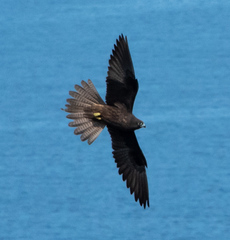
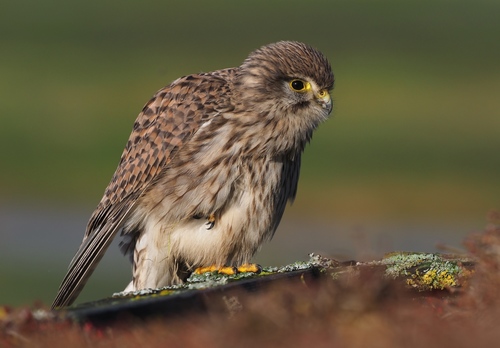
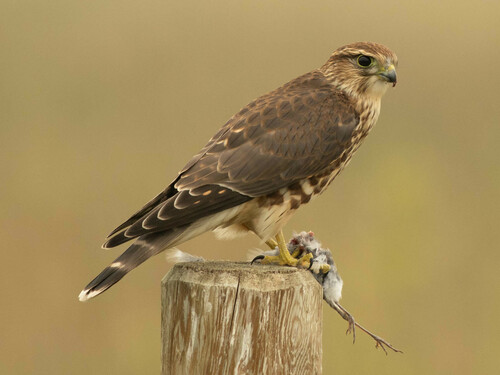
Eleonora's falcon (Falco eleonorae) is a medium-sized falcon. It belongs to the hobby group, a rather close-knit number of similar falcons often considered a subgenus Falco. The sooty falcon is sometimes considered its closest relative, but while they certainly belong to the same lineage, they do not seem to be close sister species. The English name and the species name eleonorae commemorate Eleanor of Arborea, Queen or Lady-Judge (Juighissa) and national heroine of Sardinia, who in 1392, under the jurisdiction conferred by the Carta de Logu, became the first ruler in history to grant protection to hawk and falcon nests against illegal hunters. The genus name Falco is from Late Latin falx, falcis, a sickle, referring to the claws of the bird.

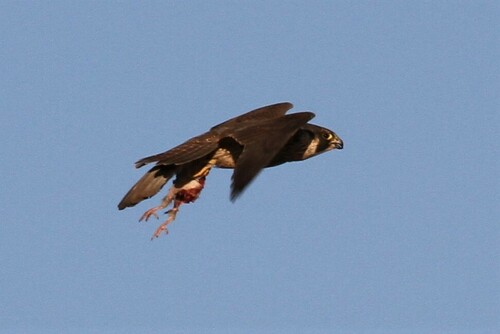
Eleonora's falcon is a bird of prey, 36–42 cm (14–17 in) long with an 87–104 cm (34–41 in) wingspan. It is shaped like a large Eurasian hobby or a small slender peregrine falcon, with its long pointed wings, long tail and slim body.

There are two colour morphs: The adult dark morph is all sooty brown, with black underwing coverts. The light morph is more like a juvenile Eurasian hobby, but has buff underparts, and also shows... Wikipedia →

Sounds

Call1:17

Italy · 2023

© Wim Jacobs · XC854572 · CC BY-NC-SA 4.0

Flight call0:12

Italy · 2021

© Alain Malengreau · XC884399 · CC BY-NC-SA 4.0

Call0:32

Cyprus · 2016

© Lars Lachmann · XC329984 · CC BY-NC-SA 4.0

Global Distribution

Parks Where Found

# Park Country Daily sighting probability
1 Ankarafantsika National Park 🇲🇬 Madagascar
<5%
2 Sierra Nevada National Park 🇪🇸 Spain
<5%
3 Camargue 🇫🇷 France
<5%
4 Pyrénées National Park 🇫🇷 France
<5%

Cities Where Found

# City Country Daily sighting probability
1 Rabat 🇲🇦 Morocco
<5%
2 Athens 🇬🇷 Greece
<5%
3 Jerusalem 🇮🇱 Israel
<5%

Before you go

What are the chances of seeing an Eleonora's Falcon in Pyrénées National Park?

Rare

Under 5% of wildlife watchers report an Eleonora's Falcon sighting in Pyrénées National Park on a given day, based on 11 verified sightings from GBIF citizen-science data from 2019 to 2026. It is the 162nd most-seen of the 174 birds we can rate there. Over three days the chance rises to under 5%, if each day is a fresh chance.

When is the best time to see an Eleonora's Falcon in Pyrénées National Park?

Any time of year

In every month with enough records, under 5% of wildlife watchers report an Eleonora's Falcon in Pyrénées National Park on a given day, so our monthly data shows no clear season.

What time of day is best to see an Eleonora's Falcon?

Between 9 am and noon

Across all the parks we cover, that three-hour window holds the most Eleonora's Falcon sightings with a recorded time, and about 8 in 10 of them come between 6 am and 6 pm: it is a daytime animal.

Is Pyrénées National Park the best place to see an Eleonora's Falcon?

Among the best

Of the 4 parks where we can rate Eleonora's Falcon sightings, Pyrénées National Park ranks 4th at under 5%, level with the leaders once rounded. The best odds are in Ankarafantsika National Park (Madagascar, under 5%), Sierra Nevada National Park (Spain, under 5%) and Camargue (France, under 5%).

Which relatives of the Eleonora's Falcon live in Pyrénées National Park?

Same genus: Falco

The closest relatives of the Eleonora's Falcon that you can see in Pyrénées National Park (genus Falco, Typical Falcons) are Common Kestrel (about 40%) and Peregrine Falcon (about 10%), with each one's daily chance of a sighting.

Where does the Eleonora's Falcon sighting chance come from?

GBIF citizen-science records

It is estimated from how often the Eleonora's Falcon is recorded against all the birds logged in Pyrénées National Park (11 verified sightings from 2019 to 2026), calibrated against known sighting rates. Figures are rounded to the nearest 10% because citizen-science data supports honest approximations, not decimals, and months with records from fewer than five people show "—". How it works.

← Back to Pyrénées National Park