Iberian Grass Snake

Iberian Grass Snake

Natrix astreptophora

Silhouette: Danny S. · PhyloPic

LCLeast ConcernNTVUENCR
Daily sighting probability ~10% · With luck
at Pyrénées National Park

In 3 days ~20% in a week ~30%

9 Verified sightings at Pyrénées National Park From 2019 to 2026
30 In all 3 parks
May Best month
☀️ Diurnal When it's spotted

About the Iberian Grass Snake

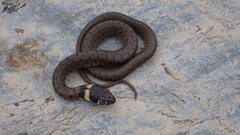
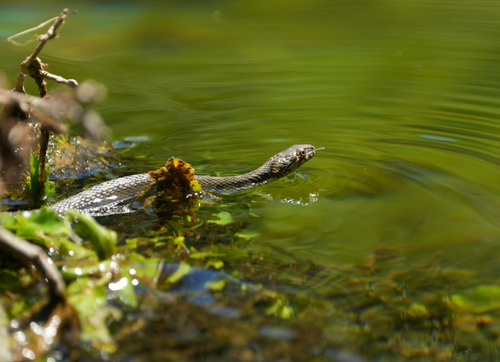
Natrix astreptophora, the red-eyed grass snake or the Iberian grass snake, is a species of natricine snake found in the Iberian Peninsula, south of France, and some coastal areas in the Maghreb, from Tangier to Tunisia. Long considered a subspecies of the European grass snake, Natrix natrix, the subspecies was split off from that taxon in 2016.

The red-eyed grass snake was formally described by the Spanish herpetologist Victor Lopez Seoane in 1903 as Natrix astreptophora based on specimens from Galicia, Spain (later restricted to A Coruña). The species was subsequently treated as a subspecies in the grass snake complex (Natrix natrix sensu lato). The North African populations of the red-eyed grass snake were described as a separate subspecies of the grass snake, Tropidonotus natrix algericus, by the German herpetologist Günther Hecht in 1930. The taxonomy of the grass snake complex remained unsettled throughout the 20th century, with various authors recognizing anywhere from four to fourteen subspecies in the complex. A 2012 study of genetic data, morphology, and bone characteristics found the red-eyed grass snake to hybridize only very rarely with the barred grass snake... Wikipedia →

Global Distribution

Parks Where Found

# Park Country Daily sighting probability
1 Picos de Europa National Park 🇪🇸 Spain
~30%
2 Monfragüe National Park 🇪🇸 Spain
~10%
3 Pyrénées National Park 🇫🇷 France
~10%

Cities Where Found

# City Country Daily sighting probability
1 Porto 🇵🇹 Portugal
~10%
2 Lisbon 🇵🇹 Portugal
<5%

Before you go

What are the chances of seeing an Iberian Grass Snake in Pyrénées National Park?

With luck

About 10% of wildlife watchers report an Iberian Grass Snake sighting in Pyrénées National Park on a given day, based on 9 verified sightings from GBIF citizen-science data from 2019 to 2026. It is the 21st most-seen of the 22 reptiles we can rate there. Over three days the chance rises to about 20%, and over a week to about 30%, if each day is a fresh chance.

When is the best time to see an Iberian Grass Snake in Pyrénées National Park?

May to September

In those months about 10% of wildlife watchers report an Iberian Grass Snake in Pyrénées National Park on a given day, against under 5% in October to April, the lowest months.

What time of day is best to see an Iberian Grass Snake?

Between 11 am and 2 pm

Across all the parks we cover, that three-hour window holds the most Iberian Grass Snake sightings with a recorded time, and about 7 in 10 of them come between 6 am and 6 pm: it is a daytime animal.

Is Pyrénées National Park the best place to see an Iberian Grass Snake?

3rd of 3

Of the 3 parks where we can rate Iberian Grass Snake sightings, Pyrénées National Park ranks 3rd at about 10%. The best odds are in Picos de Europa National Park (Spain, about 30%) and Monfragüe National Park (Spain, about 10%).

Which relatives of the Iberian Grass Snake live in Pyrénées National Park?

Same genus: Natrix

The closest relatives of the Iberian Grass Snake that you can see in Pyrénées National Park (genus Natrix) are Viperine Snake (about 20%) and barred grass snake (about 10%), with each one's daily chance of a sighting.

Where does the Iberian Grass Snake sighting chance come from?

GBIF citizen-science records

It is estimated from how often the Iberian Grass Snake is recorded against all the reptiles logged in Pyrénées National Park (9 verified sightings from 2019 to 2026), calibrated against known sighting rates. Figures are rounded to the nearest 10% because citizen-science data supports honest approximations, not decimals, and months with records from fewer than five people show "—". How it works.

← Back to Pyrénées National Park