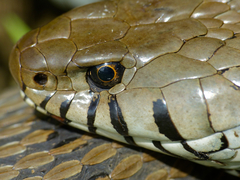
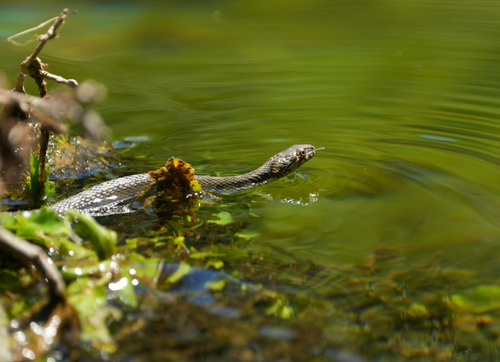
barred grass snake

barred grass snake

Natrix helvetica

Silhouette: Danny S. · PhyloPic

LCLeast ConcernNTVUENCR
Daily sighting probability ~10% · With luck
at Pyrénées National Park

In 3 days ~30% in a week ~60%

40 Verified sightings at Pyrénées National Park From 2019 to 2026
168 In all 4 parks
May Best month
☀️ Diurnal When it's spotted

About the barred grass snake

The barred grass snake (Natrix helvetica) is a non-venomous colubrid snake from Western Europe, typically living in and close to water. It was included within the grass snake species, Natrix natrix, until August 2017, when genetic analysis led to its reclassification as a separate species.

There are currently five subspecies of Natrix helvetica recognized (having been formerly classified as subspecies of N. natrix): N. helvetica helvetica (syn. N. natrix helvetica) – most of range N. helvetica cetti (syn. N. natrix cetti) – Sardinia

N. helvetica corsa (syn. N. natrix corsa) – Corsica N. helvetica lanzai (syn. N. natrix lanzai) – mainland Italy, but not south N. helvetica sicula (syn. N. natrix sicula) – Calabria and Sicily The barred grass snake has a dark grey-green upper body with distinctive black markings in the form of bars running along its sides. Its underside is pale. Like the grass snake, it has a distinctive yellow and black collar around its neck. It can grow to over a metre in length.

The species is found in Great Britain as far north as southern Scotland, and in the Netherlands, western Germany, Switzerland, Italy... Wikipedia →

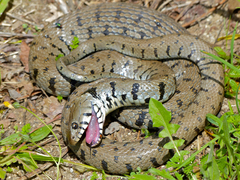
Global Distribution

Parks Where Found

# Park Country Daily sighting probability
1 Snowdonia National Park 🇬🇧 United Kingdom
~40%
2 Cévennes National Park 🇫🇷 France
~20%
3 Mercantour National Park 🇫🇷 France
~20%
4 Pyrénées National Park 🇫🇷 France
~10%

Cities Where Found

# City Country Daily sighting probability
1 London 🇬🇧 United Kingdom
~10%
2 Milan 🇮🇹 Italy
~10%
3 Paris 🇫🇷 France
~10%
4 Essen 🇩🇪 Germany
~10%
5 Amsterdam 🇳🇱 Netherlands
~10%

Zoos & Centres Where Found

# Zoo / Centre Country
1 British Wildlife Centre 🇬🇧 United Kingdom In captivity
2 Alpenzoo Innsbruck 🇦🇹 Austria In captivity

Before you go

What are the chances of seeing a barred grass snake in Pyrénées National Park?

With luck

About 10% of wildlife watchers report a barred grass snake sighting in Pyrénées National Park on a given day, based on 40 verified sightings from GBIF citizen-science data from 2019 to 2026. It is the 13th most-seen of the 22 reptiles we can rate there. Over three days the chance rises to about 30%, and over a week to about 60%, if each day is a fresh chance.

When is the best time to see a barred grass snake in Pyrénées National Park?

May–June and August

In those months about 20% of wildlife watchers report a barred grass snake in Pyrénées National Park on a given day, against under 5% in November to March, the lowest months.

What time of day is best to see a barred grass snake?

Between noon and 3 pm

Across all the parks we cover, that three-hour window holds the most barred grass snake sightings with a recorded time, and about 8 in 10 of them come between 6 am and 6 pm: it is a daytime animal.

Is Pyrénées National Park the best place to see a barred grass snake?

4th of 4

Of the 4 parks where we can rate barred grass snake sightings, Pyrénées National Park ranks 4th at about 10%. The best odds are in Snowdonia National Park (United Kingdom, about 40%), Cévennes National Park (France, about 20%) and Mercantour National Park (France, about 20%).

Which relatives of the barred grass snake live in Pyrénées National Park?

Same genus: Natrix

The closest relatives of the barred grass snake that you can see in Pyrénées National Park (genus Natrix) are Viperine Snake (about 20%) and Iberian Grass Snake (about 10%), with each one's daily chance of a sighting.

Where does the barred grass snake sighting chance come from?

GBIF citizen-science records

It is estimated from how often the barred grass snake is recorded against all the reptiles logged in Pyrénées National Park (40 verified sightings from 2019 to 2026), calibrated against known sighting rates. Figures are rounded to the nearest 10% because citizen-science data supports honest approximations, not decimals, and months with records from fewer than five people show "—". How it works.

← Back to Pyrénées National Park