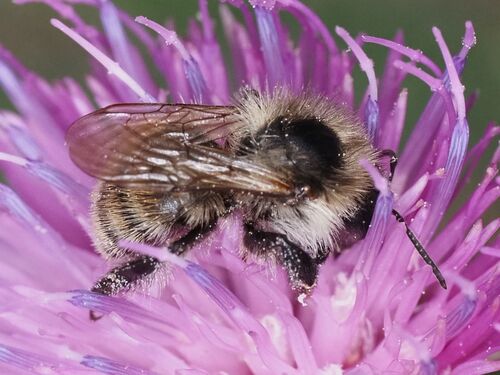
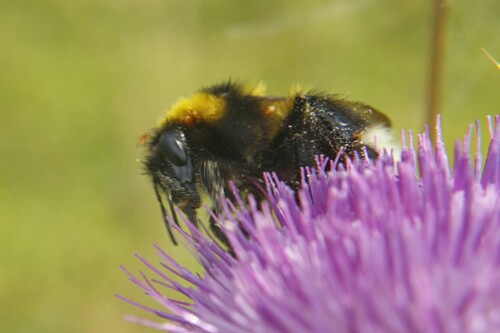
Shrill Carder-Bumble Bee

Shrill Carder-Bumble Bee

Bombus sylvarum

Daily sighting probability <5% · Rare
at Pyrénées National Park

In 3 days ~10% in a week ~20%

7 Verified sightings at Pyrénées National Park From 2019 to 2026
42 In all 4 parks
August Best month
☀️ Diurnal When it's spotted

About the Shrill Carder-Bumble Bee

Bombus sylvarum, the shrill carder bee or knapweed carder-bee, is a species of bumblebee with a wide distribution across Europe, east to the Ural Mountains, and north to Great Britain, Ireland, and southern Scandinavia.

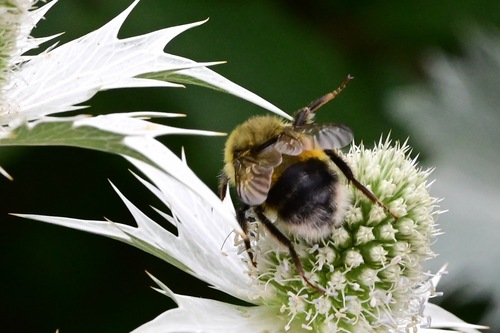
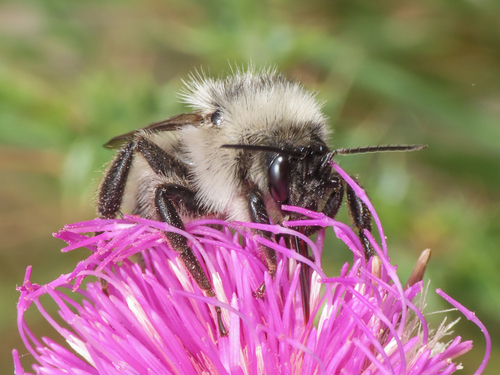
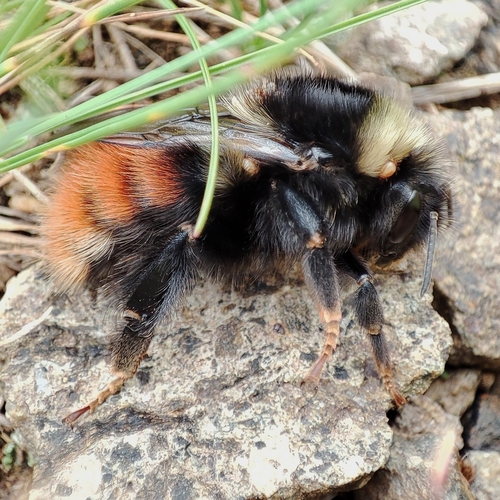
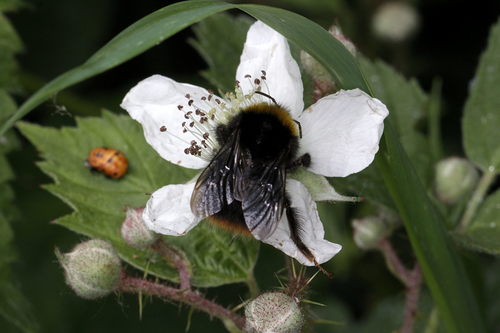
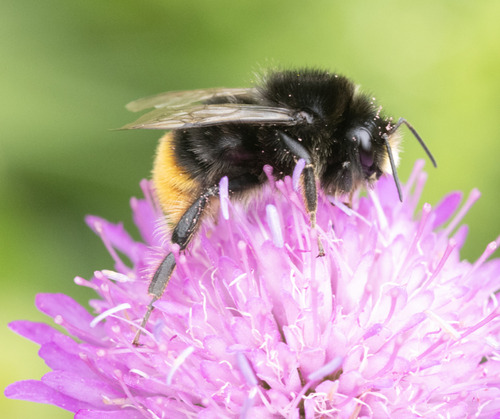
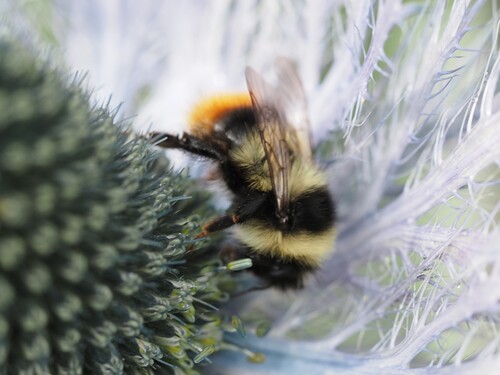
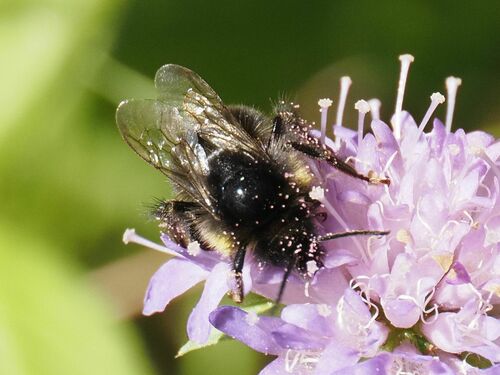
It is called the "shrill carder" because the pitch of its buzzing is more shrill than other bees and it is a carder bee – making its nest by carding material into a fabric. It is a small bumblebee; queens are 16–18 mm (0.63–0.71 in) long and female workers are 10–15 mm (0.39–0.59 in). It is mostly pale yellowish in colour with a black band across the thorax, two black bands across the abdomen, and an orange tip to the abdomen. It flies rapidly and queens produce a high-pitched buzz.

The flight period lasts from about April to September. The queen bee emerges from hibernation in the spring. She makes a nest on or slightly below the surface of the ground among open vegetation. An old mouse or vole nest may be used. By summer, the nest may contain around 100 worker bees. Each nest requires about 10 km2 (3.9 sq mi) of suitable habitat.

It occurs in herb-rich grassland where it feeds on nectar and pollen from a variety of flowers, especially... Wikipedia →
Global Distribution

Parks Where Found

# Park Country Daily sighting probability
1 Aigüestortes National Park 🇪🇸 Spain
~10%
2 Fertő-Hanság National Park 🇭🇺 Hungary
~10%
3 Bavarian Forest National Park 🇩🇪 Germany
~10%
4 Pyrénées National Park 🇫🇷 France
<5%

Cities Where Found

# City Country Daily sighting probability
1 Warsaw 🇵🇱 Poland
~10%
2 Helsinki 🇫🇮 Finland
~10%
3 Munich 🇩🇪 Germany
~10%
4 Berlin 🇩🇪 Germany
<5%
5 Saint Petersburg 🇷🇺 Russia
<5%
6 Moscow 🇷🇺 Russia
<5%
7 Prague 🇨🇿 Czechia
<5%
8 Vienna 🇦🇹 Austria
<5%
9 London 🇬🇧 United Kingdom
<5%

Before you go

What are the chances of seeing a Shrill Carder-Bumble Bee in Pyrénées National Park?

Rare

Under 5% of wildlife watchers report a Shrill Carder-Bumble Bee sighting in Pyrénées National Park on a given day, based on 7 verified sightings from GBIF citizen-science data from 2019 to 2026. It is the 940th most-seen of the 1277 insects we can rate there. Over three days the chance rises to about 10%, and over a week to about 20%, if each day is a fresh chance.

When is the best time to see a Shrill Carder-Bumble Bee in Pyrénées National Park?

August

In that month about 10% of wildlife watchers report a Shrill Carder-Bumble Bee in Pyrénées National Park on a given day, against under 5% in September to July, the lowest months.

What time of day is best to see a Shrill Carder-Bumble Bee?

Between 11 am and 2 pm

Across all the parks we cover, that three-hour window holds the most Shrill Carder-Bumble Bee sightings with a recorded time, and nearly all of them come between 6 am and 6 pm: it is a daytime animal.

Which relatives of the Shrill Carder-Bumble Bee live in Pyrénées National Park?

Same genus: Bombus

The closest relatives of the Shrill Carder-Bumble Bee that you can see in Pyrénées National Park (genus Bombus, Bumble Bees) are Common Carder Bumble Bee (about 20%), White-Tailed Bumble Bee (about 10%) and Black-Backed Bumble Bee (about 10%), with each one's daily chance of a sighting.

Where does the Shrill Carder-Bumble Bee sighting chance come from?

GBIF citizen-science records

It is estimated from how often the Shrill Carder-Bumble Bee is recorded against all the insects logged in Pyrénées National Park (7 verified sightings from 2019 to 2026), calibrated against known sighting rates. Figures are rounded to the nearest 10% because citizen-science data supports honest approximations, not decimals, and months with records from fewer than five people show "—". How it works.

← Back to Pyrénées National Park