




Completed


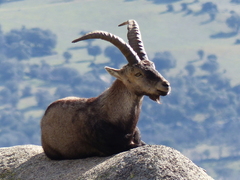


Spanish Ibex
Capra pyrenaica
Silhouette: Steven Traver · PhyloPic
- KingdomAnimalia (Animals)
- PhylumChordata (Chordates)
- ClassMammalia (Mammals)
- OrderArtiodactyla (Even-toed Ungulates and Cetaceans)
- FamilyBovidae (Bovids)
- GenusCapra (Goats)
- SpeciesCapra pyrenaica (Spanish Ibex)
In 3 days ~40% in a week ~70%
54 Verified sightings at Pyrénées National Park From 2019 to 2026
581 In all 4 parks
November Best month
☀️ Diurnal When it's spotted

Completed
About the Spanish Ibex
The Iberian ibex (Capra pyrenaica), also known as the Spanish ibex, Spanish wild goat and Iberian wild goat, is a species of ibex endemic to the Iberian Peninsula. Four subspecies have been described; two are now extinct. The Portuguese ibex became extinct in 1892, and the Pyrenean ibex became extinct in 2000 and in 2003. A project to clone the Pyrenean ibex resulted in one clone being born alive in July 2003, making it the first taxon to become "un-extinct", although the clone died a few minutes after birth due to physical defects in its left lung.
Southeastern Iberian ibex or Beceite ibex – Capra pyrenaica hispanica Schimper, 1848 The Iberian ibex is characterized by its large and flexible hooves and short legs. These physical adaptations allow it to run and leap on bare, rocky, rough and steep slopes out of reach of potential predators. The horns of the Iberian ibex curve out and up and then back, inward, and, depending on subspecies, either up again or down. The... Wikipedia →
Recent sightings of Spanish Ibex in Pyrénées National Park
LIVEiNaturalistGlobal Distribution
Parks Where Found
| # | Park | Country | Daily sighting probability |
|---|---|---|---|
| 1 | Sierra Nevada National Park | 🇪🇸 Spain | |
| 2 | Sierra de Guadarrama National Park | 🇪🇸 Spain | |
| 3 | Pyrénées National Park | 🇫🇷 France | |
| 4 | Picos de Europa National Park | 🇪🇸 Spain |
Zoos & Centres Where Found
| # | Zoo / Centre | Country | |
|---|---|---|---|
| 1 | Chomutov Zoo | 🇨🇿 Czechia | |
| 2 | Parque El Hosquillo | 🇪🇸 Spain | |
| 3 | Parc Omega | 🇨🇦 Canada | |
| 4 | Berlin Zoological Garden | 🇩🇪 Germany | |
| 5 | Terra Natura Benidorm | 🇪🇸 Spain | |
| 6 | Parque Faunístico de Lacuniacha | 🇪🇸 Spain | |
| 7 | Zoo Aquarium de Madrid | 🇪🇸 Spain | |
| 8 | Terra Natura Murcia | 🇪🇸 Spain | |
| 9 | Molló Parc Aventura | 🇪🇸 Spain | |
| 10 | Zoo de Guadalajara | 🇪🇸 Spain | |
| 11 | Aran Park | 🇪🇸 Spain | |
| 12 | Marcelle Natureza | 🇪🇸 Spain | |
| 13 | Zoo de Córdoba | 🇪🇸 Spain | |
| 14 | Santillana Zoo | 🇪🇸 Spain | |
| 15 | Centro de Recuperación de Fauna Silvestre El Valle | 🇪🇸 Spain | |
| 16 | Exotarium Sosnowiec | 🇵🇱 Poland | |
| 17 | Aquarium Berlin | 🇩🇪 Germany |
Closest Relatives at Pyrénées National Park






Before you go
What are the chances of seeing a Spanish Ibex in Pyrénées National Park?
Possible
About 20% of wildlife watchers report a Spanish Ibex sighting in Pyrénées National Park on a given day, based on 54 verified sightings from GBIF citizen-science data from 2019 to 2026. It is the 7th most-seen of the 30 mammals we can rate there. Over three days the chance rises to about 40%, and over a week to about 70%, if each day is a fresh chance.
When is the best time to see a Spanish Ibex in Pyrénées National Park?
November
In that month about 40% of wildlife watchers report a Spanish Ibex in Pyrénées National Park on a given day, against about 10% in April, June–October and December–January, the lowest months.
What time of day is best to see a Spanish Ibex?
Between 11 am and 2 pm
Across all the parks we cover, that three-hour window holds the most Spanish Ibex sightings with a recorded time, and about 7 in 10 of them come between 6 am and 6 pm: it is a daytime animal.
Is Pyrénées National Park the best place to see a Spanish Ibex?
3rd of 4
Of the 4 parks where we can rate Spanish Ibex sightings, Pyrénées National Park ranks 3rd at about 20%. The best odds are in Sierra Nevada National Park (Spain, about 80%) and Sierra de Guadarrama National Park (Spain, about 30%).
Where does the Spanish Ibex sighting chance come from?
GBIF citizen-science records
It is estimated from how often the Spanish Ibex is recorded against all the mammals logged in Pyrénées National Park (54 verified sightings from 2019 to 2026), calibrated against known sighting rates. Figures are rounded to the nearest 10% because citizen-science data supports honest approximations, not decimals, and months with records from fewer than five people show "—". How it works.
