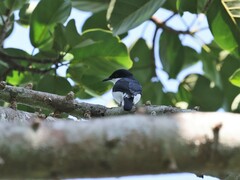
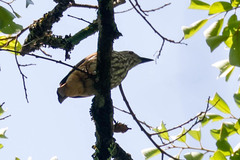
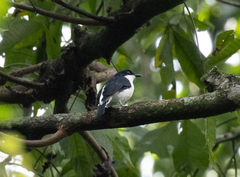

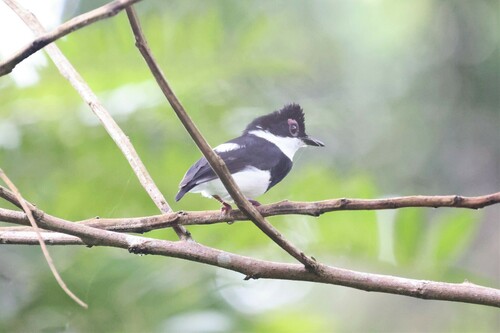
African Shrike-flycatcher

African Shrike-flycatcher

Megabyas flammulatus

Silhouette: Sheatherius · PhyloPic

LCLeast ConcernNTVUENCR
Daily sighting probability <5% · Rare
at Queen Elizabeth National Park

In 3 days <5%

7 Verified sightings at Queen Elizabeth National Park From 2019 to 2026
435 In all 6 parks
June Best month
☀️ Diurnal When it's spotted

About the African Shrike-flycatcher

The African shrike-flycatcher or red-eyed shrike-flycatcher (Megabyas flammulatus) is a species of bird in the vanga family Vangidae. It is the only species in the monotypic genus Megabyas. The African shrike-flycatcher was described by the French naturalists Jules Verreaux and Édouard Verreaux in 1855, who placed it in its own genus, Megabyas. Over the years, the species was sometimes lumped with the closely related black-and-white shrike-flycatcher in the genus Bias, another widespread African species similar in size, plumage and skull shape. The genus name is derived from the Ancient Greek word mega for large and Bias for the genus it was evidently related to.

The African shrike-flycatcher was once lumped with many other families of birds in Muscicapidae, the Old World flycatchers. Within that enlarged family, it was placed with the monarch-flycatchers until 1970 when it was identified as closer to the wattle-eye and batises in the present day family Platysteiridae. A 2004 analysis of the genetics of the species along with other members of the family showed that it, along with the genus Bias, were actually embedded in the Vangidae, a family previously thought to be... Wikipedia →

Sounds

Call0:16

Ghana · 2022

© Peter Boesman · XC719266 · CC BY-NC-ND 4.0

Song1:10

Ghana · 2017

© Patrik Åberg · XC399952 · CC BY-NC-SA 4.0

Flight call0:26

Uganda · 2015

© Martin St-Michel · XC289910 · CC BY-NC-SA 4.0

Global Distribution

Parks Where Found

# Park Country Daily sighting probability
1 Odzala-Kokoua National Park 🇨🇬 Republic of the Congo
~20%
2 Kibale National Park 🇺🇬 Uganda
~20%
3 Taï National Park 🇨🇮 Ivory Coast
~10%
4 Bwindi Impenetrable National Park 🇺🇬 Uganda
~10%
5 Semuliki National Park 🇺🇬 Uganda
<5%
6 Queen Elizabeth National Park 🇺🇬 Uganda
<5%

Before you go

What are the chances of seeing an African Shrike-flycatcher in Queen Elizabeth National Park?

Rare

Under 5% of wildlife watchers report an African Shrike-flycatcher sighting in Queen Elizabeth National Park on a given day, based on 7 verified sightings from GBIF citizen-science data from 2019 to 2026. It is the 387th most-seen of the 434 birds we can rate there. Over three days the chance rises to under 5%, if each day is a fresh chance.

When is the best time to see an African Shrike-flycatcher in Queen Elizabeth National Park?

Any time of year

In every month with enough records, under 5% of wildlife watchers report an African Shrike-flycatcher in Queen Elizabeth National Park on a given day, so our monthly data shows no clear season.

What time of day is best to see an African Shrike-flycatcher?

Between 8 and 11 am

Across all the parks we cover, that three-hour window holds the most African Shrike-flycatcher sightings with a recorded time, and about 9 in 10 of them come between 6 am and 6 pm: it is a daytime animal.

Is Queen Elizabeth National Park the best place to see an African Shrike-flycatcher?

6th of 6

Of the 6 parks where we can rate African Shrike-flycatcher sightings, Queen Elizabeth National Park ranks 6th at under 5%. The best odds are in Odzala-Kokoua National Park (Republic of the Congo, about 20%), Kibale National Park (Uganda, about 20%) and Taï National Park (Ivory Coast, about 10%).

Which relatives of the African Shrike-flycatcher live in Queen Elizabeth National Park?

Same family: Platysteiridae

The closest relatives of the African Shrike-flycatcher that you can see in Queen Elizabeth National Park (family Platysteiridae, Wattle-eyes and Batises) are Brown-throated Wattle-eye (about 20%), Chinspot Batis (about 10%) and Western Black-headed Batis (about 10%), with each one's daily chance of a sighting.

Where does the African Shrike-flycatcher sighting chance come from?

GBIF citizen-science records

It is estimated from how often the African Shrike-flycatcher is recorded against all the birds logged in Queen Elizabeth National Park (7 verified sightings from 2019 to 2026), calibrated against known sighting rates. Figures are rounded to the nearest 10% because citizen-science data supports honest approximations, not decimals, and months with records from fewer than five people show "—". How it works.

← Back to Queen Elizabeth National Park