Orange-bellied Fruit-Dove

Orange-bellied Fruit-Dove

Ptilinopus iozonus

Silhouette: L. Shyamal · PhyloPic

LCLeast ConcernNTVUENCR
Daily sighting probability <5% · Rare
at Raja Ampat

In 3 days ~10% in a week ~20%

23 Verified sightings at Raja Ampat From 2019 to 2026
23 In 1 park
March Best month
☀️ Diurnal When it's spotted

About the Orange-bellied Fruit-Dove

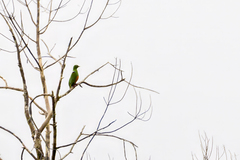
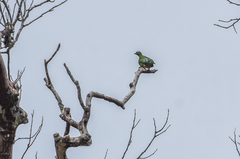
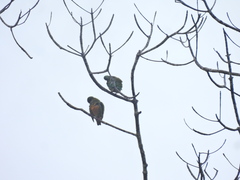
The orange-bellied fruit dove (Ptilinopus iozonus) is a small (21 cm in length) pigeon with mainly green plumage, distinguished by a large orange patch on the lower breast and belly, a small lilac shoulder patch, pale yellow undertail coverts, and a grey terminal band on the tail.

It has been recorded from Boigu Island, Queensland, Australian territory in northern Torres Strait. The dove eats the fruit from forest trees, mainly figs. The dove lays a single egg on a platform of small sticks high in a forest tree. Beehler, Bruce M.; & Finch, Brian W. (1985). Species Checklist of the Birds of New Guinea. RAOU Monograph No.1. Royal Australasian Ornithologists Union: Melbourne. ISBN 0-9599823-2-9

Beehler, Bruce M.; Pratt, Thane K.; & Zimmerman, Dale... Wikipedia →

Sounds

Song0:18

Papua New Guinea · 2011

© Iain Woxvold · XC558625 · CC BY-NC-SA 4.0

Call0:57

Indonesia · 2019

© Marc Anderson · XC500754 · CC BY-NC-ND 4.0

Song0:22

Indonesia · 2017

© Ross Gallardy · XC409509 · CC BY-NC-SA 4.0

Global Distribution

Parks Where Found

# Park Country Daily sighting probability
1 Raja Ampat 🇮🇩 Indonesia
<5%

More parks will be added in future updates.

Zoos & Centres Where Found

# Zoo / Centre Country
1 Port Moresby Nature Park 🇵🇬 Papua New Guinea In captivity

Before you go

What are the chances of seeing an Orange-bellied Fruit-Dove in Raja Ampat?

Rare

Under 5% of wildlife watchers report an Orange-bellied Fruit-Dove sighting in Raja Ampat on a given day, based on 23 verified sightings from GBIF citizen-science data from 2019 to 2026. It is the 144th most-seen of the 200 birds we can rate there. Over three days the chance rises to about 10%, and over a week to about 20%, if each day is a fresh chance.

When is the best time to see an Orange-bellied Fruit-Dove in Raja Ampat?

March

In that month about 10% of wildlife watchers report an Orange-bellied Fruit-Dove in Raja Ampat on a given day, against under 5% in April to February, the lowest months.

What time of day is best to see an Orange-bellied Fruit-Dove?

Between 7 and 10 am

Across all the parks we cover, that three-hour window holds the most Orange-bellied Fruit-Dove sightings with a recorded time, and about 8 in 10 of them come between 6 am and 6 pm: it is a daytime animal.

Where else can you see an Orange-bellied Fruit-Dove?

Only Raja Ampat, in our data

Raja Ampat is the only park on Wallace's Line with enough records to rate Orange-bellied Fruit-Dove sightings: under 5% of wildlife watchers there report one on a given day.

Which relatives of the Orange-bellied Fruit-Dove live in Raja Ampat?

Same genus: Ptilinopus

The closest relatives of the Orange-bellied Fruit-Dove that you can see in Raja Ampat (genus Ptilinopus, Typical Fruit Doves) are Claret-breasted Fruit-Dove (about 40%), Wompoo Fruit Dove (about 20%) and Beautiful Fruit-Dove (about 10%), with each one's daily chance of a sighting.

Where does the Orange-bellied Fruit-Dove sighting chance come from?

GBIF citizen-science records

It is estimated from how often the Orange-bellied Fruit-Dove is recorded against all the birds logged in Raja Ampat (23 verified sightings from 2019 to 2026), calibrated against known sighting rates. Figures are rounded to the nearest 10% because citizen-science data supports honest approximations, not decimals, and months with records from fewer than five people show "—". How it works.

← Back to Raja Ampat