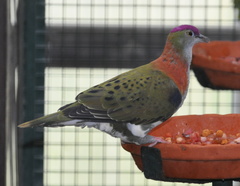
Superb Fruit-Dove

Superb Fruit-Dove

Ptilinopus superbus

Silhouette: L. Shyamal · PhyloPic

LCLeast ConcernNTVUENCR
Daily sighting probability <5% · Rare
at Raja Ampat

In 3 days ~10% in a week ~20%

30 Verified sightings at Raja Ampat From 2019 to 2026
182 In all 2 parks
December Best month
☀️ Diurnal When it's spotted

About the Superb Fruit-Dove

The superb fruit dove (Ptilinopus superbus), also known as the purple-crowned fruit dove (leading to easy confusion with the purple-capped fruit dove), is a medium-sized (22–24 cm long), colourful fruit-dove in the family Columbidae.

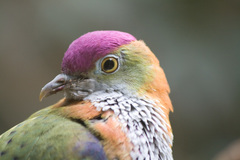
It is sexually dimorphic. Males are superbly coloured with a fiery orange nape, green ears, and a purple crown. The breast is grey, and divided from the abdomen by a wide, dark blue band. Their wings are olive green covered with dark spots, and the tail is tipped with white. Females are mostly green, with a white abdomen, blue wing tips, light blue breast, and a small, dark blue spot on the back of the head. Both sexes have yellow eyes and eye-rings. Despite its colourful plumage, the superb fruit dove is well-camouflaged amongst the rainforest foliage.

Native to Australasia, the superb fruit dove lives in the rainforests of New Guinea, Australia, Solomon Islands, the Philippines and Sulawesi of Indonesia. In Australia, it is found from southern New South Wales around the town of Moruya and extends further north, where it becomes more common to Cape York in Queensland. In some areas of its range, such as the New Guinean rainforest... Wikipedia →

Sounds

Song1:08

Indonesia · 2025

© Richard E. Webster · XC1075626 · CC BY-NC-SA 4.0

Call0:12

Australia · 2020

© Marc Anderson · XC527499 · CC BY-NC-ND 4.0

Song0:48

Australia · 2025

© Peter Boesman · XC1066880 · CC BY-NC-ND 4.0

Global Distribution

Parks Where Found

# Park Country Daily sighting probability
1 Daintree National Park 🇦🇺 Australia
~10%
2 Raja Ampat 🇮🇩 Indonesia
<5%

Zoos & Centres Where Found

# Zoo / Centre Country
1 Prague Zoo 🇨🇿 Czechia In captivity
2 Barcelona Zoo 🇪🇸 Spain In captivity
3 Zoo Pilsen 🇨🇿 Czechia In captivity
4 Chester Zoo 🇬🇧 United Kingdom In captivity
5 Burgers' Ocean 🇳🇱 Netherlands In captivity
6 Berlin Zoological Garden 🇩🇪 Germany In captivity
7 Royal Burgers' Zoo 🇳🇱 Netherlands In captivity
8 Taronga Zoo 🇦🇺 Australia In captivity
9 Wilhelma 🇩🇪 Germany In captivity
10 London Zoo 🇬🇧 United Kingdom In captivity
11 Aquarama Barcelona 🇪🇸 Spain In captivity
12 Zoologischer Garten Halle 🇩🇪 Germany In captivity
13 Featherdale Sydney Wildlife Park 🇦🇺 Australia In captivity
14 Aquarium Berlin 🇩🇪 Germany In captivity
15 NaturoSpace 🇫🇷 France In captivity
16 Rákosův pavilon 🇨🇿 Czechia In captivity
17 Velemlokárium 🇨🇿 Czechia In captivity
18 Volière 🇨🇭 Switzerland In captivity

Before you go

What are the chances of seeing a Superb Fruit-Dove in Raja Ampat?

Rare

Under 5% of wildlife watchers report a Superb Fruit-Dove sighting in Raja Ampat on a given day, based on 30 verified sightings from GBIF citizen-science data from 2019 to 2026. It is the 139th most-seen of the 200 birds we can rate there. Over three days the chance rises to about 10%, and over a week to about 20%, if each day is a fresh chance.

When is the best time to see a Superb Fruit-Dove in Raja Ampat?

February–March and December

In those months about 10% of wildlife watchers report a Superb Fruit-Dove in Raja Ampat on a given day, against under 5% in January and April–November, the lowest months.

What time of day is best to see a Superb Fruit-Dove?

Between 7 and 10 am

Across all the parks we cover, that three-hour window holds the most Superb Fruit-Dove sightings with a recorded time, and about 9 in 10 of them come between 6 am and 6 pm: it is a daytime animal.

Is Raja Ampat the best place to see a Superb Fruit-Dove?

2nd of 2

Of the 2 parks where we can rate Superb Fruit-Dove sightings, Raja Ampat ranks 2nd at under 5%. The best odds are in Daintree National Park (Australia, about 10%).

Where does the Superb Fruit-Dove sighting chance come from?

GBIF citizen-science records

It is estimated from how often the Superb Fruit-Dove is recorded against all the birds logged in Raja Ampat (30 verified sightings from 2019 to 2026), calibrated against known sighting rates. Figures are rounded to the nearest 10% because citizen-science data supports honest approximations, not decimals, and months with records from fewer than five people show "—". How it works.

← Back to Raja Ampat