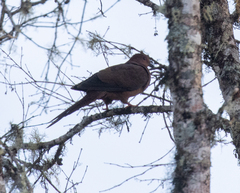
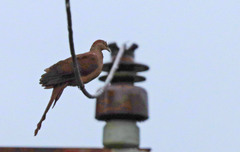
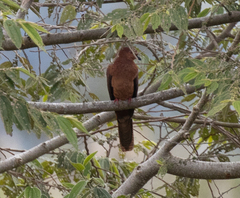
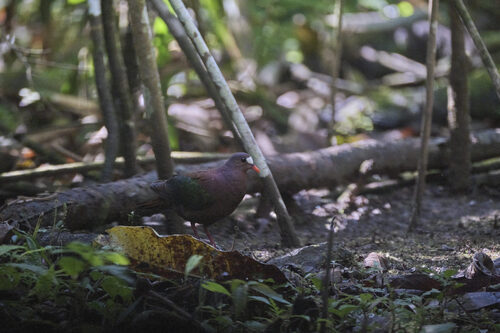
Black-billed Cuckoo-Dove

Black-billed Cuckoo-Dove

Macropygia nigrirostris

Silhouette: Sheatherius · PhyloPic

LCLeast ConcernNTVUENCR
Daily sighting probability <5% · Rare
at Raja Ampat

In 3 days <5% in a week ~10%

17 Verified sightings at Raja Ampat From 2019 to 2026
17 In 1 park
February Best month
☀️ Diurnal When it's spotted

About the Black-billed Cuckoo-Dove

The bar-tailed cuckoo-dove or black-billed cuckoo-dove (Macropygia nigrirostris) is a species of bird in the family Columbidae. It is native to New Guinea and the Bismarck Archipelago. It is rated as a species of least concern on the International Union for Conservation of Nature Red List of Endangered Species.

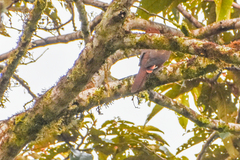
The bar-tailed cuckoo-dove measures 29 centimetres (11 in) in length. It has a short, completely black bill. The six central tail feathers are black barred. The central breast feathers are not bifurcated. The male is ruddy-brown, with no clear distinction between the underparts and the upperparts. The female, however, has black barred upperparts. The juvenile is similar to the female, but its tail is barred irregularly.

It is differentiated from other sympatric (other species existing in the same geographic area and thus frequently encountering with it) pigeons other than cuckoo-doves, by its chestnut brown plumage and slender, long tail.

It is native to Papua New Guinea and Indonesia. It inhabits old-growth forests, forest peripheries, and second-growth forests. It also occurs commonly on submontane forests on altitudes of up... Wikipedia →

Sounds

Song0:21

Papua New Guinea · 2007

© Rolf A. de By · XC409254 · CC BY-NC-SA 4.0

Call0:31

Indonesia · 2017

© JACOB Hervé · XC395236 · CC BY-NC-SA 4.0

Song0:56

Papua New Guinea · 2006

© Niels Krabbe · XC36372 · CC BY-NC-SA 3.0

Global Distribution

Parks Where Found

# Park Country Daily sighting probability
1 Raja Ampat 🇮🇩 Indonesia
<5%

More parks will be added in future updates.

Before you go

What are the chances of seeing a Black-billed Cuckoo-Dove in Raja Ampat?

Rare

Under 5% of wildlife watchers report a Black-billed Cuckoo-Dove sighting in Raja Ampat on a given day, based on 17 verified sightings from GBIF citizen-science data from 2019 to 2026. It is the 163rd most-seen of the 200 birds we can rate there. Over three days the chance rises to under 5%, and over a week to about 10%, if each day is a fresh chance.

When is the best time to see a Black-billed Cuckoo-Dove in Raja Ampat?

February

In that month about 10% of wildlife watchers report a Black-billed Cuckoo-Dove in Raja Ampat on a given day, against under 5% in March to January, the lowest months.

What time of day is best to see a Black-billed Cuckoo-Dove?

Between 7 and 10 am

Across all the parks we cover, that three-hour window holds the most Black-billed Cuckoo-Dove sightings with a recorded time, and about 9 in 10 of them come between 6 am and 6 pm: it is a daytime animal.

Where else can you see a Black-billed Cuckoo-Dove?

Only Raja Ampat, in our data

Raja Ampat is the only park on Wallace's Line with enough records to rate Black-billed Cuckoo-Dove sightings: under 5% of wildlife watchers there report one on a given day.

Where does the Black-billed Cuckoo-Dove sighting chance come from?

GBIF citizen-science records

It is estimated from how often the Black-billed Cuckoo-Dove is recorded against all the birds logged in Raja Ampat (17 verified sightings from 2019 to 2026), calibrated against known sighting rates. Figures are rounded to the nearest 10% because citizen-science data supports honest approximations, not decimals, and months with records from fewer than five people show "—". How it works.

← Back to Raja Ampat