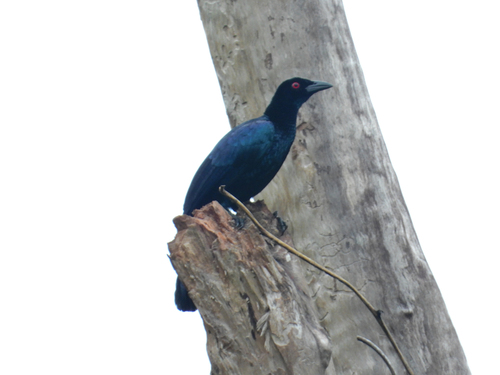
Black-sided Robin

Black-sided Robin

Poecilodryas hypoleuca

Silhouette: Sheatherius · PhyloPic

LCLeast ConcernNTVUENCR
Daily sighting probability ~20% · Possible
at Raja Ampat

In 3 days ~50% in a week ~80%

189 Verified sightings at Raja Ampat From 2019 to 2026
189 In 1 park
November Best month
☀️ Diurnal When it's spotted

About the Black-sided Robin

The black-sided robin (Poecilodryas hypoleuca), also known as the pied robin, is a species of bird in the family Petroicidae. It is widespread throughout New Guinea. Its natural habitat is subtropical or tropical moist lowland forests.

The genus name is derived from the Ancient Greek words poikilos 'pied' and dryas 'dryad', and the species name hypoleuca is derived from the Ancient Greek hypoleukos, meaning 'whitish'. Sibley and Ahlquist's DNA-DNA hybridisation studies placed this group in a Corvida parvorder comprising many tropical and Australian passerines including pardalotes, fairy-wrens, honeyeaters and crows. However, subsequent molecular research (and current consensus) places the robins as a very early offshoot of the Passerida (or "advanced" songbirds) within the songbird lineage.

Measuring 13 to 15 cm (5 to 6 in), the black-sided robin has black and white plumage. The upperparts including the crown, nape, back, wings and tail are black or brownish-black, as is its eye-stripe. It has white eyebrows, throat and underparts and a white patch on the wings. The bill is black, and the eyes are dark brown, and the legs grey or pink.

The black-sided robin is found across New Guinea from the Huon Peninsula west to the western limits of West Papua and West Papuan Islands, although is absent from the transfly region in the south. It inhabits predominantly lowland rainforests and swamp forests from sea level to 1,200 m (3,900 ft). Within the rainforest it is found singly or in pairs in the understory or on the ground. Shy, it is more often heard than seen. It is insectivorous, and hunts by gleaning and snatching insects from tree trunks and branches, and on the ground. Wikipedia →

Sounds

Song0:12

Indonesia · 2026

© Ding Li Yong · XC1165009 · CC BY-NC-ND 4.0

Call0:43

Papua New Guinea · 2010

© Iain Woxvold · XC555955 · CC BY-NC-SA 4.0

?1:12

Papua New Guinea · 2008

© Mike Catsis · XC22767 · CC BY-NC-ND 2.5

Global Distribution

Parks Where Found

# Park Country Daily sighting probability
1 Raja Ampat 🇮🇩 Indonesia
~20%

More parks will be added in future updates.

Before you go

What are the chances of seeing a Black-sided Robin in Raja Ampat?

Possible

About 20% of wildlife watchers report a Black-sided Robin sighting in Raja Ampat on a given day, based on 189 verified sightings from GBIF citizen-science data from 2019 to 2026. It is the 58th most-seen of the 200 birds we can rate there. Over three days the chance rises to about 50%, and over a week to about 80%, if each day is a fresh chance.

When is the best time to see a Black-sided Robin in Raja Ampat?

November

In that month about 30% of wildlife watchers report a Black-sided Robin in Raja Ampat on a given day, against about 10% in December to June, the lowest months.

What time of day is best to see a Black-sided Robin?

Between 6 and 9 am

Across all the parks we cover, that three-hour window holds the most Black-sided Robin sightings with a recorded time, and about 7 in 10 of them come between 6 am and 6 pm: it is a daytime animal.

Where else can you see a Black-sided Robin?

Only Raja Ampat, in our data

Raja Ampat is the only park on Wallace's Line with enough records to rate Black-sided Robin sightings: about 20% of wildlife watchers there report one on a given day.

Where does the Black-sided Robin sighting chance come from?

GBIF citizen-science records

It is estimated from how often the Black-sided Robin is recorded against all the birds logged in Raja Ampat (189 verified sightings from 2019 to 2026), calibrated against known sighting rates. Figures are rounded to the nearest 10% because citizen-science data supports honest approximations, not decimals, and months with records from fewer than five people show "—". How it works.

← Back to Raja Ampat