Helmeted Friarbird

Helmeted Friarbird

Philemon buceroides

Silhouette: Ferran Sayol · PhyloPic

LCLeast ConcernNTVUENCR
Daily sighting probability ~70% · Very likely
at Raja Ampat

In 3 days >90%

1,018 Verified sightings at Raja Ampat From 2019 to 2026
2,573 In all 6 parks
May Best month
☀️ Diurnal When it's spotted

About the Helmeted Friarbird

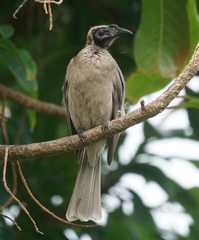
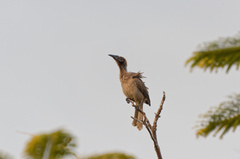
The helmeted friarbird (Philemon buceroides) is part of the Meliphagidae family. The helmeted friarbird, along with all their subspecies, is commonly referred to as "leatherhead" by the birding community. The helmeted friarbird was formally described in 1838 by the English zoologist William Swainson under the binomial name Philedon buceroides. The specific epithet combines the genus Buceros that was introduced in 1758 by Carl Linnaeus for the hornbills with the Ancient Greek -οιδης/-oidēs meaning "resembling". Swainson believed that his specimen had come from Australia (New Holland) but this was an error and in 1916 the Austrian ornithologist Carl Eduard Hellmayr designated the island of Timor as the type locality. The helmeted friarbird is now one of 17 friarbirds placed in the genus Philemon that was introduced in 1816 by the French ornithologist Louis Pierre Vieillot.

Ten subspecies are recognised: Wikipedia →

Sounds

Call0:26

Indonesia · 2025

© Peter Ericsson · XC1032186 · CC BY-NC-SA 4.0

Uncertain0:17

Australia · 2023

© Heather Bennett · XC992778 · CC BY-NC-SA 4.0

Song0:58

Australia · 2023

© James Lambert · XC780460 · CC BY-NC-ND 4.0

Global Distribution

Parks Where Found

# Park Country Daily sighting probability
1 Raja Ampat 🇮🇩 Indonesia
~70%
2 Komodo National Park 🇮🇩 Indonesia
~50%
3 Daintree National Park 🇦🇺 Australia
~50%
4 Kakadu National Park 🇦🇺 Australia
~20%
5 Litchfield National Park 🇦🇺 Australia
<5%
6 Nitmiluk National Park 🇦🇺 Australia
<5%

Zoos & Centres Where Found

# Zoo / Centre Country
1 Prague Zoo 🇨🇿 Czechia In captivity
2 Bali Zoo 🇮🇩 Indonesia In captivity
3 Gembira Loka Zoo 🇮🇩 Indonesia In captivity
4 Bandung Zoo 🇮🇩 Indonesia In captivity
5 Birdworld Kuranda 🇦🇺 Australia In captivity
6 Kuranda Koala Gardens 🇦🇺 Australia In captivity
7 Rákosův pavilon 🇨🇿 Czechia In captivity
8 Velemlokárium 🇨🇿 Czechia In captivity

Before you go

What are the chances of seeing a Helmeted Friarbird in Raja Ampat?

Very likely

About 70% of wildlife watchers report a Helmeted Friarbird sighting in Raja Ampat on a given day, based on 1,018 verified sightings from GBIF citizen-science data from 2019 to 2026. It is the 3rd most-seen of the 200 birds we can rate there. Over three days the chance rises to over 90%, if each day is a fresh chance.

When is the best time to see a Helmeted Friarbird in Raja Ampat?

April–May and July

In those months about 80% of wildlife watchers report a Helmeted Friarbird in Raja Ampat on a given day, against about 50% in March and September, the lowest months.

What time of day is best to see a Helmeted Friarbird?

Between 3 and 6 pm

Across all the parks we cover, that three-hour window holds the most Helmeted Friarbird sightings with a recorded time, and about 9 in 10 of them come between 6 am and 6 pm: it is a daytime animal.

Is Raja Ampat the best place to see a Helmeted Friarbird?

Yes

Of the 6 parks where we can rate Helmeted Friarbird sightings, Raja Ampat has the highest daily chance: about 70%. Next come Komodo National Park (Indonesia, about 50%) and Daintree National Park (Australia, about 50%). All parks ranked.

Which relatives of the Helmeted Friarbird live in Raja Ampat?

Same family: Meliphagidae

The closest relatives of the Helmeted Friarbird that you can see in Raja Ampat (family Meliphagidae, Honeyeaters) are Mimic Honeyeater (about 40%), Puff-backed Honeyeater (about 20%) and Varied Honeyeater (about 20%), with each one's daily chance of a sighting.

Where does the Helmeted Friarbird sighting chance come from?

GBIF citizen-science records

It is estimated from how often the Helmeted Friarbird is recorded against all the birds logged in Raja Ampat (1,018 verified sightings from 2019 to 2026), calibrated against known sighting rates. Figures are rounded to the nearest 10% because citizen-science data supports honest approximations, not decimals, and months with records from fewer than five people show "—". How it works.

← Back to Raja Ampat