Red Bird-of-Paradise

Red Bird-of-Paradise

Paradisaea rubra

Silhouette: Ferran Sayol · PhyloPic

LCNTNear ThreatenedVUENCR Endemic
Daily sighting probability ~50% · Likely
at Raja Ampat

In 3 days ~90% in a week >90%

836 Verified sightings at Raja Ampat From 2019 to 2026
836 In 1 park
June Best month
☀️ Diurnal When it's spotted

About the Red Bird-of-Paradise

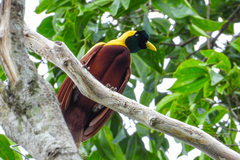
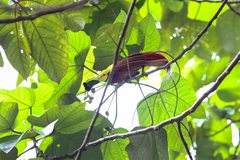
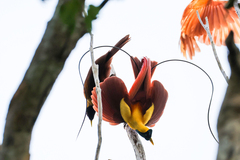
The red bird-of-paradise (Paradisaea rubra), also called the cendrawasih merah, is a bird-of-paradise in the genus Paradisaea, family Paradisaeidae. Large, up to 33 cm long, brown and yellow with a dark brown iris, grey legs, and yellow bill. The male has an emerald green face, a pair of elongated black corkscrew-shaped tail wires, dark green feather pompoms above each eye, and a train of glossy crimson red plumes with whitish tips at either side of the breast.

The male measures up to 72 cm long, including the ornamental red plumes that require at least six years to fully attain. The female is similar but smaller in size, with a dark brown face and has no ornamental red plumes. The diet consists mainly of fruits, berries and arthropods.

An Indonesian endemic, the red bird-of-paradise is distributed to lowland rainforests of Waigeo and Batanta islands of Raja Ampat, West Papua. This species shares its home with another bird-of-paradise, the Wilson's bird-of-paradise. Hybridisation between these two species has not been recorded.

The red bird-of-paradise is depicted on the front side of 1992 edition of Indonesia 20000 Rupiah... Wikipedia →

Sounds

Song1:01

Indonesia · 2026

© Ding Li Yong · XC1166073 · CC BY-NC-ND 4.0

Call0:08

Indonesia · 2025

© Kelle Moreau · XC1059977 · CC BY-NC-SA 4.0

Recording0:15

Indonesia · 2022

© Jorge de Leon Cardozo · XC830247 · CC BY-NC-SA 4.0

Global Distribution

Parks Where Found

# Park Country Daily sighting probability
1 Raja Ampat 🇮🇩 Indonesia
~50%

More parks will be added in future updates.

Zoos & Centres Where Found

# Zoo / Centre Country
1 Bronx Zoo 🇺🇸 United States In captivity
2 Bangkok Aquarium 🇹🇭 Thailand In captivity

Before you go

What are the chances of seeing a Red Bird-of-Paradise in Raja Ampat?

Likely

About 50% of wildlife watchers report a Red Bird-of-Paradise sighting in Raja Ampat on a given day, based on 836 verified sightings from GBIF citizen-science data from 2019 to 2026. It is the 11th most-seen of the 200 birds we can rate there. Over three days the chance rises to about 90%, and over a week to over 90%, if each day is a fresh chance.

When is the best time to see a Red Bird-of-Paradise in Raja Ampat?

June and August

In those months about 70% of wildlife watchers report a Red Bird-of-Paradise in Raja Ampat on a given day, against about 40% in March–April and October–January, the lowest months.

What time of day is best to see a Red Bird-of-Paradise?

Between 5 and 8 am

Across all the parks we cover, that three-hour window holds the most Red Bird-of-Paradise sightings with a recorded time, and about 8 in 10 of them come between 6 am and 6 pm: it is a daytime animal.

Where else can you see a Red Bird-of-Paradise?

Only Raja Ampat, in our data

Raja Ampat is the only park on Wallace's Line with enough records to rate Red Bird-of-Paradise sightings: about 50% of wildlife watchers there report one on a given day.

Which relatives of the Red Bird-of-Paradise live in Raja Ampat?

Same family: Paradisaeidae

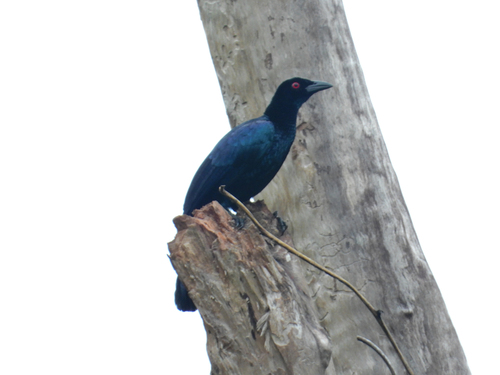
The closest relatives of the Red Bird-of-Paradise that you can see in Raja Ampat (family Paradisaeidae, Birds-of-Paradise) are Glossy-mantled Manucode (about 50%) and Wilson's Bird-Of-Paradise (about 30%), with each one's daily chance of a sighting.

Where does the Red Bird-of-Paradise sighting chance come from?

GBIF citizen-science records

It is estimated from how often the Red Bird-of-Paradise is recorded against all the birds logged in Raja Ampat (836 verified sightings from 2019 to 2026), calibrated against known sighting rates. Figures are rounded to the nearest 10% because citizen-science data supports honest approximations, not decimals, and months with records from fewer than five people show "—". How it works.

← Back to Raja Ampat