Moluccan Naked-backed Fruit Bat

Moluccan Naked-backed Fruit Bat

Dobsonia moluccensis

Silhouette: Steven Traver · PhyloPic

LCLeast ConcernNTVUENCR
Daily sighting probability ~20% · Possible
at Raja Ampat

In 3 days ~40% in a week ~70%

9 Verified sightings at Raja Ampat From 2019 to 2026
9 In 1 park
June Best month
☀️🌙 Day & Night When it's spotted

About the Moluccan Naked-backed Fruit Bat

The bare-backed fruit bat or Moluccan naked-backed fruit bat (Dobsonia moluccensis) is a fruit bat in the family Pteropodidae. It was described as a new species in 1830 by Jean René Constant Quoy and Joseph Paul Gaimard who placed it in the now-defunct bat genus Hypoderma, with the scientific name H. moluccensis. Its relationship with Dobsonia magna requires further investigation. Its species name "moluccensis" means "belonging to the Moluccas," which is where the species is found.

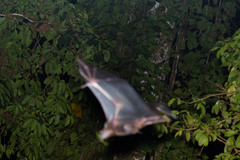
Its fur is brown and its feet have distinctive white claws. It is smaller than the New Guinea naked-backed fruit bat. Males weigh 380–500 g (0.84–1.10 lb) while females weigh 325–525 g (0.717–1.157 lb). Its ears are pointed, and its second digits lack claws, unlike flying foxes. Its wings attach at the back along the spine rather than along the sides of the body.

The bare-backed fruit bat is a seasonal breeder, with the mating season from April to June. Females give birth from mid-August through November. It is found in Indonesia, East Timor, Papua New Guinea, and Australia. It has been documented from 0–2,700 m (0–8,858 ft) above sea... Wikipedia →

Global Distribution

Parks Where Found

# Park Country Daily sighting probability
1 Raja Ampat 🇮🇩 Indonesia
~20%

More parks will be added in future updates.

Before you go

What are the chances of seeing a Moluccan Naked-backed Fruit Bat in Raja Ampat?

Possible

About 20% of wildlife watchers report a Moluccan Naked-backed Fruit Bat sighting in Raja Ampat on a given day, based on 9 verified sightings from GBIF citizen-science data from 2019 to 2026. It is the 4th most-seen of the 13 mammals we can rate there. Over three days the chance rises to about 40%, and over a week to about 70%, if each day is a fresh chance.

When is the best time to see a Moluccan Naked-backed Fruit Bat in Raja Ampat?

June

In that month about 40% of wildlife watchers report a Moluccan Naked-backed Fruit Bat in Raja Ampat on a given day, against under 5% in May, July, September and December–February, the lowest months.

What time of day is best to see a Moluccan Naked-backed Fruit Bat?

Between 7 and 10 pm

Across all the parks we cover, that three-hour window holds the most Moluccan Naked-backed Fruit Bat sightings with a recorded time, and about 7 in 10 of them come between 6 pm and 6 am: it is seen both by day and at night.

Where else can you see a Moluccan Naked-backed Fruit Bat?

Only Raja Ampat, in our data

Raja Ampat is the only park on Wallace's Line with enough records to rate Moluccan Naked-backed Fruit Bat sightings: about 20% of wildlife watchers there report one on a given day.

Where does the Moluccan Naked-backed Fruit Bat sighting chance come from?

GBIF citizen-science records

It is estimated from how often the Moluccan Naked-backed Fruit Bat is recorded against all the mammals logged in Raja Ampat (9 verified sightings from 2019 to 2026), calibrated against known sighting rates. Figures are rounded to the nearest 10% because citizen-science data supports honest approximations, not decimals, and months with records from fewer than five people show "—". How it works.

← Back to Raja Ampat