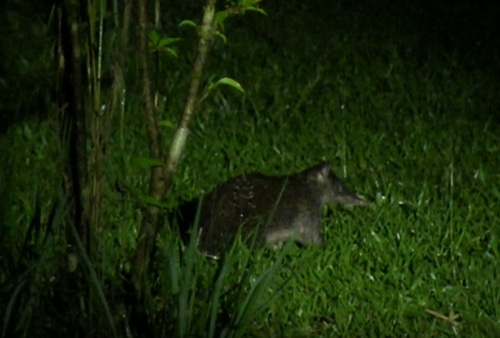
Omura's Whale

Omura's Whale

Balaenoptera omurai

Silhouette: Chris huh · PhyloPic

Daily sighting probability ~10% · With luck
at Raja Ampat

In 3 days ~40% in a week ~60%

6 Verified sightings at Raja Ampat From 2019 to 2026
6 In 1 park
February Best month
☀️ Diurnal When it's spotted

About the Omura's Whale

Omura's whale or the dwarf fin whale (Balaenoptera omurai) is a species of rorqual about which very little is known. Before its formal description, it was referred to as a small, dwarf or pygmy form of Bryde's whale by various sources. The common name and specific epithet commemorate Japanese cetologist Hideo Omura.

The scientific description of this whale was made in Nature in 2003 by three Japanese scientists. They determined the existence of the species by analysing the morphology and mitochondrial DNA of nine individuals – eight caught by Japanese research vessels in the late 1970s in the Indo-Pacific and an adult female collected in 1998 from Tsunoshima, an island in the Sea of Japan. Later, abundant genetic evidence confirmed Omura's whale as a valid species and revealed it to be an early offshoot from the rorqual lineage, diverging much earlier than Bryde's and sei whales. It is perhaps more closely related to its larger relative, the blue whale.

In the third edition of Mammal Species of the World, the "species" is relegated to being a synonym of Balaenoptera edeni. However, the authors note that this is subject to a revision of the genus. The database ITIS lists this as a valid taxon, noting a caveat on the disputed systematics of this species, Balaenoptera edeni and Balaenoptera brydei. Wikipedia →

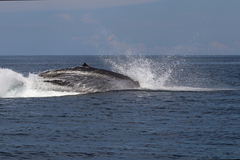
Global Distribution

Parks Where Found

# Park Country Daily sighting probability
1 Raja Ampat 🇮🇩 Indonesia
~10%

More parks will be added in future updates.

Before you go

What are the chances of seeing an Omura's Whale in Raja Ampat?

With luck

About 10% of wildlife watchers report an Omura's Whale sighting in Raja Ampat on a given day, based on 6 verified sightings from GBIF citizen-science data from 2019 to 2026. It is the 6th most-seen of the 13 mammals we can rate there. Over three days the chance rises to about 40%, and over a week to about 60%, if each day is a fresh chance.

When is the best time to see an Omura's Whale in Raja Ampat?

February

In that month about 40% of wildlife watchers report an Omura's Whale in Raja Ampat on a given day, against under 5% in January, April and June–November, the lowest months.

What time of day is best to see an Omura's Whale?

Between 9 am and noon

Across all the parks we cover, that three-hour window holds the most Omura's Whale sightings with a recorded time, and about 8 in 10 of them come between 6 am and 6 pm: it is a daytime animal.

Where else can you see an Omura's Whale?

Only Raja Ampat, in our data

Raja Ampat is the only park on Wallace's Line with enough records to rate Omura's Whale sightings: about 10% of wildlife watchers there report one on a given day.

Where does the Omura's Whale sighting chance come from?

GBIF citizen-science records

It is estimated from how often the Omura's Whale is recorded against all the mammals logged in Raja Ampat (6 verified sightings from 2019 to 2026), calibrated against known sighting rates. Figures are rounded to the nearest 10% because citizen-science data supports honest approximations, not decimals, and months with records from fewer than five people show "—". How it works.

← Back to Raja Ampat