Blue Damselfly

Blue Damselfly

Austrolestes colensonis

Endemic
Daily sighting probability ~10% · With luck
at Rakiura National Park

In 3 days ~20% in a week ~50%

7 Verified sightings at Rakiura National Park From 2019 to 2026
46 In all 4 parks
April Best month
☀️ Diurnal When it's spotted

About the Blue Damselfly

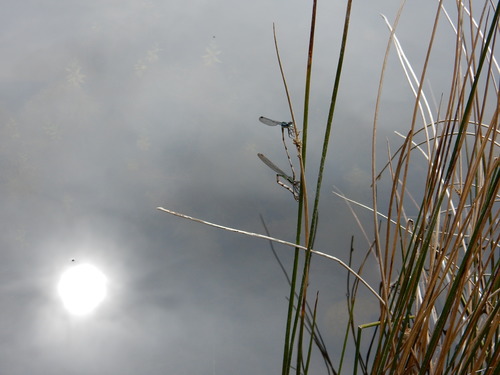
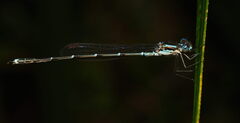
Austrolestes colensonis (Māori: kekewai), commonly known as the blue damselfly, is a species of damselfly of the family Lestidae. It is endemic to New Zealand and can commonly be found throughout the country, and at any time of the year. It is New Zealand's largest damselfly, and only blue odonate.

This species was first being described by Adam White in 1846. The first reference to this species was an illustration published under the name Agrion colensonis. In 1862 Edmond de Sélys Longchamps wrote a description of the species and used the name Lestes colensonis. The New Zealand entomologist George Hudson described, discussed and illustrated this species in 1904 under the name L. colensonis. In 1913 Robin Tillyard placed this species within the genus Austrolestes.

Hudson described the species as follows: The expansion of the wings is 2+1⁄8 inches, and the length of the body 1+3⁄4 inches. The general colour of the male is dark purplish-black, with brilliant blue markings. The front of the labium, the pronotum, two broad stripes on the mesonotum, the articulations of the wings and the articulations of the abdomen are brilliant blue. The legs are black... Wikipedia →
Global Distribution

Parks Where Found

# Park Country Daily sighting probability
1 Fiordland National Park 🇳🇿 New Zealand
~10%
2 Arthur's Pass National Park 🇳🇿 New Zealand
~10%
3 Rakiura National Park 🇳🇿 New Zealand
~10%
4 Egmont National Park 🇳🇿 New Zealand
~10%

Cities Where Found

# City Country Daily sighting probability
1 Auckland 🇳🇿 New Zealand
<5%

Closest Relatives at Rakiura National Park

No species of the same family or order lives in Rakiura National Park, so these are its closest relatives here: other insects.

Before you go

What are the chances of seeing a Blue Damselfly in Rakiura National Park?

With luck

About 10% of wildlife watchers report a Blue Damselfly sighting in Rakiura National Park on a given day, based on 7 verified sightings from GBIF citizen-science data from 2019 to 2026. It is the 103rd most-seen of the 118 insects we can rate there. Over three days the chance rises to about 20%, and over a week to about 50%, if each day is a fresh chance.

When is the best time to see a Blue Damselfly in Rakiura National Park?

December to April

In those months about 10% of wildlife watchers report a Blue Damselfly in Rakiura National Park on a given day, against under 5% in May to November, the lowest months.

What time of day is best to see a Blue Damselfly?

Between 1 and 4 pm

Across all the parks we cover, that three-hour window holds the most Blue Damselfly sightings with a recorded time, and about 9 in 10 of them come between 6 am and 6 pm: it is a daytime animal.

Is Rakiura National Park the best place to see a Blue Damselfly?

Among the best

Of the 4 parks where we can rate Blue Damselfly sightings, Rakiura National Park ranks 3rd at about 10%, level with the leaders once rounded. The best odds are in Fiordland National Park (New Zealand, about 10%) and Arthur's Pass National Park (New Zealand, about 10%).

Where does the Blue Damselfly sighting chance come from?

GBIF citizen-science records

It is estimated from how often the Blue Damselfly is recorded against all the insects logged in Rakiura National Park (7 verified sightings from 2019 to 2026), calibrated against known sighting rates. Figures are rounded to the nearest 10% because citizen-science data supports honest approximations, not decimals, and months with records from fewer than five people show "—". How it works.

← Back to Rakiura National Park