Crossley's Babbler

Crossley's Babbler

Mystacornis crossleyi

Silhouette: Sheatherius · PhyloPic

LCNTNear ThreatenedVUENCR Endemic
Daily sighting probability ~30% · Possible
at Ranomafana National Park

In 3 days ~60% in a week ~90%

208 Verified sightings at Ranomafana National Park From 2019 to 2026
355 In all 2 parks
July Best month
☀️ Diurnal When it's spotted

About the Crossley's Babbler

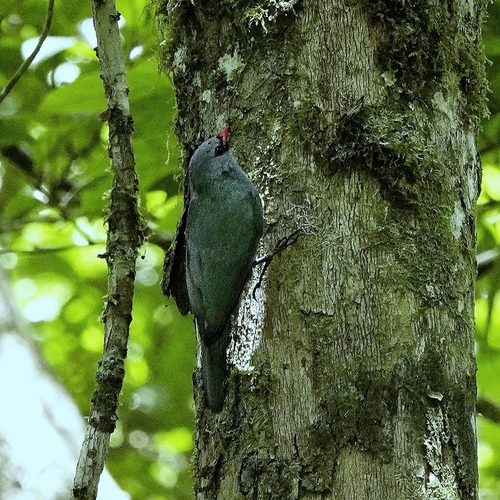
Crossley's vanga (Mystacornis crossleyi), also known as Crossley's babbler-vanga, Crossley's babbler, Madagascar groundhunter, or Madagascar groundjumper, is a bird species in the family Vangidae. It is named after the specimen collector Alfred Crossley.

The bird is in the monotypic genus Mystacornis. The species is an example of convergent evolution: its bill and body shape adapted to its habit of looking for insect prey in the leaf litter, eventually becoming so similar to that of ground-babblers that early naturalists initially classified the Crossley's vanga into what was then known as the babbler family, Timaliidae.

Crossley's vanga is a small babbler-like bird, 15 cm long and weighing around 25 g. Its most distinctive feature is the olive-grey bill, which is disproportionately long and slightly hooked at the end. The plumage of the male is olive green on the crown, back, wings, tail and flanks, a grey belly, black throat and face, with a white submoustachial stripe and grey stripe above the eye. The legs are grey and the iris black. The female is similar but with a white throat and belly.

The breeding season for... Wikipedia →

Sounds

Song0:42

Madagascar · 2012

© Peter Boesman · XC762845 · CC BY-NC-ND 4.0

Call0:08

Madagascar · 2017

© Ross Gallardy · XC418957 · CC BY-NC-SA 4.0

Song0:30

Madagascar · 2018

© Garry Bakker · XC573771 · CC BY-NC-SA 4.0

Global Distribution

Parks Where Found

# Park Country Daily sighting probability
1 Mantadia National Park 🇲🇬 Madagascar
~30%
2 Ranomafana National Park 🇲🇬 Madagascar
~30%

Before you go

What are the chances of seeing a Crossley's Babbler in Ranomafana National Park?

Possible

About 30% of wildlife watchers report a Crossley's Babbler sighting in Ranomafana National Park on a given day, based on 208 verified sightings from GBIF citizen-science data from 2019 to 2026. It is the 41st most-seen of the 102 birds we can rate there. Over three days the chance rises to about 60%, and over a week to about 90%, if each day is a fresh chance.

When is the best time to see a Crossley's Babbler in Ranomafana National Park?

July

In that month about 40% of wildlife watchers report a Crossley's Babbler in Ranomafana National Park on a given day, against about 20% in March–April, August–September and December, the lowest months. That is one of Ranomafana National Park's driest months, with about 110 mm of rain against 450 mm in January. January and June have too few records to rate.

What time of day is best to see a Crossley's Babbler?

Between 6 and 9 am

Across all the parks we cover, that three-hour window holds the most Crossley's Babbler sightings with a recorded time, and about 7 in 10 of them come between 6 am and 6 pm: it is a daytime animal.

Is Ranomafana National Park the best place to see a Crossley's Babbler?

Among the best

Of the 2 parks where we can rate Crossley's Babbler sightings, Ranomafana National Park ranks 2nd at about 30%, level with the leaders once rounded. The best odds are in Mantadia National Park (Madagascar, about 30%).

Which relatives of the Crossley's Babbler live in Ranomafana National Park?

Same family: Vangidae

The closest relatives of the Crossley's Babbler that you can see in Ranomafana National Park (family Vangidae, Vangas, Helmetshrikes, and Allies) are Tylas Vanga (about 60%), Red-tailed Vanga (about 60%) and Common Newtonia (about 60%), with each one's daily chance of a sighting.

Where does the Crossley's Babbler sighting chance come from?

GBIF citizen-science records

It is estimated from how often the Crossley's Babbler is recorded against all the birds logged in Ranomafana National Park (208 verified sightings from 2019 to 2026), calibrated against known sighting rates. Figures are rounded to the nearest 10% because citizen-science data supports honest approximations, not decimals, and months with records from fewer than five people show "—". How it works.

← Back to Ranomafana National Park