
Chabert Vanga

Chabert Vanga

Leptopterus chabert

Silhouette: Sheatherius · PhyloPic

LCLeast ConcernNTVUENCR Endemic
Daily sighting probability ~30% · Possible
at Ranomafana National Park

In 3 days ~60% in a week ~90%

229 Verified sightings at Ranomafana National Park From 2019 to 2026
554 In all 4 parks
September Best month
☀️ Diurnal When it's spotted

About the Chabert Vanga

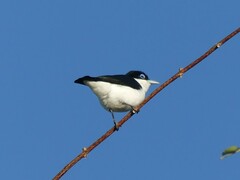
The chabert vanga (Leptopterus chabert), also erroneously called "Chabert's vanga", is a species of bird in the family Vangidae. It is monotypic within the genus Leptopterus. The chabert vanga is the smallest bird in the vanga family when compared to the white-headed vanga and the blue vanga. Their biometrics are typically 14 centimeters in length and their weight ranges from 17 to 26.5 grams.

The chabert vanga is endemic to Madagascar. Its natural habitats are subtropical or tropical dry forest, subtropical or tropical moist lowland forest, and subtropical or tropical moist montane forest. They tend to reside on sea level and up to 1000m. Very occasionally they are found higher than 1000m above sea level.

The chabert vanga's name comes from a rendition of its call. Their calls tend to repeat every two to three seconds making the sound "teedee" or a "tse tse tse" when trying to communicate. They feed on insects such as; beetles, cockroaches, and worms. Also, they have been found to eat small vertebrates such as chameleons and some small berries.

The cabaret vanga only possess two colors, black and white. Their head and wings... Wikipedia →

Sounds

Call0:15

Madagascar · 2022

© Ken Behrens · XC750015 · CC BY-NC-SA 4.0

Call0:11

Madagascar · 2019

© Dries Van de Loock · XC536982 · CC BY-NC-SA 4.0

Call0:32

Madagascar · 2010

© Fernand DEROUSSEN · XC142965 · CC BY-NC-ND 3.0

Global Distribution

Parks Where Found

# Park Country Daily sighting probability
1 Mantadia National Park 🇲🇬 Madagascar
~40%
2 Ranomafana National Park 🇲🇬 Madagascar
~30%
3 Ankarafantsika National Park 🇲🇬 Madagascar
~20%
4 Berenty Reserve 🇲🇬 Madagascar
~20%

Cities Where Found

# City Country Daily sighting probability
1 Antananarivo 🇲🇬 Madagascar
<5%

Before you go

What are the chances of seeing a Chabert Vanga in Ranomafana National Park?

Possible

About 30% of wildlife watchers report a Chabert Vanga sighting in Ranomafana National Park on a given day, based on 229 verified sightings from GBIF citizen-science data from 2019 to 2026. It is the 45th most-seen of the 102 birds we can rate there. Over three days the chance rises to about 60%, and over a week to about 90%, if each day is a fresh chance.

When is the best time to see a Chabert Vanga in Ranomafana National Park?

September

In that month about 40% of wildlife watchers report a Chabert Vanga in Ranomafana National Park on a given day, against about 10% in March, the lowest month. That is one of Ranomafana National Park's driest months, with about 80 mm of rain against 450 mm in January. January and June have too few records to rate.

What time of day is best to see a Chabert Vanga?

Between 7 and 10 am

Across all the parks we cover, that three-hour window holds the most Chabert Vanga sightings with a recorded time, and about 8 in 10 of them come between 6 am and 6 pm: it is a daytime animal.

Is Ranomafana National Park the best place to see a Chabert Vanga?

2nd of 4

Of the 4 parks where we can rate Chabert Vanga sightings, Ranomafana National Park ranks 2nd at about 30%. The best odds are in Mantadia National Park (Madagascar, about 40%).

Which relatives of the Chabert Vanga live in Ranomafana National Park?

Same family: Vangidae

The closest relatives of the Chabert Vanga that you can see in Ranomafana National Park (family Vangidae, Vangas, Helmetshrikes, and Allies) are Tylas Vanga (about 60%), Red-tailed Vanga (about 60%) and Common Newtonia (about 60%), with each one's daily chance of a sighting.

Where does the Chabert Vanga sighting chance come from?

GBIF citizen-science records

It is estimated from how often the Chabert Vanga is recorded against all the birds logged in Ranomafana National Park (229 verified sightings from 2019 to 2026), calibrated against known sighting rates. Figures are rounded to the nearest 10% because citizen-science data supports honest approximations, not decimals, and months with records from fewer than five people show "—". How it works.

← Back to Ranomafana National Park