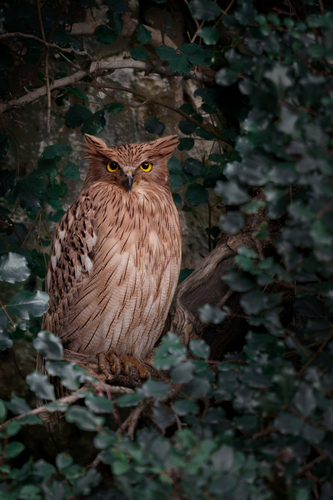
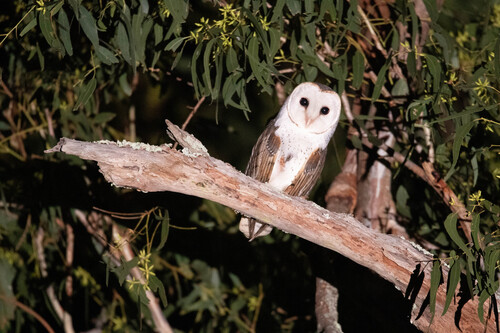
Dusky Eagle-Owl

Dusky Eagle-Owl

Ketupa coromanda

LCLeast ConcernNTVUENCR
Daily sighting probability ~10% · With luck
at Ranthambore National Park

In 3 days ~30% in a week ~50%

126 Verified sightings at Ranthambore National Park From 2019 to 2026
1,195 In all 5 parks
December Best month
☀️ Diurnal When it's spotted

About the Dusky Eagle-Owl

The dusky eagle-owl (Ketupa coromanda) is an owl species in the family Strigidae that is widespread in South and Southeast Asia. The type specimen used to describe the species was collected on the Coromandel Coast, which was used for the specific epithet. It is listed as Least Concern on the IUCN Red List. The species's extent of occurrence is estimated at 9,250,000 km2 (3,570,000 sq mi). However, volunteer generated databases such as eBird.org suggest that the available extent of occurrence is a vast over-estimate.

The species was first described by John Latham in 1790 as Strix coromanda. This is the nominate subspecies that occurs in South Asia. In the 20th century, the following subspecies was described: Ketupa coromanda klossii described by Herbert C. Robinson in 1911 was an adult dark brown male eagle-owl collected in north Perak, Malaysia. Only four skins are known. This subspecies is thought to occur in Southeast Asia.

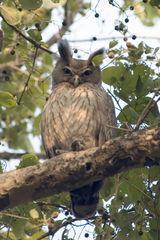
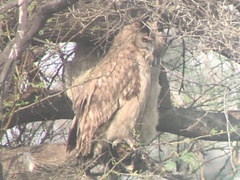
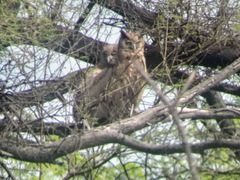
The dusky eagle-owl is a large greyish-brown owl with prominent ear tufts. Its underparts are greyish white with some dark brown streaks, and its dark brown wings have some whitish streaks. K. c. klossii is similar to the nominate... Wikipedia →

Sounds

Song0:17

Malaysia · 2025

© Ding Li Yong · XC1069556 · CC BY-NC-ND 4.0

Call0:13

Malaysia · 2020

© Lim Ying Hien 林勇贤 · XC1067096 · CC BY-NC-ND 4.0

Duet0:39

Malaysia · 2018

© Lim Ying Hien · XC808130 · CC BY-NC-ND 4.0

Global Distribution

Parks Where Found

# Park Country Daily sighting probability
1 Keoladeo National Park 🇮🇳 India
~40%
2 Kaziranga National Park 🇮🇳 India
~10%
3 Ranthambore National Park 🇮🇳 India
~10%
4 Royal Bardia National Park 🇳🇵 Nepal
<5%
5 Satpura National Park 🇮🇳 India
<5%

Before you go

What are the chances of seeing a Dusky Eagle-Owl in Ranthambore National Park?

With luck

About 10% of wildlife watchers report a Dusky Eagle-Owl sighting in Ranthambore National Park on a given day, based on 126 verified sightings from GBIF citizen-science data from 2019 to 2026. It is the 122nd most-seen of the 251 birds we can rate there. Over three days the chance rises to about 30%, and over a week to about 50%, if each day is a fresh chance.

When is the best time to see a Dusky Eagle-Owl in Ranthambore National Park?

October and December

In those months about 20% of wildlife watchers report a Dusky Eagle-Owl in Ranthambore National Park on a given day, against under 5% in April and July–August, the lowest months. Those are among Ranthambore National Park's driest months, with about 15 mm of rain a month against 270 mm in August.

What time of day is best to see a Dusky Eagle-Owl?

Between 4 and 7 pm

Across all the parks we cover, that three-hour window holds the most Dusky Eagle-Owl sightings with a recorded time, and about 7 in 10 of them come between 6 am and 6 pm: it is a daytime animal.

Is Ranthambore National Park the best place to see a Dusky Eagle-Owl?

3rd of 5

Of the 5 parks where we can rate Dusky Eagle-Owl sightings, Ranthambore National Park ranks 3rd at about 10%. The best odds are in Keoladeo National Park (India, about 40%) and Kaziranga National Park (India, about 10%).

Which relatives of the Dusky Eagle-Owl live in Ranthambore National Park?

Same family: Strigidae

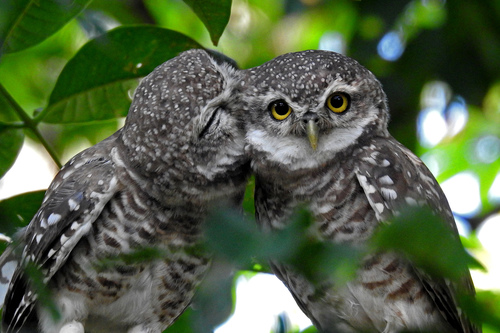
The closest relatives of the Dusky Eagle-Owl that you can see in Ranthambore National Park (family Strigidae, Typical Owls) are Spotted Owlet (about 40%), Indian Scops-Owl (about 20%) and Brown Fish-Owl (about 20%), with each one's daily chance of a sighting.

Where does the Dusky Eagle-Owl sighting chance come from?

GBIF citizen-science records

It is estimated from how often the Dusky Eagle-Owl is recorded against all the birds logged in Ranthambore National Park (126 verified sightings from 2019 to 2026), calibrated against known sighting rates. Figures are rounded to the nearest 10% because citizen-science data supports honest approximations, not decimals, and months with records from fewer than five people show "—". How it works.

← Back to Ranthambore National Park