White Orange Tip

White Orange Tip

Ixias marianne

Daily sighting probability ~20% · Possible
at Ranthambore National Park

In 3 days ~50% in a week ~80%

8 Verified sightings at Ranthambore National Park From 2019 to 2026
45 In all 2 parks
July Best month
☀️ Diurnal When it's spotted

About the White Orange Tip

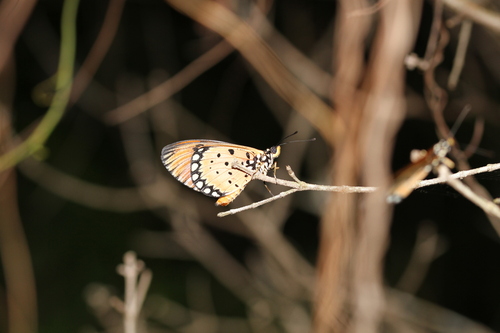
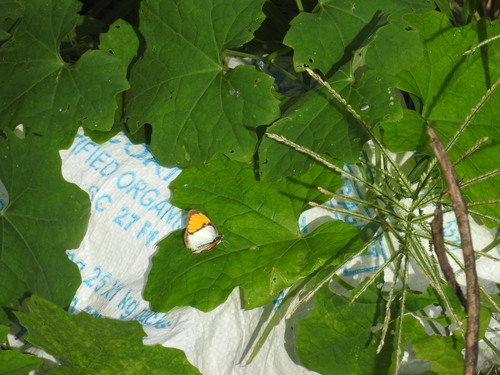
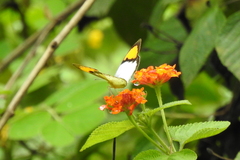
Ixias marianne, the white orange tip, is a small butterfly of the family Pieridae, (the yellows and whites) found in India and Sri Lanka. The characteristics of this species vary according to the season in which the eggs are laid.

The male has chalky-white wings with the apical half of the forewing and terminal margin of the hindwing broadly black. There is a broad, rich, orange patch obliquely across the black area extended to the upper apex of the forewing. At the lower apex this orange patch is very broad and leaves only the tip of the wing black along with a comparatively narrow band along the edge. The base of the wing is covered with black scales.

The underside of the wing is a rich sulphur-yellow as in other species of the genus, and is covered with reddish brown, short, transverse striations and minute dots. The forewing has an orange patch on the upperside which can be plainly seen because of the transparency on the wing, a broadly triangular area below this cell white, large and prominent discocellular spots with a white centre. Both forewings and hindwings have a discal transverse series of reddish-brown spots, more or less conspicuous... Wikipedia →
Global Distribution

Parks Where Found

# Park Country Daily sighting probability
1 Keoladeo National Park 🇮🇳 India
~40%
2 Ranthambore National Park 🇮🇳 India
~20%

Cities Where Found

# City Country Daily sighting probability
1 Pune 🇮🇳 India
~20%
2 Nashik 🇮🇳 India
~20%
3 New Delhi 🇮🇳 India
~10%
4 Salem 🇮🇳 India
~10%
5 Mumbai 🇮🇳 India
~10%
6 Hyderabad 🇮🇳 India
~10%
7 Bengaluru 🇮🇳 India
<5%

Before you go

What are the chances of seeing a White Orange Tip in Ranthambore National Park?

Possible

About 20% of wildlife watchers report a White Orange Tip sighting in Ranthambore National Park on a given day, based on 8 verified sightings from GBIF citizen-science data from 2019 to 2026. It is the 5th most-seen of the 14 insects we can rate there. Over three days the chance rises to about 50%, and over a week to about 80%, if each day is a fresh chance.

When is the best time to see a White Orange Tip in Ranthambore National Park?

July

In that month about 50% of wildlife watchers report a White Orange Tip in Ranthambore National Park on a given day, against under 5% in May–June and December–March, the lowest months. That is one of Ranthambore National Park's wettest months, with about 250 mm of rain against 5 mm in February.

What time of day is best to see a White Orange Tip?

Between 9 am and noon

Across all the parks we cover, that three-hour window holds the most White Orange Tip sightings with a recorded time, and about 9 in 10 of them come between 6 am and 6 pm: it is a daytime animal.

Is Ranthambore National Park the best place to see a White Orange Tip?

2nd of 2

Of the 2 parks where we can rate White Orange Tip sightings, Ranthambore National Park ranks 2nd at about 20%. The best odds are in Keoladeo National Park (India, about 40%).

Which relatives of the White Orange Tip live in Ranthambore National Park?

Same family: Pieridae

The closest relatives of the White Orange Tip that you can see in Ranthambore National Park (family Pieridae, Whites, Yellows, and Sulphurs) are Common Grass Yellow (about 20%) and Pioneer White (about 20%), with each one's daily chance of a sighting.

Where does the White Orange Tip sighting chance come from?

GBIF citizen-science records

It is estimated from how often the White Orange Tip is recorded against all the insects logged in Ranthambore National Park (8 verified sightings from 2019 to 2026), calibrated against known sighting rates. Figures are rounded to the nearest 10% because citizen-science data supports honest approximations, not decimals, and months with records from fewer than five people show "—". How it works.

← Back to Ranthambore National Park