Death’s Head Cockroach

Death’s Head Cockroach

Blaberus craniifer

Daily sighting probability ~30% · Possible
at Ría Lagartos Biosphere Reserve

In 3 days ~60% in a week ~90%

25 Verified sightings at Ría Lagartos Biosphere Reserve From 2019 to 2026
41 In all 3 parks
June Best month
🌙 Nocturnal When it's spotted

About the Death’s Head Cockroach

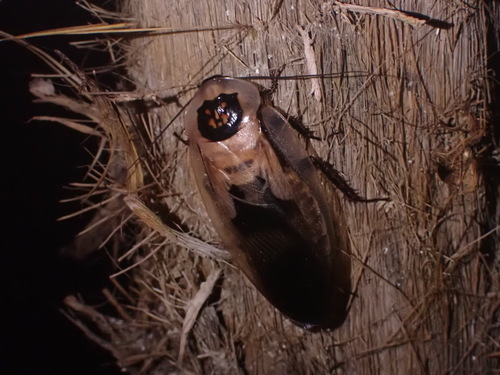
The death's head cockroach (Blaberus craniifer) is a species of cockroach belonging to the family Blaberidae. It is often confused with the discoid cockroach, Blaberus discoidalis, due to its similar appearance. It is distinguished by jet black cloak-like marking on its wings and a skull-shaped, amber/black marking on its pronotum. The name death's head comes from the markings on the top of the pronotum: "cranii", which is Latin for "of the head", and "fer", meaning "carry" or "carrier". Due to their unique appearance and certain characteristics, they make an easy to care for pet or display insect for entomologists and hobbyists.

B. craniifer is native to Mexico, the West Indies, and Central America. It has also been introduced into southern Florida in the United States. They can be found on forest floors, hiding in leaf matter and rotting wood. In their native habitats, B. craniifer will feed on any organic food source available, including leaf matter. In captivity, it is recommended they are provided foods like fresh fruit and vegetables, wet dog food and moist cereal. B. craniifer is potential prey for both invertebrates, such... Wikipedia →
Global Distribution

Parks Where Found

# Park Country Daily sighting probability
1 Ría Lagartos Biosphere Reserve 🇲🇽 Mexico
~30%
2 Arrecifes de Cozumel National Park 🇲🇽 Mexico
~10%
3 Calakmul Biosphere Reserve 🇲🇽 Mexico
~10%

Before you go

What are the chances of seeing a Death’s Head Cockroach in Ría Lagartos Biosphere Reserve?

Possible

About 30% of wildlife watchers report a Death’s Head Cockroach sighting in Ría Lagartos Biosphere Reserve on a given day, based on 25 verified sightings from GBIF citizen-science data from 2019 to 2026. It is the 17th most-seen of the 112 insects we can rate there. Over three days the chance rises to about 60%, and over a week to about 90%, if each day is a fresh chance.

When is the best time to see a Death’s Head Cockroach in Ría Lagartos Biosphere Reserve?

June and July

In those months about 40% of wildlife watchers report a Death’s Head Cockroach in Ría Lagartos Biosphere Reserve on a given day, against under 5% in October and November, the lowest months. Those are among Ría Lagartos Biosphere Reserve's wettest months, with about 110 mm of rain a month against 20 mm in February.

What time of day is best to see a Death’s Head Cockroach?

Between 7 and 10 pm

Across all the parks we cover, that three-hour window holds the most Death’s Head Cockroach sightings with a recorded time, and about 8 in 10 of them come between 6 pm and 6 am: it is mostly seen at night.

Is Ría Lagartos Biosphere Reserve the best place to see a Death’s Head Cockroach?

Yes

Of the 3 parks where we can rate Death’s Head Cockroach sightings, Ría Lagartos Biosphere Reserve has the highest daily chance: about 30%. Next come Arrecifes de Cozumel National Park (Mexico, about 10%) and Calakmul Biosphere Reserve (Mexico, about 10%).

Where does the Death’s Head Cockroach sighting chance come from?

GBIF citizen-science records

It is estimated from how often the Death’s Head Cockroach is recorded against all the insects logged in Ría Lagartos Biosphere Reserve (25 verified sightings from 2019 to 2026), calibrated against known sighting rates. Figures are rounded to the nearest 10% because citizen-science data supports honest approximations, not decimals, and months with records from fewer than five people show "—". How it works.

← Back to Ría Lagartos Biosphere Reserve