Snow Goose

Snow Goose

Anser caerulescens

Silhouette: Andy Wilson · PhyloPic

LCLeast ConcernNTVUENCR
Daily sighting probability <5% · Rare
at Riding Mountain National Park

In 3 days ~10% in a week ~20%

15 Verified sightings at Riding Mountain National Park From 2019 to 2026
689 In all 17 parks
May Best month
🌅 Crepuscular When it's spotted

About the Snow Goose

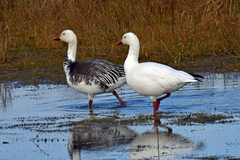
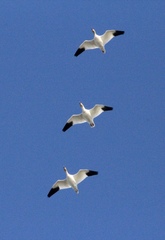
The snow goose (Anser caerulescens) is a species of goose native to North America. Both white and dark morphs exist, the latter often known as blue goose. Its name derives from the typically white plumage. The species was previously placed in the genus Chen, but is now typically included in the "gray goose" genus Anser.

Snow geese breed north of the timberline in Greenland, Canada, Alaska, and the northeastern tip of Siberia, and spend winters in warm parts of North America from southwestern British Columbia through parts of the United States to Mexico.

In 1750, English naturalist George Edwards included an illustration and a description of the snow goose in the third volume of his A Natural History of Uncommon Birds. He used the English name "the blue-winged goose". Edwards based his hand-coloured etching on a preserved specimen that had been brought to London from the Hudson Bay area of Canada by James Isham. When in 1758 the Swedish naturalist Carl Linnaeus updated his Systema Naturae for the 10th edition, he placed the snow goose with the ducks and geese in the genus Anas. Linnaeus included a brief description, coined the binomial name Anas caerulescens, and cited... Wikipedia →

Sounds

Alarm call1:24

Canada · 2025

© Denis Provencher · XC1051616 · CC BY-NC-SA 4.0

Flight call0:28

United Kingdom · 2024

© Matthew Kirkland · XC903659 · CC BY-NC-SA 4.0

Call0:35

United States · 2019

© Sue Riffe · XC532048 · CC BY-NC-SA 4.0

Global Distribution

Parks Where Found

# Park Country Daily sighting probability
1 Death Valley National Park 🇺🇸 United States
<5%
2 Bahía de Loreto National Park 🇲🇽 Mexico
<5%
3 Padre Island National Seashore 🇺🇸 United States
<5%
4 Elk Island National Park 🇨🇦 Canada
<5%
5 Riding Mountain National Park 🇨🇦 Canada
<5%
6 Great Bear Rainforest 🇨🇦 Canada
<5%
7 El Vizcaíno Biosphere Reserve 🇲🇽 Mexico
<5%
8 Kluane National Park 🇨🇦 Canada
<5%
9 Channel Islands National Park 🇺🇸 United States
<5%
10 Pacific Rim National Park Reserve 🇨🇦 Canada
<5%
11 Banff National Park 🇨🇦 Canada
<5%
12 Big Bend National Park 🇺🇸 United States
<5%
13 Svalbard 🇳🇴 Norway
<5%
14 Grand Teton National Park 🇺🇸 United States
<5%
15 Yellowstone National Park 🇺🇸 United States
<5%
16 Wadden Sea National Park 🇩🇪 Germany
<5%
17 Point Pelee National Park 🇨🇦 Canada
<5%

Cities Where Found

# City Country Daily sighting probability
1 Ciudad Juárez 🇲🇽 México
~30%
2 León 🇲🇽 México
~10%
3 Vancouver 🇨🇦 Canada
<5%
4 Las Vegas 🇺🇸 United States
<5%
5 Sacramento 🇺🇸 United States
<5%
6 San Diego 🇺🇸 United States
<5%
7 Los Angeles 🇺🇸 United States
<5%
8 Denver 🇺🇸 United States
<5%
9 Montreal 🇨🇦 Canada
<5%
10 Anchorage 🇺🇸 United States
<5%

Zoos & Centres Where Found

# Zoo / Centre Country
1 National Zoological Park 🇺🇸 United States In captivity
2 Tierpark Berlin 🇩🇪 Germany In captivity
3 Parc des oiseaux 🇫🇷 France In captivity
4 Ecomuseum Zoo 🇨🇦 Canada In captivity
5 Toronto Zoo 🇨🇦 Canada In captivity
6 Columbus Zoo and Aquarium 🇺🇸 United States In captivity
7 Tallinn Zoo 🇪🇪 Estonia In captivity
8 Greater Vancouver Zoo 🇨🇦 Canada In captivity
9 Warsaw Zoo 🇵🇱 Poland In captivity
10 Hellabrunn Zoo 🇩🇪 Germany In captivity
11 Chișinău Zoo 🇲🇩 Moldova In captivity
12 Almaty Zoo 🇰🇿 Kazakhstan In captivity
13 Centro Cicogne e Anatidi 🇮🇹 Italy In captivity
14 Cologne Zoological Garden 🇩🇪 Germany In captivity
15 Nikolaev Zoo 🇺🇦 Ukraine In captivity
16 Kharkiv Zoo 🇺🇦 Ukraine In captivity
17 Cleres Zoological Park 🇫🇷 France In captivity
18 Rivne Zoo 🇺🇦 Ukraine In captivity
19 Santillana Zoo 🇪🇸 Spain In captivity
20 Trevor Zoo 🇺🇸 United States In captivity
21 Zoo Koki (Parque zoológico y botánico) 🇪🇸 Spain In captivity
22 Kharkiv Dolphinarium 🇺🇦 Ukraine In captivity
23 herpetarium warszawskiego ZOO 🇵🇱 Poland In captivity
24 akwarium warszawskiego ZOO 🇵🇱 Poland In captivity
25 Cologne Zoo Aquarium 🇩🇪 Germany In captivity
26 hipopotamiarnia i akwarium morskie warszawskiego ZOO 🇵🇱 Poland In captivity
27 Les Oiseaux du Marais Poitevin 🇫🇷 France In captivity
28 Safari Borysew Zoo 🇵🇱 Poland In captivity
29 Tierpark Schlichtweg 15 in München 🇩🇪 Germany In captivity
30 Zoo Schlichtweg 11 in München 🇩🇪 Germany In captivity
31 Zoo Siebenbrunner Straße 6 in München 🇩🇪 Germany In captivity

Before you go

What are the chances of seeing a Snow Goose in Riding Mountain National Park?

Rare

Under 5% of wildlife watchers report a Snow Goose sighting in Riding Mountain National Park on a given day, based on 15 verified sightings from GBIF citizen-science data from 2019 to 2026. It is the 152nd most-seen of the 181 birds we can rate there. Over three days the chance rises to about 10%, and over a week to about 20%, if each day is a fresh chance.

When is the best time to see a Snow Goose in Riding Mountain National Park?

May

In that month about 10% of wildlife watchers report a Snow Goose in Riding Mountain National Park on a given day, against under 5% in June to April, the lowest months.

What time of day is best to see a Snow Goose?

Between 5 and 8 pm

Across all the parks we cover, that three-hour window holds the most Snow Goose sightings with a recorded time, and about 6 in 10 of them come between 6 am and 6 pm: it is most active around dawn and dusk.

Which relatives of the Snow Goose live in Riding Mountain National Park?

Same family: Anatidae

The closest relatives of the Snow Goose that you can see in Riding Mountain National Park (family Anatidae, Ducks, Geese, and Swans) are Mallard (about 40%), Canada Goose (about 40%) and Common Goldeneye (about 30%), with each one's daily chance of a sighting.

Where does the Snow Goose sighting chance come from?

GBIF citizen-science records

It is estimated from how often the Snow Goose is recorded against all the birds logged in Riding Mountain National Park (15 verified sightings from 2019 to 2026), calibrated against known sighting rates. Figures are rounded to the nearest 10% because citizen-science data supports honest approximations, not decimals, and months with records from fewer than five people show "—". How it works.

← Back to Riding Mountain National Park