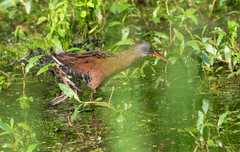
Virginia Rail

Virginia Rail

Rallus limicola

Silhouette: Ferran Sayol · PhyloPic

LCLeast ConcernNTVUENCR
Daily sighting probability <5% · Rare
at Riding Mountain National Park

In 3 days ~10% in a week ~20%

18 Verified sightings at Riding Mountain National Park From 2019 to 2026
892 In all 18 parks
July Best month
☀️ Diurnal When it's spotted

About the Virginia Rail

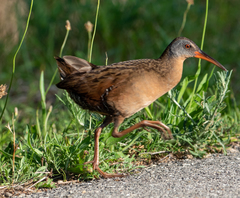
The Virginia rail (Rallus limicola) is a small waterbird, of the family Rallidae. These birds remain fairly common despite continuing loss of habitat, but are secretive by nature and more often heard than seen. They are also considered a game species in some provinces and states, though rarely hunted. The Ecuadorian rail is often considered a subspecies, but some taxonomic authorities consider it distinct.

Adults are mainly brown, darker on the back and crown, with orange-brown legs. To walk through dense vegetation, they have evolved a laterally compressed body and strong forehead feathers adapted to withstand wear from pushing through vegetation. Rails have the highest ratio of leg-muscle to flight-muscle of all birds (25% - 15% of body weight respectively). They have long toes used to walk on floating vegetation. Their tail is short and they have a long slim reddish bill. Their cheeks are grey, with a light stripe over the eye and a whitish throat. Chicks are black. Juveniles are blackish brown on upperparts with rufous on the edge of feathers and brownish bill and legs. Their underparts are dark brown to black, while the face is grayish brown. Both sexes are very... Wikipedia →

Sounds

Call0:41

United States · 2024

© Sue Riffe · XC938114 · CC BY-NC-SA 4.0

Song0:06

Mexico · 2022

© Manuel Grosselet · XC698490 · CC BY-NC-SA 4.0

Alarm call0:17

United States · 2020

© Keith Corliss · XC660753 · CC BY-NC-SA 4.0

Global Distribution

Parks Where Found

# Park Country Daily sighting probability
1 Channel Islands National Park 🇺🇸 United States
~10%
2 El Vizcaíno Biosphere Reserve 🇲🇽 Mexico
~10%
3 Riding Mountain National Park 🇨🇦 Canada
<5%
4 Death Valley National Park 🇺🇸 United States
<5%
5 Yosemite National Park 🇺🇸 United States
<5%
6 Redwood National Park 🇺🇸 United States
<5%
7 Big Bend National Park 🇺🇸 United States
<5%
8 Merritt Island National Wildlife Refuge 🇺🇸 United States
<5%
9 Point Pelee National Park 🇨🇦 Canada
<5%
10 Bahía de Loreto National Park 🇲🇽 Mexico
<5%
11 Big Cypress National Preserve 🇺🇸 United States
<5%
12 Great Bear Rainforest 🇨🇦 Canada
<5%
13 Pacific Rim National Park Reserve 🇨🇦 Canada
<5%
14 Banff National Park 🇨🇦 Canada
<5%
15 Everglades National Park 🇺🇸 United States
<5%
16 Acadia National Park 🇺🇸 United States
<5%
17 Yellowstone National Park 🇺🇸 United States
<5%
18 Rocky Mountain National Park 🇺🇸 United States
<5%

Cities Where Found

# City Country Daily sighting probability
1 Seattle 🇺🇸 United States
~10%
2 Denver 🇺🇸 United States
<5%
3 Vancouver 🇨🇦 Canada
<5%
4 Los Angeles 🇺🇸 United States
<5%
5 Montreal 🇨🇦 Canada
<5%
6 Portland 🇺🇸 United States
<5%
7 San Francisco 🇺🇸 United States
<5%
8 Sacramento 🇺🇸 United States
<5%
9 Boston 🇺🇸 United States
<5%
10 Mexico City 🇲🇽 México
<5%

Zoos & Centres Where Found

# Zoo / Centre Country
1 Columbus Zoo and Aquarium 🇺🇸 United States In captivity

Before you go

What are the chances of seeing a Virginia Rail in Riding Mountain National Park?

Rare

Under 5% of wildlife watchers report a Virginia Rail sighting in Riding Mountain National Park on a given day, based on 18 verified sightings from GBIF citizen-science data from 2019 to 2026. It is the 137th most-seen of the 181 birds we can rate there. Over three days the chance rises to about 10%, and over a week to about 20%, if each day is a fresh chance.

When is the best time to see a Virginia Rail in Riding Mountain National Park?

July

In that month about 10% of wildlife watchers report a Virginia Rail in Riding Mountain National Park on a given day, against under 5% in August to June, the lowest months. That is one of Riding Mountain National Park's wettest months, with about 70 mm of rain against 20 mm in February.

What time of day is best to see a Virginia Rail?

Between 8 and 11 am

Across all the parks we cover, that three-hour window holds the most Virginia Rail sightings with a recorded time, and about 8 in 10 of them come between 6 am and 6 pm: it is a daytime animal.

Is Riding Mountain National Park the best place to see a Virginia Rail?

3rd of 18

Of the 18 parks where we can rate Virginia Rail sightings, Riding Mountain National Park ranks 3rd at under 5%. The best odds are in Channel Islands National Park (United States, about 10%) and El Vizcaíno Biosphere Reserve (Mexico, about 10%).

Which relatives of the Virginia Rail live in Riding Mountain National Park?

Same family: Rallidae

The closest relatives of the Virginia Rail that you can see in Riding Mountain National Park (family Rallidae, Rails, Gallinules, and Coots) are Sora (about 20%) and American Coot (about 10%), with each one's daily chance of a sighting.

Where does the Virginia Rail sighting chance come from?

GBIF citizen-science records

It is estimated from how often the Virginia Rail is recorded against all the birds logged in Riding Mountain National Park (18 verified sightings from 2019 to 2026), calibrated against known sighting rates. Figures are rounded to the nearest 10% because citizen-science data supports honest approximations, not decimals, and months with records from fewer than five people show "—". How it works.

← Back to Riding Mountain National Park