Quokka

Quokka

Setonix brachyurus

Silhouette: T. Michael Keesey (photo by Sean Mack) · PhyloPic

LCNTVUVulnerableENCR
Daily sighting probability ~80% · Very likely
at Rottnest Island

In 3 days >90%

1,093 Verified sightings at Rottnest Island From 2019 to 2026
1,093 In 1 park
February Best month
☀️ Diurnal When it's spotted

About the Quokka

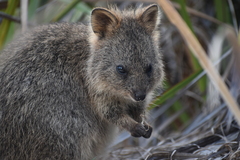
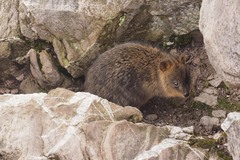
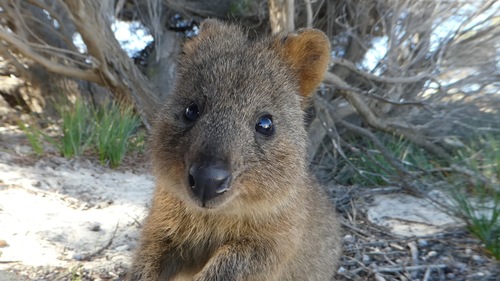
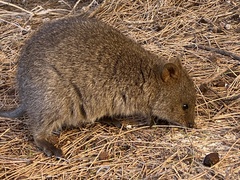
The quokka (Setonix brachyurus) is a macropod native to Australia. It is about the size of a domestic cat. It is the only member of the genus Setonix. Like other marsupials in the macropod family (such as kangaroos and wallabies), the quokka is herbivorous and mainly nocturnal.

The quokka's range is a small area of southwestern Australia. They inhabit some smaller islands off the coast of Western Australia, particularly Rottnest Island just off Perth and Bald Island near Albany. Isolated, scattered populations also exist in forest and coastal heath between Perth and Albany. A small colony inhabits a protected area of Two Peoples Bay Nature Reserve, where they coexist with the critically endangered Gilbert's potoroo.

A quokka weighs 2.5 to 5.0 kg (5+1⁄2 to 11 lb) and is 40 to 54 cm (16 to 21 in) long with a 25-to-30 cm-long (9.8-to-12 in) tail, which is quite short for a macropod. It has a stocky build, well developed hind legs, rounded ears, and a short, broad head. Although looking rather like a very small kangaroo, it can climb small trees and shrubs up to 1.5 m (4 ft 11 in). Its coarse fur is a grizzled brown colour, fading to buff underneath. The quokka is known... Wikipedia →
Global Distribution

Parks Where Found

# Park Country Daily sighting probability
1 Rottnest Island 🇦🇺 Australia
~80%

More parks will be added in future updates.

Zoos & Centres Where Found

# Zoo / Centre Country
1 Australia Zoo 🇦🇺 Australia In captivity
2 Saitama Children's Zoo 🇯🇵 Japan In captivity
3 Taronga Zoo 🇦🇺 Australia In captivity
4 Wilhelma 🇩🇪 Germany In captivity
5 Melbourne Zoo 🇦🇺 Australia In captivity
6 Parndana Wildlife Park 🇦🇺 Australia In captivity
7 Perth Zoo 🇦🇺 Australia In captivity
8 Moonlit Sanctuary Wildlife Conservation Park 🇦🇺 Australia In captivity
9 Sydney Zoo 🇦🇺 Australia In captivity
10 Adelaide Zoo 🇦🇺 Australia In captivity
11 Australian Reptile Park 🇦🇺 Australia In captivity
12 Gorge Wildlife Park 🇦🇺 Australia In captivity
13 Symbio Wildlife Park 🇦🇺 Australia In captivity
14 Featherdale Sydney Wildlife Park 🇦🇺 Australia In captivity
15 Tralaga Wildlife park 🇦🇺 Australia In captivity
16 Sea Life Sydney Aquarium 🇦🇺 Australia In captivity
17 Wild Life Sydney 🇦🇺 Australia In captivity
18 Birdworld Kuranda 🇦🇺 Australia In captivity
19 Kuranda Koala Gardens 🇦🇺 Australia In captivity
20 Australian Wildlife Park, Albany 🇦🇺 Australia In captivity
21 Caversham Wildlife Park 🇦🇺 Australia In captivity
22 Wildlife HQ Zoo 🇦🇺 Australia In captivity

Closest Relatives at Rottnest Island

No species of the same family or order lives in Rottnest Island, so these are its closest relatives here: other mammals.

Before you go

What are the chances of seeing a Quokka in Rottnest Island?

Very likely

About 80% of wildlife watchers report a Quokka sighting in Rottnest Island on a given day, based on 1,093 verified sightings from GBIF citizen-science data from 2019 to 2026. Over three days the chance rises to over 90%, if each day is a fresh chance.

When is the best time to see a Quokka in Rottnest Island?

February

In that month about 90% of wildlife watchers report a Quokka in Rottnest Island on a given day, against about 70% in July, the lowest month. That is one of Rottnest Island's driest months, with about 20 mm of rain against 120 mm in June.

What time of day is best to see a Quokka?

Between noon and 3 pm

Across all the parks we cover, that three-hour window holds the most Quokka sightings with a recorded time, and about 7 in 10 of them come between 6 am and 6 pm: it is a daytime animal.

Where else can you see a Quokka?

Only Rottnest Island, in our data

Rottnest Island is the only park on Wallace's Line with enough records to rate Quokka sightings: about 80% of wildlife watchers there report one on a given day.

Where does the Quokka sighting chance come from?

GBIF citizen-science records

It is estimated from how often the Quokka is recorded against all the mammals logged in Rottnest Island (1,093 verified sightings from 2019 to 2026), calibrated against known sighting rates. Figures are rounded to the nearest 10% because citizen-science data supports honest approximations, not decimals, and months with records from fewer than five people show "—". How it works.

← Back to Rottnest Island