Red-necked Avocet

Red-necked Avocet

Recurvirostra novaehollandiae

Silhouette: Alexandre Vong · PhyloPic

LCLeast ConcernNTVUENCR Endemic
Daily sighting probability ~60% · Likely
at Rottnest Island

In 3 days ~90% in a week >90%

298 Verified sightings at Rottnest Island From 2019 to 2026
306 In all 2 parks
February Best month
☀️ Diurnal When it's spotted

About the Red-necked Avocet

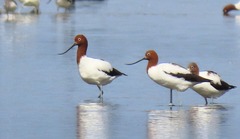
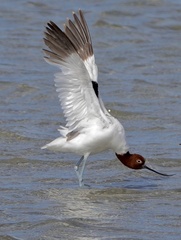
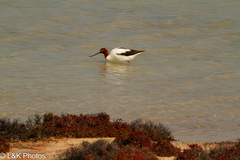
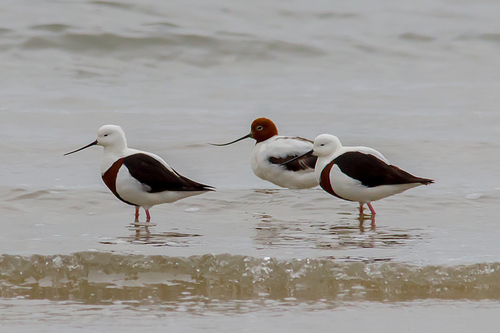
The red-necked avocet (Recurvirostra novaehollandiae) also known as the Australian avocet, cobbler, cobbler's awl, and painted lady, is a wader of the family Recurvirostridae that is endemic to Australia and is fairly common and widespread throughout, except for the north and north east coastal areas of the country. Closely related to the stilts, it shares their fragile slender elegance, however the deep red head and neck distinguish them. It appeared on a 13 cent postage stamp in 1966.

The French naturalist Louis Pierre Vieillot described the red-necked avocet in 1816, and it still bears its original name. It is one of four species of avocet that make up the genus Recurvirostra. A 2004 study combining genetics and morphology showed that it was the sister taxon to a lineage that gave rise to the Andean and American avocets.

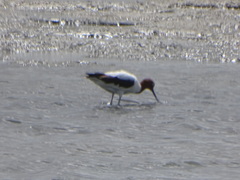
The distinguishing feature of the red-necked avocet, and all avocet species, is the distinctive upcurved bill that is used for skimming the surface of water to catch small invertebrates. The adult's head and neck is a rich chestnut brown in colour (from which it derives its name) with a narrow white eye ring and a red-brown iris... Wikipedia →

Sounds

Call0:19

Australia · 2018

© Marc Anderson · XC434170 · CC BY-NC-ND 4.0

Uncertain0:19

Australia · 2020

© nick talbot · XC610905 · CC BY-NC-SA 4.0

Call0:38

Australia · 2017

© Greg McLachlan · XC377151 · CC BY-NC-SA 4.0

Global Distribution

Parks Where Found

# Park Country Daily sighting probability
1 Rottnest Island 🇦🇺 Australia
~60%
2 Hattah-Kulkyne National Park 🇦🇺 Australia
<5%

Cities Where Found

# City Country Daily sighting probability
1 Sydney 🇦🇺 Australia
<5%
2 Perth 🇦🇺 Australia
<5%
3 Brisbane 🇦🇺 Australia
<5%
4 Melbourne 🇦🇺 Australia
<5%

Before you go

What are the chances of seeing a Red-necked Avocet in Rottnest Island?

Likely

About 60% of wildlife watchers report a Red-necked Avocet sighting in Rottnest Island on a given day, based on 298 verified sightings from GBIF citizen-science data from 2019 to 2026. It is the 13th most-seen of the 81 birds we can rate there. Over three days the chance rises to about 90%, and over a week to over 90%, if each day is a fresh chance.

When is the best time to see a Red-necked Avocet in Rottnest Island?

January–February and November

In those months about 70% of wildlife watchers report a Red-necked Avocet in Rottnest Island on a given day, against about 30% in May and June, the lowest months. Those are among Rottnest Island's driest months, with about 20 mm of rain a month against 120 mm in June.

What time of day is best to see a Red-necked Avocet?

Between 1 and 4 pm

Across all the parks we cover, that three-hour window holds the most Red-necked Avocet sightings with a recorded time, and about 9 in 10 of them come between 6 am and 6 pm: it is a daytime animal.

Is Rottnest Island the best place to see a Red-necked Avocet?

Yes

Of the 2 parks where we can rate Red-necked Avocet sightings, Rottnest Island has the highest daily chance: about 60%. Next come Hattah-Kulkyne National Park (Australia, under 5%).

Which relatives of the Red-necked Avocet live in Rottnest Island?

Same family: Recurvirostridae

The closest relatives of the Red-necked Avocet that you can see in Rottnest Island (family Recurvirostridae, Stilts and Avocets) are White-headed Stilt (about 70%) and Banded Stilt (about 60%), with each one's daily chance of a sighting.

Where does the Red-necked Avocet sighting chance come from?

GBIF citizen-science records

It is estimated from how often the Red-necked Avocet is recorded against all the birds logged in Rottnest Island (298 verified sightings from 2019 to 2026), calibrated against known sighting rates. Figures are rounded to the nearest 10% because citizen-science data supports honest approximations, not decimals, and months with records from fewer than five people show "—". How it works.

← Back to Rottnest Island