About the Southern Eagle Ray
The New Zealand eagle ray or Australian eagle ray (Myliobatis tenuicaudatus) is an eagle ray of the family Myliobatidae, found in bays, estuaries, and near rocky reefs around New Zealand and southern Australia on the inner continental shelf. It is a common species and the International Union for Conservation of Nature has assessed its conservation status as being of "least concern".
Myliobatis tenuicaudatus was first described in 1877 by the Scottish naturalist James Hector, who was director of the geological survey of New Zealand; the fish was thought to be endemic to New Zealand. Subsequently, in 1881, the Australian zoologist William John Macleay described Myliobatis australis from the waters of Southern Australia as a new species. In a generic revision in 2014, W.T. White determined that the two are synonymous, and that M. australis is a junior synonym of M. tenuicaudatus.
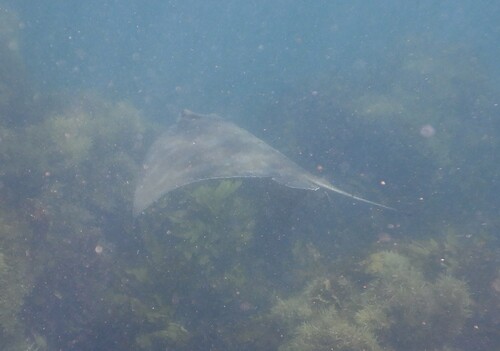
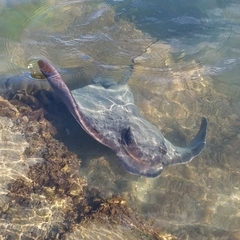
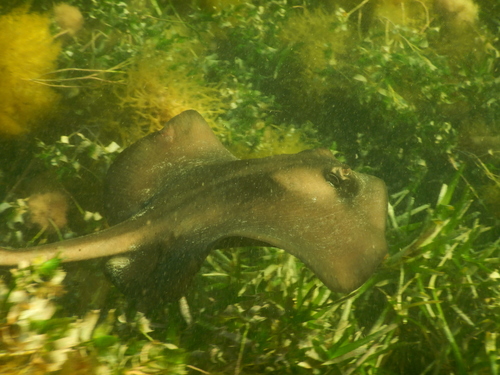
The New Zealand eagle ray is a cartilaginous fish with a roughly circular disc-like body, a projecting frog-like head, large fleshy pectoral fins and a long tail armed with a spine that is capable of injecting venom. The pectoral fins beat up and down so that the fish appears... Wikipedia →