Striped Stingaree

Striped Stingaree

Trygonoptera ovalis

Daily sighting probability ~60% · Likely
at Rottnest Island

In 3 days ~90% in a week >90%

14 Verified sightings at Rottnest Island From 2019 to 2026
14 In 1 park
March Best month
☀️ Diurnal When it's spotted

About the Striped Stingaree

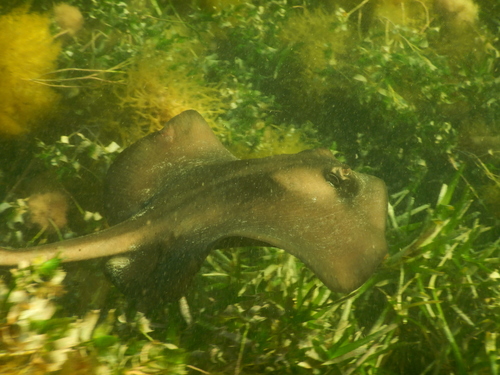
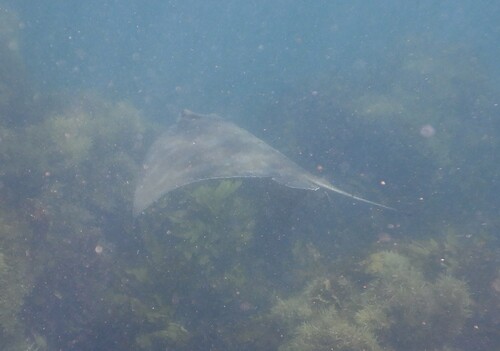
The striped stingaree (Trygonoptera ovalis) is a common but little-known species of stingray in the family Urolophidae, endemic to shallow, inshore waters off southwestern Australia. Reaching 61 cm (24 in) long, this species is characterized by an oval, grayish to brownish disc with darker mask-like markings around the eyes and paired blotches at the center of the disc that are extended posteriorly into horizontal lines. Its nostrils have enlarged lobes on the outer margins and a skirt-shaped curtain of skin with a deeply fringed trailing margin in between. Its tail terminates in a relatively large leaf-shaped caudal fin, and bears a small dorsal fin just before the stinging spine. The rounded, flexible disc of the striped stingaree enable it to maneuver through the rocks, reefs, and seagrass that comprise its favored habitats. The International Union for Conservation of Nature (IUCN) has listed this species under Least Concern; it is seldom caught by fisheries due to its habitat preferences.

The striped stingaree was described by Peter Last and Martin Gomon in a 1987 issue of Memoirs of the National Museum of Victoria; its specific epithet ovalis means "oval" in Latin... Wikipedia →

Global Distribution

Parks Where Found

# Park Country Daily sighting probability
1 Rottnest Island 🇦🇺 Australia
~60%

More parks will be added in future updates.

Before you go

What are the chances of seeing a Striped Stingaree in Rottnest Island?

Likely

About 60% of wildlife watchers report a Striped Stingaree sighting in Rottnest Island on a given day, based on 14 verified sightings from GBIF citizen-science data from 2019 to 2026. Over three days the chance rises to about 90%, and over a week to over 90%, if each day is a fresh chance.

What time of day is best to see a Striped Stingaree?

Between 1 and 4 pm

Across all the parks we cover, that three-hour window holds the most Striped Stingaree sightings with a recorded time, and about 9 in 10 of them come between 6 am and 6 pm: it is a daytime animal.

Where else can you see a Striped Stingaree?

Only Rottnest Island, in our data

Rottnest Island is the only park on Wallace's Line with enough records to rate Striped Stingaree sightings: about 60% of wildlife watchers there report one on a given day.

Which relatives of the Striped Stingaree live in Rottnest Island?

Same order: Myliobatiformes

The closest relatives of the Striped Stingaree that you can see in Rottnest Island (order Myliobatiformes, Stingrays) are Southern Eagle Ray (about 60%) and Short-tail Stingray (about 50%), with each one's daily chance of a sighting.

Where does the Striped Stingaree sighting chance come from?

GBIF citizen-science records

It is estimated from how often the Striped Stingaree is recorded against all the sharks and rays logged in Rottnest Island (14 verified sightings from 2019 to 2026), calibrated against known sighting rates. Figures are rounded to the nearest 10% because citizen-science data supports honest approximations, not decimals, and months with records from fewer than five people show "—". How it works.
← Back to Rottnest Island
