Himalayan Cuckoo

Himalayan Cuckoo

Cuculus saturatus

Silhouette: Nicolas Huet le Jeune and Jean-Gabriel Prêtre (vectorized by T. Michael Keesey) · PhyloPic

LCLeast ConcernNTVUENCR
Daily sighting probability ~20% · Possible
at Royal Manas National Park

In 3 days ~40% in a week ~70%

208 Verified sightings at Royal Manas National Park From 2019 to 2026
314 In all 7 parks
April Best month
☀️ Diurnal When it's spotted

About the Himalayan Cuckoo

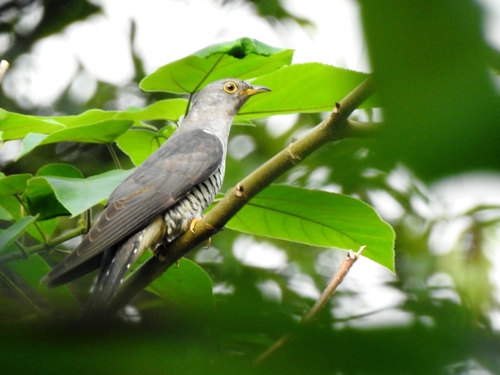
The Himalayan cuckoo or Oriental cuckoo (Cuculus saturatus) is a brooding parasitic bird that is part of the Cuculidae family. The species breeds from the Himalayas eastward to southern China and Taiwan. It migrates to southeast Asia and the Greater Sunda Islands for the winter.

It was formerly known as "Oriental cuckoo" and contained several subspecies found over most of Asia. In 2005, it was determined that this "species" consists of three distinct lineages: Himalayan cuckoo, Cuculus (saturatus) saturatus

Oriental cuckoo proper, Cuculus (saturatus) optatus Sunda cuckoo, Cuculus (saturatus) lepidus These are usually seen as distinct species nowadays. As the type specimen of the former "Oriental" cuckoo is a bird of the Himalayan population, the name saturatus applies to the Himalayan cuckoo if it is considered a species.

With new information from a recent mtDNA study, it appears that the Himalayan cuckoo is most closely related to Cuculus canorus, creating a sister-clade with the two other species: C.gularis and C.rochii. The species C.optatus, previously named horsfieldi for Palearctic populations but was proven unsuitable, is considered a separate species because... Wikipedia →
Sounds

Call1:07

China · 2016

© Mike Nelson · XC681622 · CC BY-NC-SA 4.0

Song1:10

China · 2021

© Zhen niu · XC652932 · CC BY-NC-SA 4.0

Call0:17

Bhutan · 2020

© Langur Eco Travels, bhutanbiridngtours.com · XC613197 · CC BY-NC-SA 4.0

Global Distribution

Parks Where Found

# Park Country Daily sighting probability
1 Royal Manas National Park 🇧🇹 Bhutan
~20%
2 Langtang National Park 🇳🇵 Nepal
~10%
3 Manas National Park 🇮🇳 India
<5%
4 Khao Yai National Park 🇹🇭 Thailand
<5%
5 Doi Inthanon National Park 🇹🇭 Thailand
<5%
6 Kaeng Krachan National Park 🇹🇭 Thailand
<5%
7 Chitwan National Park 🇳🇵 Nepal
<5%

Cities Where Found

# City Country Daily sighting probability
1 Kathmandu 🇳🇵 Nepal
<5%
2 Bangkok 🇹🇭 Thailand
<5%
3 Singapore 🇸🇬 Singapore
<5%

Before you go

What are the chances of seeing a Himalayan Cuckoo in Royal Manas National Park?

Possible

About 20% of wildlife watchers report a Himalayan Cuckoo sighting in Royal Manas National Park on a given day, based on 208 verified sightings from GBIF citizen-science data from 2019 to 2026. It is the 83rd most-seen of the 388 birds we can rate there. Over three days the chance rises to about 40%, and over a week to about 70%, if each day is a fresh chance.

When is the best time to see a Himalayan Cuckoo in Royal Manas National Park?

April

In that month about 30% of wildlife watchers report a Himalayan Cuckoo in Royal Manas National Park on a given day, against under 5% in October to February, the lowest months. August and September have too few records to rate.

What time of day is best to see a Himalayan Cuckoo?

Between 7 and 10 am

Across all the parks we cover, that three-hour window holds the most Himalayan Cuckoo sightings with a recorded time, and about 8 in 10 of them come between 6 am and 6 pm: it is a daytime animal.

Is Royal Manas National Park the best place to see a Himalayan Cuckoo?

Yes

Of the 7 parks where we can rate Himalayan Cuckoo sightings, Royal Manas National Park has the highest daily chance: about 20%. Next come Langtang National Park (Nepal, about 10%) and Manas National Park (India, under 5%).

Which relatives of the Himalayan Cuckoo live in Royal Manas National Park?

Same genus: Cuculus

The closest relatives of the Himalayan Cuckoo that you can see in Royal Manas National Park (genus Cuculus, Typical Old World Cuckoos) are Large Hawk Cuckoo (about 20%) and Indian Cuckoo (about 20%), with each one's daily chance of a sighting.

Where does the Himalayan Cuckoo sighting chance come from?

GBIF citizen-science records

It is estimated from how often the Himalayan Cuckoo is recorded against all the birds logged in Royal Manas National Park (208 verified sightings from 2019 to 2026), calibrated against known sighting rates. Figures are rounded to the nearest 10% because citizen-science data supports honest approximations, not decimals, and months with records from fewer than five people show "—". How it works.

← Back to Royal Manas National Park

