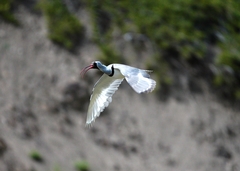
Ibisbill

Ibisbill

Ibidorhyncha struthersii

Silhouette: Sheatherius · PhyloPic

LCLeast ConcernNTVUENCR
Daily sighting probability <5% · Rare
at Royal Manas National Park

In 3 days <5% in a week ~10%

11 Verified sightings at Royal Manas National Park From 2019 to 2026
93 In all 4 parks
December Best month
☀️ Diurnal When it's spotted

About the Ibisbill

The ibisbill (Ibidorhyncha struthersii) is a bird related to the waders, but sufficiently distinctive to merit its own family Ibidorhynchidae. It is grey with a white belly, red legs and long down-curved bill, and a black face and black breast band. It occurs on the shingle riverbanks of the high plateaux of central Asia and the Himalayas.

The ibisbill belongs to the order Charadriiformes which also includes the sandpipers, plovers, terns, auks, gulls, skuas and others. In its evolutionary relationships, it appears to be most closely related to a group including the oystercatchers (Haematopodidae), and the avocets and stilts (Recurvirostridae), but sufficiently distinctive to merit its own family, Ibidorhynchidae. It is monotypic, with no subspecies.

The species was described in 1831 by Vigors based on painting by John Gould, although Brian Hodgson had sent a manuscript to the Asiatic Society of Bengal two years earlier describing it as the "Red-billed Erolia" but this was published only in 1835 with an apology from the editor. Hodgson later suggested a new genus name of Clorhynchus for the bird stating that Gould's description of Ibidorhyncha was inaccurate while Vieillot... Wikipedia →

Sounds

Call0:09

Kyrgyzstan · 2023

© Peter Boesman · XC813423 · CC BY-NC-ND 4.0

Alarm call0:18

China · 2020

© He Wenjin/文进 · XC767516 · CC BY-NC-SA 4.0

Recording0:09

China · 2006

© guus van duin · Observation.org, Nature data from around the World · CC BY-NC-ND 4.0

Global Distribution

Parks Where Found

# Park Country Daily sighting probability
1 Namdapha National Park 🇮🇳 India
<5%
2 Langtang National Park 🇳🇵 Nepal
<5%
3 Royal Manas National Park 🇧🇹 Bhutan
<5%
4 Jim Corbett National Park 🇮🇳 India
<5%

Before you go

What are the chances of seeing an Ibisbill in Royal Manas National Park?

Rare

Under 5% of wildlife watchers report an Ibisbill sighting in Royal Manas National Park on a given day, based on 11 verified sightings from GBIF citizen-science data from 2019 to 2026. It is the 322nd most-seen of the 388 birds we can rate there. Over three days the chance rises to under 5%, and over a week to about 10%, if each day is a fresh chance.

When is the best time to see an Ibisbill in Royal Manas National Park?

December

In that month about 10% of wildlife watchers report an Ibisbill in Royal Manas National Park on a given day, against under 5% in January–July and October–November, the lowest months. That is one of Royal Manas National Park's driest months, with about 10 mm of rain against 930 mm in July. August and September have too few records to rate.

What time of day is best to see an Ibisbill?

Between 2 and 5 pm

Across all the parks we cover, that three-hour window holds the most Ibisbill sightings with a recorded time, and about 9 in 10 of them come between 6 am and 6 pm: it is a daytime animal.

Is Royal Manas National Park the best place to see an Ibisbill?

Among the best

Of the 4 parks where we can rate Ibisbill sightings, Royal Manas National Park ranks 3rd at under 5%, level with the leaders once rounded. The best odds are in Namdapha National Park (India, under 5%) and Langtang National Park (Nepal, under 5%).

Where does the Ibisbill sighting chance come from?

GBIF citizen-science records

It is estimated from how often the Ibisbill is recorded against all the birds logged in Royal Manas National Park (11 verified sightings from 2019 to 2026), calibrated against known sighting rates. Figures are rounded to the nearest 10% because citizen-science data supports honest approximations, not decimals, and months with records from fewer than five people show "—". How it works.

← Back to Royal Manas National Park